


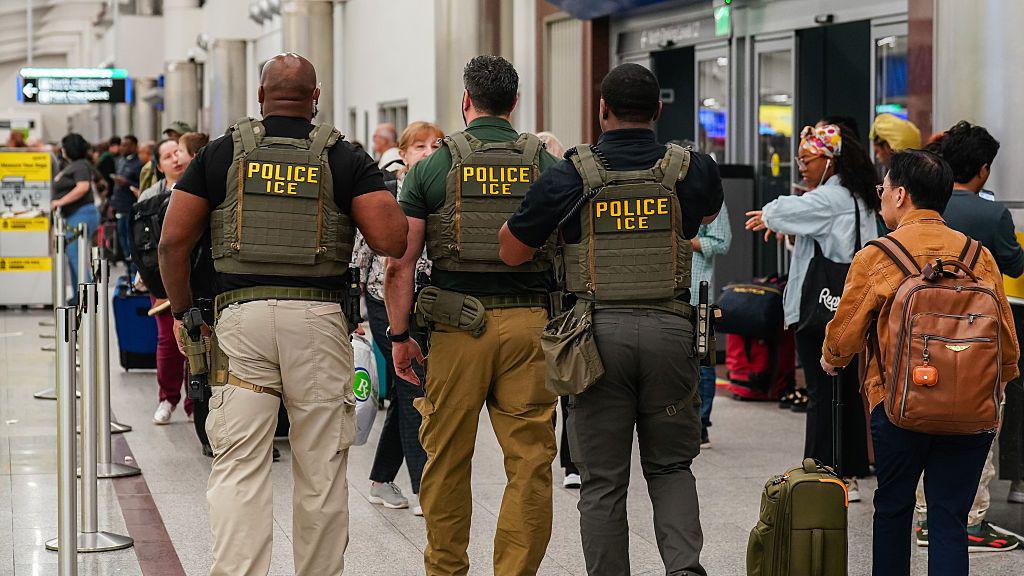
Brooklyn, NY: The immediate trigger behind the decision lies in the partial shutdown of the Department of Homeland Security (DHS), which has severely impacted the Transportation Security Administration workforce.
Hundreds of TSA officers have either resigned or stopped reporting to work due to missed paychecks, leading to unprecedented staffing shortages and security delays across major airports.
As a stopgap measure, the administration ordered ICE agents to be deployed to more than a dozen airports, including major hubs like JFK and Atlanta, to assist with non-specialized tasks. However, ICE agents are not trained airport screeners, limiting their operational effectiveness.
Reports indicate that their presence has done little to reduce wait times, which in some cases have stretched to several hours.
Analytically, this move reflects a broader trend: the securitization of civilian infrastructure using enforcement agencies not originally designed for such roles. Rather than solving the root issue—funding and staffing—the deployment represents a political and symbolic response to a logistical crisis.
Political Reactions: Deepening Partisan Divides
The decision has sharply divided American politics, reinforcing entrenched partisan narratives.
Democratic Response
Democrats have strongly criticized the move, framing it as dangerous and politically motivated. Concerns center on the potential for intimidation, especially among immigrant communities, and the risk of escalating tensions in already stressful airport environments.
More broadly, Democrats link the crisis to the administration’s refusal to compromise on immigration-related provisions in DHS funding negotiations.
They argue that the deployment of ICE agents is an attempt to normalize immigration enforcement in civilian spaces while deflecting responsibility for the shutdown.
Republican Response
Republicans, by contrast, have largely defended the decision as a necessary emergency measure. From their perspective, ensuring operational continuity at airports outweighs procedural concerns about agency roles.
President Trump himself framed the move as a response to what he described as Democratic obstruction, warning that airports must be kept “safe” and operational amid the funding deadlock.
This divergence reflects a deeper ideological split: Republicans prioritize enforcement and executive flexibility, while Democrats emphasize civil liberties, institutional norms, and specialized governance.
TSA Officers: Workforce under Pressure
The long-term implications for TSA personnel are significant. The shutdown has exposed structural vulnerabilities in the agency:
TSA workers are classified as essential, meaning they must work without pay during shutdowns.
Morale has sharply declined, with hundreds quitting and absentee rates rising dramatically.
Operational capacity has been severely degraded, with some airports operating only a fraction of their screening checkpoints.
The use of ICE agents may further complicate the TSA’s institutional identity. If such substitutions become normalized, it could undermine the professionalization of aviation security and create uncertainty about the agency’s future role.
In the long term, this could lead to:
- Increased union pressure and workforce demands
- Calls for structural reform within DHS
- Greater reliance on cross-agency deployments in crises
- Shutdown Dynamics and Temporary Measures
The broader context is a prolonged DHS funding standoff, now stretching toward critical limits. The shutdown has already forced emergency measures, including:
- Temporary suspension (and later restoration) of TSA Pre-Check
- Suspension of Global Entry programs for a period
- Reallocation of resources away from non-essential services
While negotiations between Democrats and Republicans continue, signals from the White House suggest uncertainty about any imminent resolution.
Crucially, ICE and other enforcement arms remain funded through prior allocations, which explain their availability for redeployment—highlighting an imbalance where enforcement capacity persists even as civilian-facing services degrade.
Strategic and Institutional Implications
From an analytical perspective, the deployment of ICE agents to airports is less about immediate operational efficiency and more about governance under crisis. It raises several critical questions:
Institutional boundaries: Should immigration enforcement agencies play roles in civilian security infrastructure?
Precedent-setting: Does this normalize the presence of enforcement agents in everyday public spaces?
Policy leverage: Is the disruption of airport operations being used as a bargaining tool in political negotiations?
The move also underscores a paradox: while intended to restore order, it may deepen public anxiety and reduce trust in federal institutions.
Conclusion
The ICE deployment to airports is a symptom of a larger systemic breakdown—where political deadlock, institutional fragility, and operational urgency intersect. Democrats see it as an overreach that risks civil liberties, while Republicans frame it as pragmatic crisis management.
Meanwhile, TSA officers remain caught in the middle, bearing the brunt of a prolonged shutdown that threatens both their livelihoods and the integrity of the aviation security system.
Ultimately, unless the DHS funding impasse is resolved, such extraordinary measures may become less of an exception and more of a recurring feature of governance in times of political stalemate.







