


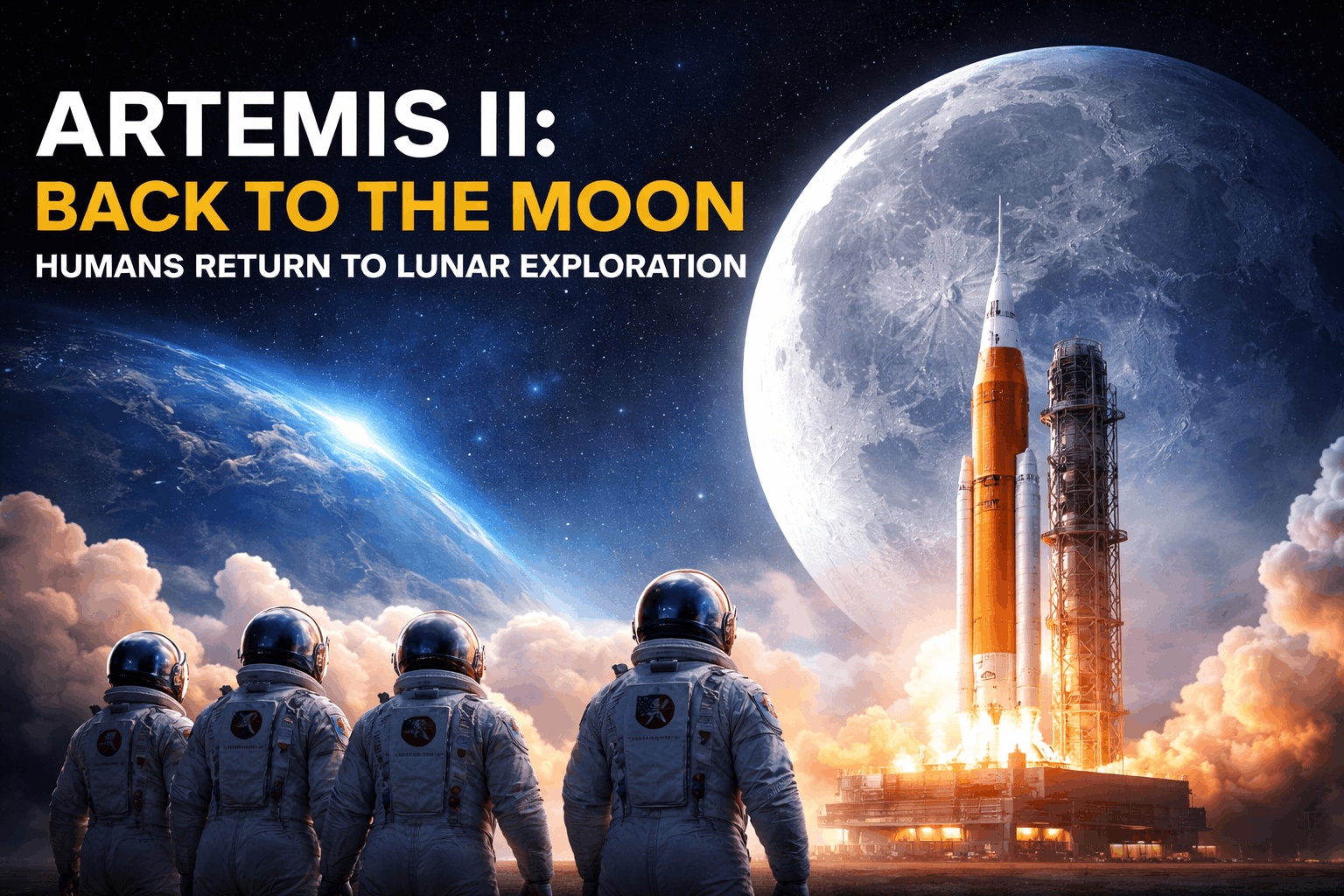
Rochester, NY: The NASA Artemis II mission represents one of the most significant milestones in modern space exploration—a return of humans to deep space for the first time in more than half a century. As the second major step in the Artemis program, Artemis II is designed as a crewed lunar flyby mission, meaning astronauts will travel around the Moon but will not land on its surface.
This mission builds directly on the success of Artemis I, the unscrewed test flight launched in 2022, which validated the performance of the agency’s next-generation exploration systems. Artemis II will be the first time astronauts fly aboard the powerful Orion spacecraft, launched by the Space Launch System rocket, marking the first human-rated test of these systems in deep space.
At its core, Artemis II is not just a symbolic mission—it is a critical systems test in real space conditions. Astronauts will evaluate life-support systems, navigation, propulsion, and communication capabilities while traveling far beyond Earth’s orbit. The mission aims to ensure that future crewed landings on the Moon can be conducted safely and sustainably.
A Historic Return to Deep Space
The significance of Artemis II lies in its historical context. The last time humans ventured beyond low Earth orbit was during the Apollo era, with Apollo 17 in 1972. Artemis II will therefore mark humanity’s return to deep space after more than five decades.
The mission will carry four astronauts—three from the United States and one from Canada—on a journey that could take them farther from Earth than any humans have ever traveled. This includes a “free-return trajectory” around the Moon, allowing the spacecraft to loop around the lunar far side and safely return to Earth without requiring major propulsion corrections.
Beyond its technical goals, Artemis II also reflects a broader shift toward international cooperation in space exploration. The inclusion of a Canadian astronaut highlights the growing role of global partnerships in NASA’s long-term ambitions for the Moon and eventually Mars.
Mission Profile and Journey around the Moon
Artemis II is planned as a roughly 10-day mission that will take astronauts on a complex and carefully designed journey. After launch, the Orion spacecraft will first enter Earth orbit, where systems checks will be performed. Once cleared, it will execute a powerful burn to send the crew toward the Moon.
During the outbound journey, astronauts will conduct a range of tests and observations. As the spacecraft approaches the Moon, it will swing around the far side in a figure-eight trajectory, offering unprecedented views and data collection opportunities. At its farthest point, the mission may set a new record for the distance humans have traveled from Earth.
The return journey will be equally critical, as Orion will re-enter Earth’s atmosphere at extremely high speeds—around 25,000 miles per hour—testing its heat shield and reentry systems before splashing down in the Pacific Ocean.
When Will Artemis II Launch?
Artemis II is scheduled to launch no earlier than April 1, 2026, from Kennedy Space Center in the United States.
According to the latest updates, the primary launch window opens on April 1, with additional opportunities extending into early April depending on weather and technical readiness. The targeted launch time on the opening day is around early evening Eastern Time, though such missions often remain subject to last-minute adjustments.
This timing follows years of development delays, testing challenges, and technical refinements, making Artemis II one of the most anticipated launches in recent space history.
Why Artemis II Matters for the Future
Artemis II is more than a standalone mission—it is a gateway to a new era of human space exploration. Its success will directly determine the timeline and feasibility of future missions, including Artemis III, which aims to land astronauts on the Moon for the first time since the Apollo era.
The broader Artemis program envisions establishing a sustained human presence near the Moon’s South Pole, developing lunar infrastructure, and using the Moon as a stepping stone for missions to Mars. Artemis II is the bridge between testing and execution—between ambition and reality.
In essence, Artemis II is not just about returning to the Moon; it is about redefining humanity’s place in space, laying the groundwork for long-term exploration beyond Earth, and opening a new chapter in the history of spaceflight.







