


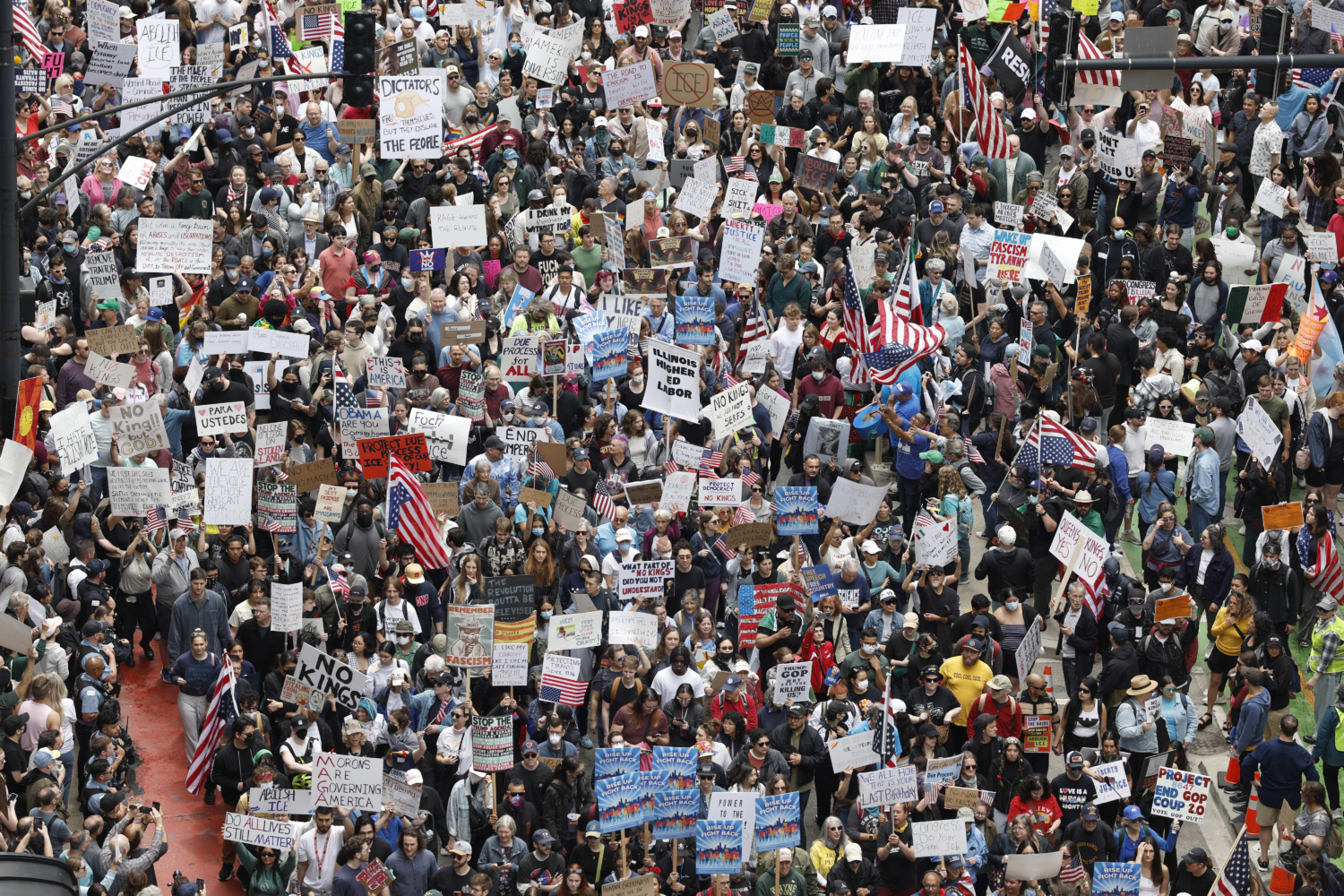
Rochester, NY: The wave of “No Kings” protests unfolding across the United States in late March 2026 represents more than a moment of political dissent; it reflects a deepening structural unease about the direction of American governance under Donald Trump.
What distinguishes this movement from earlier protest cycles is not only its geographic spread but its symbolic framing. By invoking the language of monarchy, demonstrators are not merely opposing policies; they are questioning whether the balance of power in the American system is being fundamentally altered.
In recent days, protests have surged across thousands of locations, from major metropolitan centers to smaller towns that have historically remained distant from mass political mobilization. Estimates from national coverage suggest that millions of Americans have participated in coordinated rallies, marking one of the largest protest mobilizations in recent U.S. history.
The crowds have been notably diverse, cutting across generational and, in some cases, ideological lines, suggesting that dissatisfaction is not confined to a single political base but is beginning to seep into broader segments of society.
At the heart of the protests lies a growing perception that the current administration has adopted a style of governance that prioritizes executive authority at the expense of institutional balance.
Demonstrators frequently point to aggressive policy actions, particularly in immigration enforcement and federal authority expansion, as evidence of what they describe as an erosion of democratic norms.
The symbolism of “No Kings” is therefore not accidental; it is a deliberate attempt to frame the political moment as one that echoes the very conditions the United States was founded to reject.
Immigration policy has become one of the most immediate triggers of public anger. Reports of intensified enforcement operations, widely circulated through media and social platforms, have created a sense of urgency among protestors who view these actions as both humanitarian and constitutional concerns.
The issue has resonated particularly strongly in states with large immigrant populations, but its emotional and political impact has spread nationwide, reinforcing the narrative that federal power is being exercised with limited accountability.
The protests have also been shaped by the broader geopolitical climate, especially tensions in the Middle East involving U.S. military positioning. Many demonstrators have drawn a direct line between foreign policy decisions and domestic consequences, arguing that military escalation abroad diverts attention and resources from pressing economic challenges at home.
Rising living costs, persistent inflationary pressures, and concerns about economic stability have all been woven into protest messaging, creating a convergence of grievances that extends beyond any single issue.
Prominent political figures have lent visibility and legitimacy to the movement, even as its decentralized nature resists traditional leadership structures. Senator Bernie Sanders has publicly framed the protests as a defense of democratic institutions, while leaders such as Tim Walz have been associated with large-scale rallies that drew tens of thousands of participants.
Cultural figures have also played a role in amplifying the message, turning the protests into a broader social phenomenon rather than a purely political one. Their statements have consistently emphasized the idea that the current moment is not simply about partisan disagreement but about the preservation of democratic norms.
The response from the Trump administration has been notably dismissive, a stance that reveals as much about political calculation as it does about ideological conviction. By characterizing the protests as partisan or exaggerated, the administration appears to be prioritizing the consolidation of its core support base over engagement with dissenting voices.
This approach reflects a broader strategy in contemporary American politics, where acknowledging opposition movements can sometimes be perceived as conceding legitimacy. Instead, the administration has relied on a narrative that frames the protests as disconnected from the concerns of “ordinary Americans,” even as participation numbers suggest otherwise.
Public opinion data provides a more complex picture. Recent surveys indicate that while the president retains strong support among his core constituency, there has been a measurable decline in approval ratings among independent and suburban voters.
This shift is particularly significant because these groups often determine the outcome of midterm elections. Polling trends suggest that concerns about governance style, economic management, and political polarization are beginning to influence voter sentiment in ways that could have tangible electoral consequences.
The implications for the upcoming midterm elections are therefore substantial. Historically, large-scale protest movements have served as catalysts for increased political participation, particularly among opposition voters.
The scale and persistence of the “No Kings” protests suggest that they could play a similar role, potentially reshaping turnout dynamics in key districts. At the same time, the highly polarized nature of the current political environment means that the protests could also energize supporters of the administration, creating a dual mobilization effect that intensifies electoral competition.
What ultimately sets the “No Kings” movement apart is its attempt to redefine the terms of political debate in the United States. Rather than focusing solely on policy disagreements, it raises fundamental questions about power, accountability, and the nature of democratic governance. Whether this framing will translate into lasting political change remains uncertain, but its immediate impact is undeniable. It has forced a national conversation that extends beyond traditional partisan boundaries and has highlighted the growing tension between institutional authority and public accountability.
As the protests continue to unfold, their significance will likely be measured not only by their size but by their ability to influence the political trajectory of the country.
For now, they stand as a powerful indicator of a society grappling with profound questions about its future, its leadership, and the enduring meaning of democracy in a rapidly changing political landscape.







