Courtesy: Reporting Contribution by Ghulam Murtaza [A Senior Journalist I Islamabad, Pakistan] & Anjali Sharma [A freelance Journalist I New Delhi, India]
Rochester, NY/Islamabad, PK/New Delhi, IN: The reported US-Iran peace agreement has placed Pakistan at the center of one of the most consequential diplomatic developments in the Middle East in recent years.
For decades, Islamabad has sought to position itself as a bridge between competing regional and global powers, but rarely has it found itself involved in a process carrying such significant geopolitical implications.
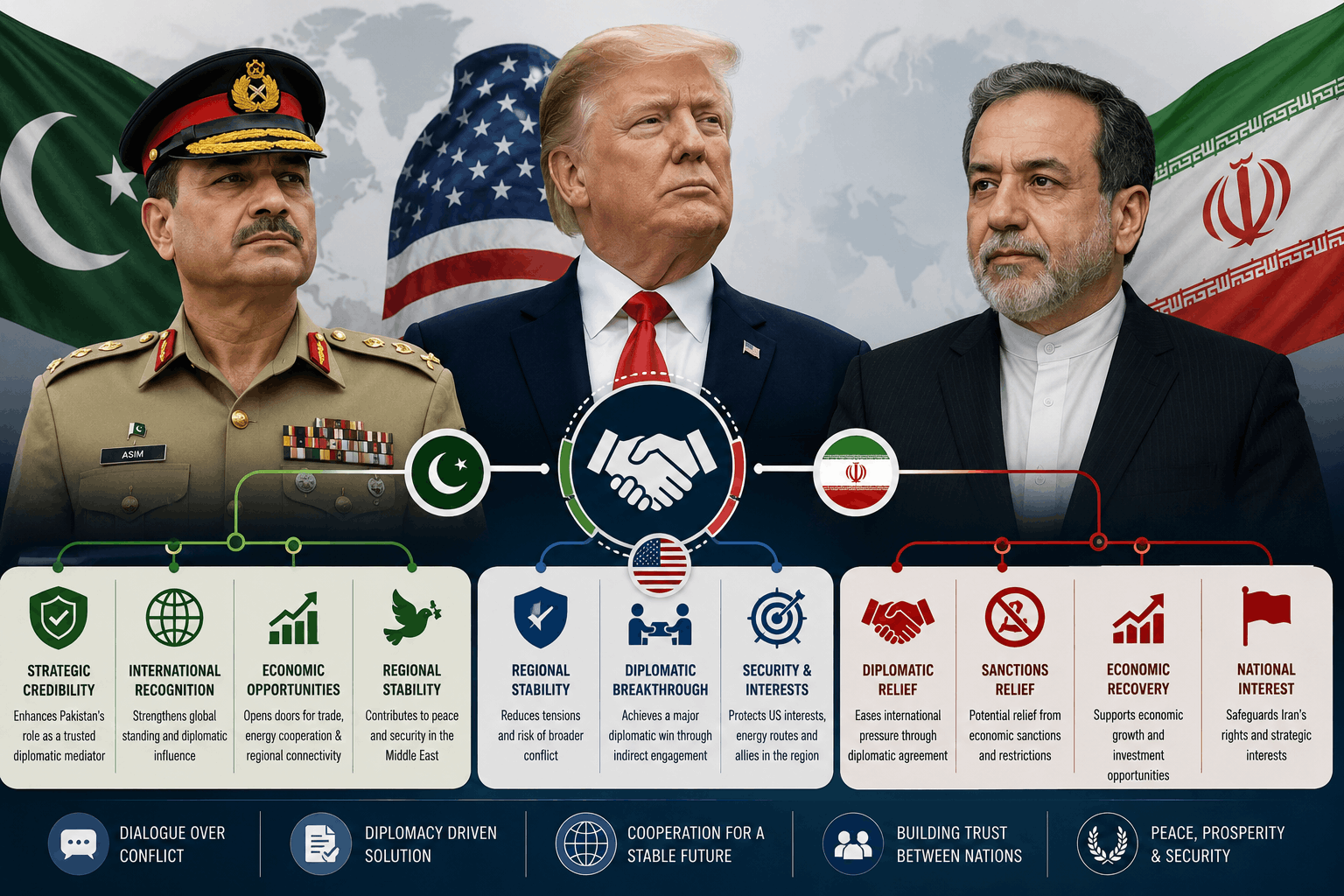
If the agreement ultimately survives political opposition and implementation challenges, Pakistan could emerge as one of its biggest diplomatic beneficiaries. However, if the deal collapses, Islamabad may also face reputational costs and increased strategic pressure from competing regional actors.
Pakistan’s involvement comes at a time when the international system is undergoing significant transformation.
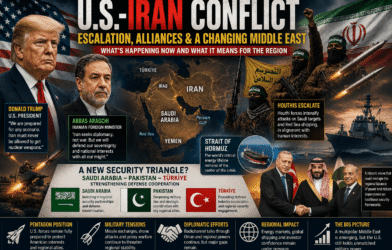
The United States remains committed to preserving stability in the Gulf region, Iran seeks relief from economic and military pressures, and regional powers are attempting to avoid a wider conflict that could disrupt energy supplies and global trade.
In this environment, Islamabad’s ability to maintain communication with both Washington and Tehran has become a valuable diplomatic asset.
Why Washington Needed Pakistan
The Trump administration appears to have approached the negotiations with a pragmatic mindset.
Despite decades of fluctuating relations between Washington and Islamabad, Pakistan remains one of the few countries capable of maintaining regular dialogue with both American and Iranian leadership circles.
Unlike many Gulf States that are viewed by Tehran with suspicion, or countries that openly align with either side, Pakistan possesses a unique combination of geographic proximity, historical ties, and diplomatic channels.
For the White House, Pakistan’s value lies not only in its relationship with Iran but also in its ability to communicate with multiple stakeholders simultaneously.
Islamabad maintains working relations with Saudi Arabia, China, Turkey, Qatar, and the United States, making it a useful intermediary during periods of heightened tension.
The Trump administration’s willingness to engage Pakistan in the peace effort suggests that Washington views Islamabad as a practical diplomatic facilitator rather than merely a regional security actor.
President Donald Trump has repeatedly emphasized that any agreement with Iran would be contingent upon strict compliance.
Following the signing process, Trump warned that the United States could resume military action if Iran violated the terms of the agreement, signaling that Washington remains skeptical despite pursuing diplomacy.
This warning highlights the fragile nature of the peace process and underscores why mediators such as Pakistan remain important even after an agreement is reached.
The Strategic Gains for Pakistan
Should the agreement hold, Pakistan stands to achieve one of its most significant diplomatic successes in recent decades?
Internationally, Islamabad would gain recognition as a responsible stakeholder capable of contributing to conflict resolution beyond South Asia.
Such recognition could help Pakistan improve its image in Western capitals where it has often been viewed primarily through the prism of security concerns.
The diplomatic success could also strengthen Pakistan’s relationship with Washington. While the United States continues to view India as a major strategic partner, successful mediation in a crisis involving Iran provides Islamabad with an opportunity to demonstrate its relevance to American foreign policy objectives.
The resulting goodwill could create opportunities for enhanced diplomatic engagement, economic cooperation, and security dialogue.
Economically, a stable Gulf region serves Pakistan’s interests directly. The country’s economy depends heavily on energy imports, remittances from workers in Gulf States, and maritime trade routes connected to the Strait of Hormuz.
Reduced tensions between Washington and Tehran would lower the risk of disruptions to oil supplies and regional trade.
A more stable Iran could also create opportunities for expanded bilateral commerce, border cooperation, and energy connectivity projects that have remained dormant due to sanctions and geopolitical uncertainty.
The Risks Hidden Behind Diplomatic Success
While the potential benefits are considerable, Pakistan’s role also carries significant risks. Mediators often receive praise when agreements succeed but face criticism when they fail.
The US-Iran relationship has historically been characterized by mistrust, conflicting strategic objectives, and domestic political opposition on both sides. Any future collapse of the agreement could lead observers to question the effectiveness of the mediation process and the countries involved in facilitating it.
Another challenge for Islamabad is maintaining neutrality. Pakistan enjoys longstanding security and diplomatic relations with the United States while simultaneously sharing a border and deep cultural connections with Iran.
If tensions re-emerge, Pakistan could find itself under pressure from both sides to take positions that might jeopardize its broader foreign policy interests.
The agreement also places Pakistan under greater international scrutiny. Any future disputes involving Iran’s nuclear activities, regional militias, or maritime security could bring renewed attention to Islamabad’s role and its relationships with the parties involved.
How India Views Pakistan’s Growing Diplomatic Profile
Perhaps no country is watching Pakistan’s diplomatic rise more closely than India. For years, New Delhi has worked to strengthen its strategic partnership with Washington and position itself as America’s principal partner in South Asia.
From an Indian perspective, Pakistan’s successful involvement in a major international peace initiative could potentially enhance Islamabad’s standing in Washington and challenge perceptions that Pakistan’s regional role is diminishing.
Many Indian analysts are likely to acknowledge that Pakistan’s geography and relationship with Iran make it a logical intermediary.
However, there is also likely to be concern within sections of the Indian strategic establishment that successful mediation could improve Pakistan’s international image and create new opportunities for engagement with the United States.
This concern becomes more significant when viewed alongside recent diplomatic developments involving Washington and New Delhi. India has invested heavily in portraying itself as an indispensable strategic partner for the United States in the Indo-Pacific region.
Any perception that Pakistan has regained diplomatic relevance in Washington could therefore attract considerable attention in Indian policy circles.
Trump’s Remark during the Modi Meeting
Adding another layer to the geopolitical equation was President Donald Trump’s meeting with Indian Prime Minister Narendra Modi on the sidelines of the G7 summit.
During the interaction, Trump delivered one of the strongest public statements in support of India by declaring that if India came under attack, the United States would help defend it.
Trump reportedly stated that “if they were attacked, we would be there to help,” while also emphasizing his confidence in Modi’s leadership. The remark was interpreted by many observers as a reaffirmation of the strategic partnership between Washington and New Delhi, even as the United States was simultaneously working with Pakistan on the Iran diplomacy track.
The statement highlights the complexity of American foreign policy in Asia. Washington increasingly views India as a long-term strategic partner in balancing China, while at the same time recognizing Pakistan’s utility in addressing specific regional crises.
Rather than replacing one relationship with the other, the Trump administration appears to be pursuing parallel partnerships that serve different strategic purposes.
What Pakistan, India, and the United States Are Saying
Prime Minister Shehbaz Sharif has portrayed the agreement as a major diplomatic achievement and repeatedly emphasized Pakistan’s role in facilitating dialogue between Washington and Tehran.
Islamabad has argued that regional stability can only be achieved through diplomacy rather than military confrontation.
President Donald Trump, while welcoming the agreement, has maintained a firm stance toward Tehran.
His warning that military action could resume if Iran violates its commitments reflects the continuing skepticism within Washington regarding Iran’s intentions and underscores the fragile nature of the peace process.
Prime Minister Narendra Modi, meanwhile, has focused on the broader implications of regional stability, particularly maritime security and the uninterrupted flow of commerce through the Strait of Hormuz.
Given India’s dependence on energy imports and overseas trade, New Delhi has a strong interest in preventing renewed conflict in the Gulf.
The Real Test Lies Ahead
Pakistan’s diplomatic achievement will ultimately be judged not by the signing of an agreement but by its durability.
The history of US-Iran relations is filled with failed understandings, abandoned agreements, and mutual accusations of bad faith.
The unresolved questions surrounding Iran’s nuclear program, regional security architecture, and future American policy toward Tehran remain significant obstacles.
If the agreement survives these challenges, Pakistan could emerge as one of the major diplomatic winners of the process, enhancing its international standing and demonstrating that it remains an influential player in regional affairs.
If the agreement fails, however, Islamabad could find itself caught between Washington and Tehran, facing difficult choices while watching its diplomatic investment unravel.
For now, Pakistan has achieved something few expected: it has positioned itself at the center of a geopolitical breakthrough involving two of the world’s most persistent adversaries.
Whether that breakthrough evolves into lasting peace or another chapter in the long history of US-Iran tensions will determine whether Pakistan’s role is remembered as a diplomatic triumph or a high-stakes gamble.
Bookmark The Variant for trusted updates, informed analysis, and comprehensive coverage of the stories that matter most.