


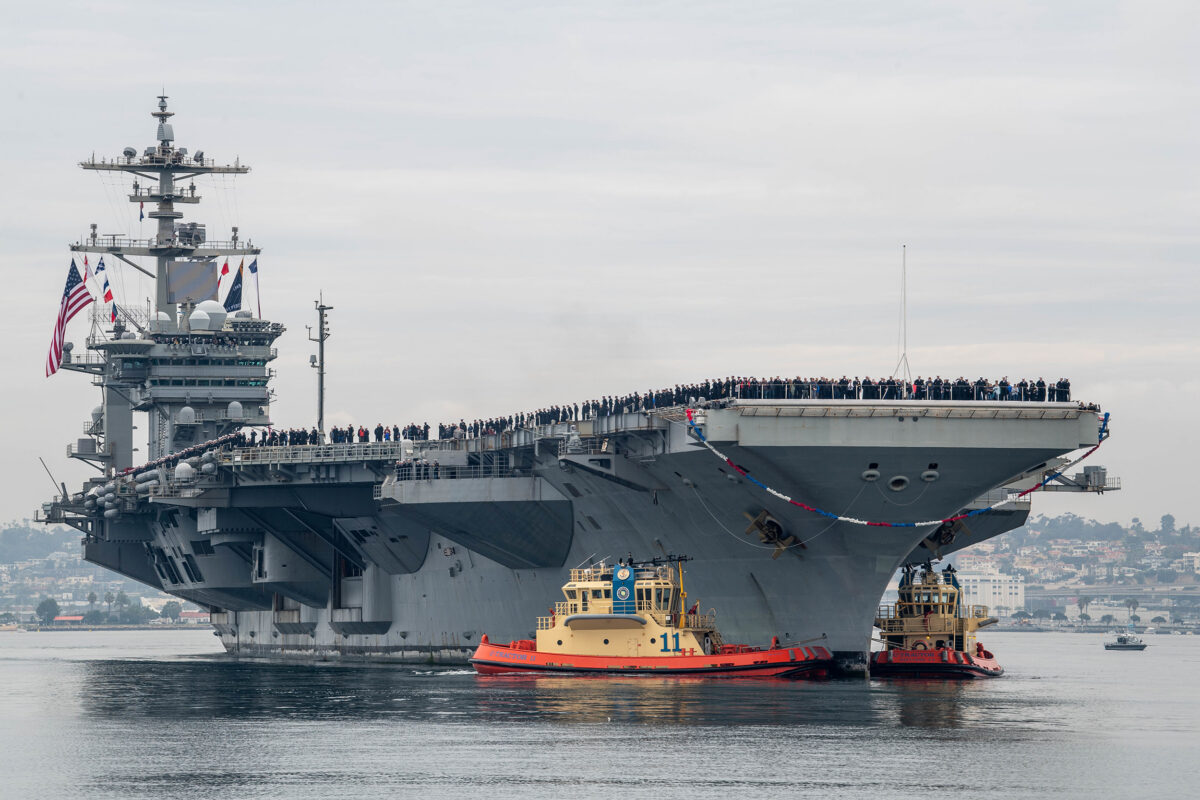
Toronto, Ontario: When the United States sends a message of military resolve across the oceans, few symbols are as potent as an aircraft carrier steaming toward distant seas. Among these floating fortresses, the USS Abraham Lincoln—designated CVN-72—stands out as a centerpiece of American naval power.
Named for the 16th U.S. president, the Lincoln is a Nimitz-class nuclear-powered aircraft carrier that has served the U.S. Navy for more than three decades, projecting force, supporting humanitarian missions, and reinforcing alliances around the world.
Commissioned on November 11, 1989, the Abraham Lincoln stretches an impressive 1,092 feet in length with a flight deck covering roughly 4.5 acres, enough space to operate a wide variety of aircraft simultaneously. Its nuclear propulsion system, driven by two Westinghouse A4W reactors and four turbines producing approximately 260,000 shaft horsepower, enables it to exceed speeds of 30 knots and travel virtually without limitation as long as supplies and crew endurance hold.
The human element aboard the Lincoln is vast. The ship accommodates roughly 5,680 personnel, including about 3,200 sailors forming the ship’s company and roughly 2,480 aircrew and support staff comprising its embarked air wing. This floating city includes everything from a hospital and mess halls to barbershops and a postal service—all necessary to sustain life during long deployments.
At the heart of the carrier’s mission is its air wing, typically composed of dozens of aircraft configured for a range of tasks, from strike operations to early warning and electronic warfare. While capacity can reach up to around 90 fixed-wing aircraft and helicopters, typical expeditionary configurations range between 60 and 75 operational aircraft.
These include multirole fighters such as the F/A-18E/F Super Hornet, the advanced stealth F-35C Lightning II, electronic warfare EA-18G Growlers, airborne early warning E-2D Hawkeyes, logistical support aircraft like the CMV-22B Osprey, and MH-60 Seahawk helicopters for search and rescue or anti-submarine operations.
Though designed for strike and air superiority, the Abraham Lincoln is by no means undefended close to its own hull. Its self-defense suite integrates multiple layers of protection, including Sea Sparrow and Rolling Airframe Missile (RAM) launchers to counter incoming aircraft or missiles and several Phalanx Close-In Weapon Systems (CIWS) that provide rapid-fire defense against close threats.
These systems work in concert with advanced radars like the AN/SPS-48E 3-D air search and AN/SPS-49 long-range radars, along with electronic warfare and countermeasure systems to detect and disrupt hostile targeting.
One of the Lincoln’s greatest advantages stems from its nuclear power plant, which eliminates the need for traditional fuel bunkering for propulsion and gives the vessel virtually unlimited range over its operational lifecycle, limited primarily by food, water, and crew endurance. This contrasts sharply with carriers powered by fossil fuels and underscores why nuclear carriers remain central to U.S. maritime strategy.
Yet nuclear propulsion does not remove all consumable costs. The carrier and its air wing require vast supplies of aviation fuel (like JP-5) and ordnance for aircraft operations. Data from naval logistics movements show carriers routinely onload millions of gallons of jet fuel before major exercises and deployments to ensure flight operations can continue at full tempo.
While the exact per-day fuel bill for aircraft operations varies widely depending on sortie rates and mission requirements, exercise data indicate carriers like the Lincoln may take on over 1.7 million gallons of aviation fuel in preparation for sustained operations—a testament to the sheer scale of the logistical effort involved.
The day-to-day operating expense of a super-carrier like the Abraham Lincoln is substantial, reflecting not only fuel and ordnance but also personnel costs, maintenance, and supply.
Estimates from defense analysts place the annual operating cost of a U.S. Navy carrier strike group well into several hundreds of millions of dollars, with daily operating costs for the carrier itself often cited in the hundreds of thousands of dollars per day even without expeditionary air operations.
These figures include everything from utility costs to spare parts and sustainment but can spike dramatically during combat or high-intensity exercises. (Defense cost estimates from analysts and budget documents; typical figures).
Beyond its hardware and crew, the Abraham Lincoln has accumulated decades of operational experience. It has sailed across the Pacific, Indian Ocean, and Mediterranean, participated in multinational exercises with partner navies, and supported crisis responses both humanitarian and military. In recent years it has operated in strategic theatres like the South China Sea and the Middle East, reinforcing U.S. presence and deterrence.
In a geopolitical moment where U.S. military deployments are watched closely around the globe, the Abraham Lincoln embodies America’s capacity to project air power from the sea. It is a testament to decades of naval engineering, sustained by thousands of trained personnel and formidable technology that together make it one of the most complex machines ever put into continuous operation—a floating base, a deterrent force, and a symbol of U.S. maritime commitment.







