


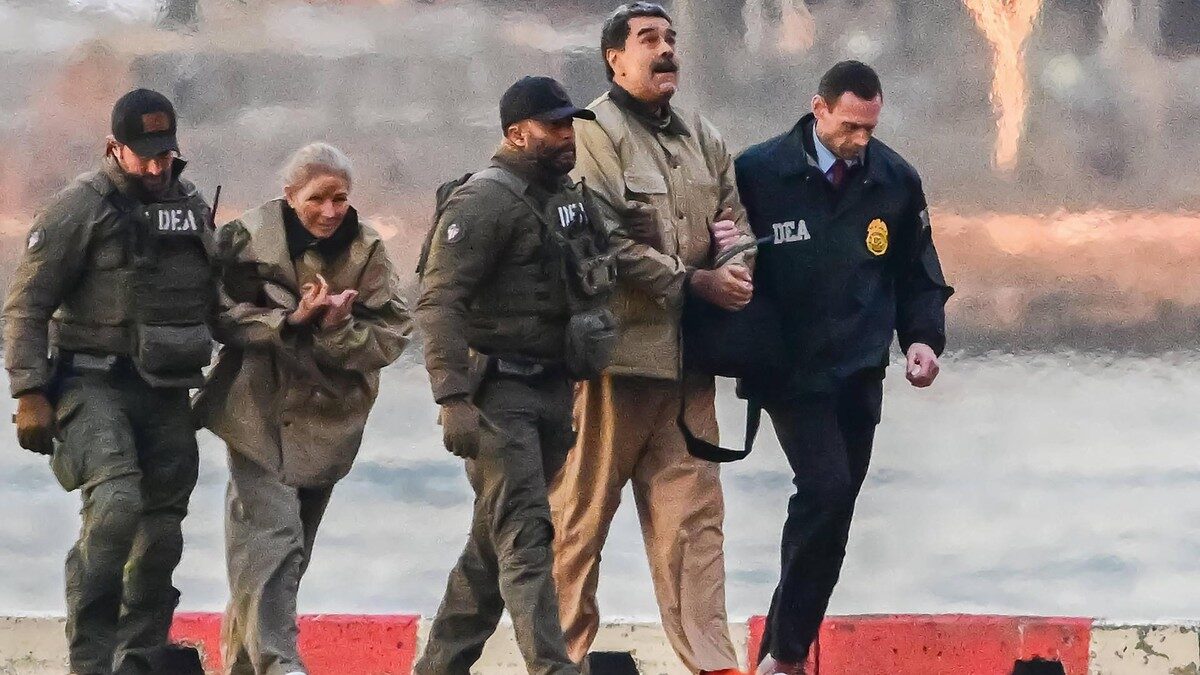
New York/Valencia: The United States’ military operation in Venezuela that resulted in the capture of President Nicolás Maduro has triggered a geopolitical reckoning across South and Latin America.
Operation Absolute Resolve launched on January 3, 2026, involved coordinated U.S. airstrikes on military sites in Caracas and a Special Forces mission that extracted Maduro and First Lady Cilia Flores. Both were transported to New York, where they now face U.S. federal charges including narco-trafficking and conspiracy.
The US President Donald Trump declared the mission a success, describing it as a “decisive action against criminal governance” and indicating that Washington would oversee conditions for a transitional Venezuelan administration.
The sudden removal of a sitting head of state without United Nations authorization sparked immediate controversy. Official reactions across Latin America reflected deep ideological divisions. Left-leaning governments in Brazil, Mexico, Chile, and Colombia condemned the intervention as a breach of Venezuela’s sovereignty and a destabilizing precedent in the hemisphere.
They warned that such actions could unravel long-standing diplomatic norms. Right-leaning administrations and U.S. allies in Argentina and parts of Chile voiced support, framing the operation as the termination of an authoritarian regime accused of human rights abuses and narco-trafficking ties.
Major international powers also weighed in. China and Russia issued formal condemnations, characterizing the operation as hegemonic overreach, while European Union officials took a more cautious line, urging respect for international law and calling for a peaceful political transition.
Within the United States, legal scholars and lawmakers debated whether the White House had overstepped statutory requirements for military engagement abroad, with critics arguing that congressional approval should have been sought.
Beyond the legal debate, Operation Absolute Resolve sent strategic signals. Analysts noted that the mission demonstrated Washington’s willingness to deploy force unilaterally in the Western Hemisphere and without multilateral backing.
Some foreign policy experts warned that this could erode global norms against forcible regime change and prompt rival powers to adopt similar tactics under their own security justifications. Public sentiment inside the United States has been mixed, with polling data showing discomfort among segments of the electorate about the risks associated with expanded overseas intervention.
Venezuela now faces a period of political uncertainty. Acting officials in Caracas are attempting to maintain continuity in government operations as opposition figures, including María Corina Machado, seek international support for a post-Maduro transition. Diplomatic negotiations are underway, with scenarios ranging from early elections to internationally supervised governance frameworks.
The regional consequences are already visible. Countries alarmed by the precedent are exploring tighter cooperation with China, Russia, and non-Western political blocs, signaling a potential recalibration of hemispheric alliances. Others are looking toward Washington for security guarantees and economic partnerships, deepening ideological polarization.
Multilateral organizations including the Organization of American States and the Community of Latin American and Caribbean States have been thrust into internal disputes over sovereignty, democracy, and the legitimacy of outside intervention.
While the long-term impact of Operation Absolute Resolve remains unclear, it has undeniably reshaped perceptions of U.S. power in the region.
The intervention has reopened historical debates over external influence in Latin American affairs and raised questions about the future of international law governing the removal of political leaders. Whether Venezuela emerges with renewed democratic institutions or enters a prolonged period of geopolitical contestation will determine how this episode is ultimately judged in regional and global terms.
In the weeks following Operation Absolute Resolve, the political landscape in Venezuela and its economic ties with the United States have undergone dramatic shifts.
After the U.S. military’s capture of President Nicolás Maduro on January 3, 2026, Maduro’s longtime vice president, Delcy Rodríguez, assumed the role of interim president and has taken steps to stabilize an economy battered by years of sanctions, mismanagement, and political isolation.
Under her leadership, Venezuela reported receiving approximately $300 million in revenue from recent oil sales, marking the first tangible funds flowing from a new oil deal with the United States.
Those proceeds were deposited in a Qatari account and are slated for distribution among Venezuelan banks to shore up foreign exchange reserves and help support domestic economic needs.
This emerging economic arrangement centers on an unprecedented oil agreement between the interim Venezuelan government and the U.S. administration.
President Donald Trump announced that Venezuela would turn over between 30 million and 50 million barrels of “sanctioned” crude oil to the United States, to be sold at market prices with the resulting revenue controlled by the U.S. executive branch.
Trump framed this as a measure to “benefit the people of Venezuela and the United States,” although specifics about how the funds would be allocated domestically in Venezuela remain limited.
Trump’s statements, disseminated via social media and in official briefings, extended beyond oil volumes. He declared that the United States would oversee the marketing and sale of Venezuelan crude, with Energy Secretary Chris Wright tasked with executing the plan to bring the oil to U.S. ports.
The administration has signaled intentions to maintain control over future Venezuelan oil sales, positioning U.S. policy not only as transactional but as a longer-term economic strategy in the hemisphere.
In parallel to the deal, Trump has articulated a broader vision for Venezuela’s economic orientation. In statements reported by international media, he asserted that Venezuela would use the oil revenue to purchase exclusively U.S.-made goods, including agricultural products, medicines, and industrial equipment, thereby making the United States its primary trading partner—a dramatic pivot in a nation historically aligned with China and other global markets.
Despite these developments, there has been internal debate within the U.S. government about the scope and nature of its involvement. Secretary of State Marco Rubio stressed that the United States would not engage in prolonged nation-building but would enforce an “oil quarantine” and related policies, even as Trump reiterated his assertion that “we’re in charge” of Venezuela’s transition and that Washington would help “run it” and “fix it” as necessary.
Internationally, this evolving oil arrangement has reinforced concerns among Venezuela’s traditional allies. China and Russia, both major buyers and investors in Venezuelan oil before the crisis, have criticized U.S. moves as violations of sovereignty and disruptive to global energy markets.
Meanwhile, global oil companies and investors have been cautious, with some U.S. firms indicating that Venezuela’s industry requires extensive legal and structural reforms before large-scale investment can be viable.
Within Venezuela, interim authorities have shown a willingness to engage with U.S. officials, including high-level meetings aimed at curbing narco-trafficking and opening the economy to foreign investment.
The interim government’s tentative cooperation with Washington marks a stark departure from the staunch anti-U.S. rhetoric of the preceding regime, underscoring the dramatic realignment of political and economic priorities in Caracas.
As the deal unfolds, the revenues and political implications of Venezuela’s oil — a resource that once made the country the world’s largest holder of proven crude — have suddenly become central to a broader geopolitical reconfiguration. How this oil trade agreement will balance Venezuelan national interests with U.S. strategic objectives will be a defining question for both nations in the months ahead.







