


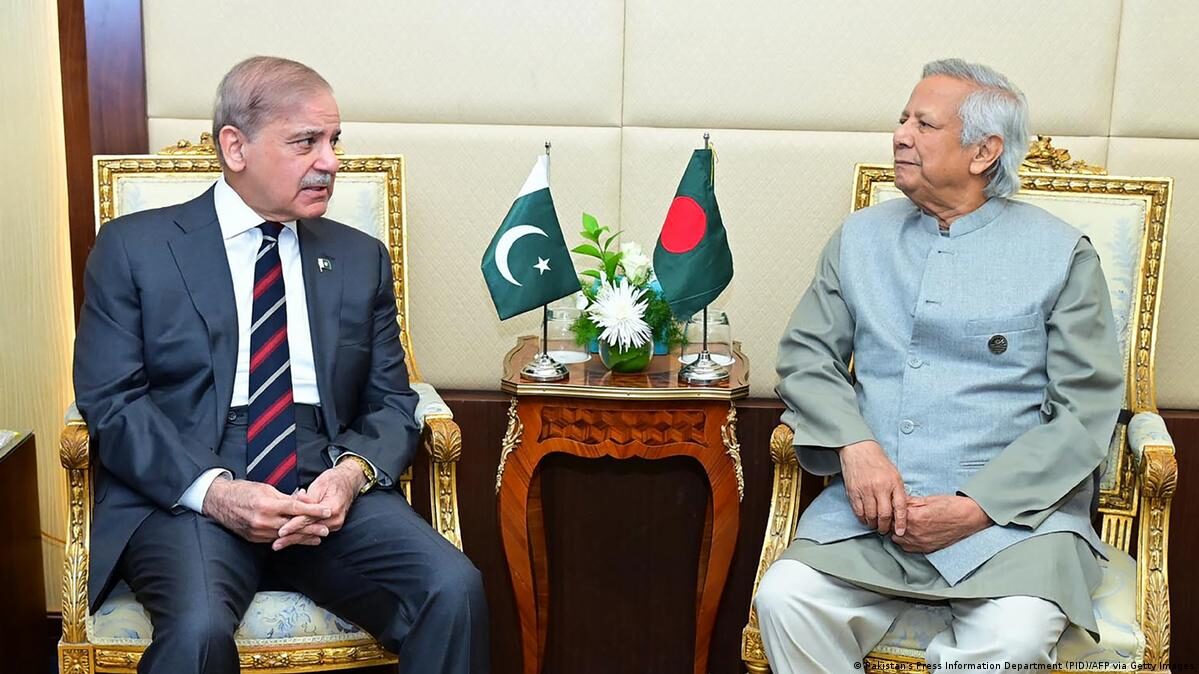
Rochester, NY: The political tremors unleashed by Bangladesh’s July Revolution have continued to reshape South Asia’s balance of power, with the country’s quiet but steady rapprochement with Pakistan emerging as one of the most consequential shifts in regional diplomacy.
What began as a domestic political upheaval in mid-2024 has evolved into a recalibration of Bangladesh’s foreign policy, eroding India’s long-standing dominance in Dhaka and opening space for new strategic partnerships.
The fall of former Prime Minister Sheikh Hasina, an unwavering ally of New Delhi, ended an era defined by strong India-Bangladesh cooperation. Her departure from the country following mass demonstrations created the conditions for a transitional government under Nobel laureate Muhammad Yunus, which has since redirected Dhaka’s external engagements toward greater diversification and autonomy.
This change in posture became increasingly visible as Bangladesh reopened channels with Pakistan after more than five decades of diplomatic stagnation.
In Islamabad, the thaw was welcomed as an opportunity to reshape South Asia’s diplomatic equation. Pakistan has moved swiftly to improve trade, cultural exchanges, and high-level diplomatic communication with Dhaka, while signaling its readiness to deepen cooperation in defense and infrastructure.
Direct trade, halted for decades, has resumed, and discussions surrounding potential procurement of Pakistani-manufactured equipment — including the JF-17 fighter jet — have elevated the relationship beyond symbolic reconciliation. For Pakistan, this diplomatic opening enhances its strategic reach in a region where New Delhi has historically claimed uncontested primacy.
India has reacted to these developments with visible discomfort. Its once-assured position in Dhaka has been strained by Bangladesh’s pursuit of alternative partnerships. Trade dependency on India has declined as Dhaka expands commercial ties with Islamabad and Beijing, prompting urgent recalculations in New Delhi’s strategic community.
In January 2026, India’s decision to withdraw the families of its diplomats from Bangladesh, citing security concerns, underscored the fragility of a relationship that had long been advertised as stable and mutually beneficial.
For regional observers, the withdrawal was interpreted as symbolic of a deeper loss of influence rather than a mere protective measure.
“Domestic political transitions in nations such as Bangladesh frequently affect the mobilization of external major-power rivalries, as internal priorities dictate the manner in which countries interact with super-regional actors, thereby challenging established assumptions.” Paul Staniland, a South Asia scholar at the Carnegie Endowment, said in his statement.
Pakistan, meanwhile, has sought to embed its renewed engagement with Bangladesh within broader regional frameworks. Islamabad’s proposals for trilateral cooperation with Beijing and Dhaka have not gone unnoticed, reflecting a vision for an alternative South Asian economic and security configuration that restricts Indian dominance while expanding Pakistani leverage.
For Bangladesh’s interim authorities, such options strengthen their bargaining power and reinforce the political narrative that the country is no longer beholden to a single regional patron.
Diplomatic diversification has also resonated with domestic sentiment inside Bangladesh. Sections of the population, particularly youth involved in the 2024 uprising, have expressed dissatisfaction with what they perceived as India’s heavy-handed influence in Dhaka’s political affairs during Hasina’s tenure.
The transitional government’s outreach to Pakistan and China taps into these sentiments by signaling a foreign policy rooted in sovereignty rather than alignment.
The strategic implications for South Asia are significant. A warmer Bangladesh–Pakistan relationship diminishes India’s ability to shape developments in its immediate eastern neighborhood and complicates its long-standing strategy of leveraging historic ties to secure influence.
The Pew Research Center’s statement indicates that public perceptions in Bangladesh regarding Pakistan have evolved: although historical memory remains significant, an increasing proportion of Bangladeshis hold a more favorable view of Pakistan than anticipated, illustrating changing social and political dynamics.
For Islamabad, the re-engagement allows it to cultivate diplomatic depth at a time when South Asia is witnessing the rise of multi-polar alignments. For Beijing, which maintains close ties with both countries, the adjustment presents opportunities to expand regional connectivity under its economic and infrastructural initiatives.
Moving forward much will depend on Bangladesh’s electoral trajectory and the durability of its post-revolution foreign policy doctrine. Yet even if future governments seek to rebalance toward India, the era of unilateral dependency appears to be over. Dhaka has tasted diplomatic flexibility and Pakistan has positioned itself as a key beneficiary of Bangladesh’s evolving political identity.
Dr. Nazam Laila, Associate, Digital Society Programme, Chatham House believes that Bangladesh is helping to create a geopolitical shift in South Asia by reducing its reliance on a single neighbor and opening strategic space with partners beyond India, including Pakistan and China.
In a region where history often constrains diplomacy, the emerging Dhaka–Islamabad equation is rewriting assumptions. For India, it marks a rare moment of geopolitical vulnerability in South Asia. For Pakistan, it signals a strategic opening that was unthinkable for much of the past five decades. For Bangladesh, it represents a new chapter — one defined less by historical trauma and more by political choice.







