


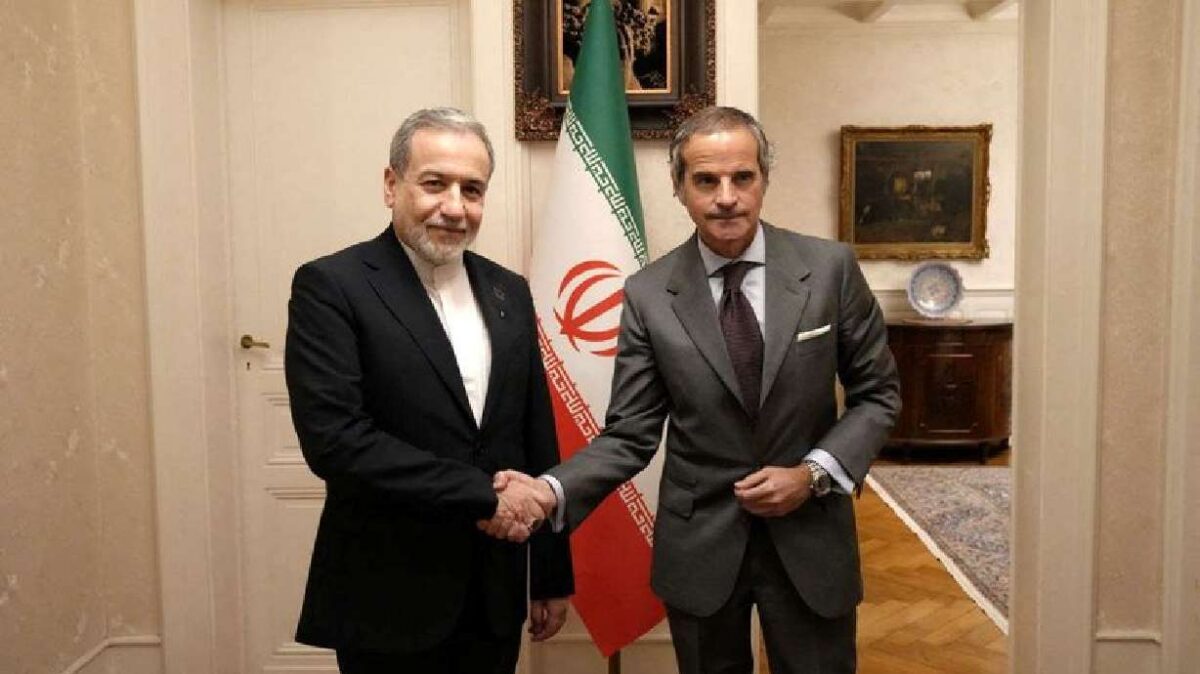
Rochester, NY: Abbas Araghchi, the Iranian Foreign Minister, expressed cautious optimism when he announced that the most recent round of indirect nuclear negotiations with the United States had made “good progress.” However, optimism remains contingent upon Washington’s perspective.
American officials continue to emphasize that diplomacy is the preferred approach, although it is not the sole one. The gravity of the situation is underscored by the warning that military action remains an option.
The Joint Comprehensive Plan of Action, which was formally known as the 2015 nuclear accord, is the foundation of the ongoing negotiations. In exchange for sanctions relief, Iran agreed to reduce its centrifuge stockpile and adhere to stringent uranium enrichment restrictions, which were limited at 3.67% purity.
The agreement substantially extended Iran’s “breakout time,” which is the time required to produce sufficient fissile material for one nuclear weapon, to approximately one year.
Nevertheless, Iran’s nuclear activities were progressively intensified in the wake of the U.S. withdrawal from the agreement in 2018 and the reimposition of extensive economic sanctions. Iran has enriched uranium to levels as high as 60% purity, according to estimates from the International Atomic Energy Agency (IAEA).
This is a brief technical step from the 90% weapons-grade threshold. Western intelligence assessments indicate that Iran’s exit time has decreased significantly, potentially to a matter of weeks rather than months. This change is not merely a technical violation for Washington; it is a strategic threat.
American officials contend that enrichment at 60% serves no credible civilian energy purpose.
Enrichment levels below 5% are typically required for commercial nuclear power reactors, and even research reactors rarely require material that is enriched above 20%. Consequently, the accumulation of higher-enriched uranium heightens apprehensions that Iran is pursuing the leverage, if not the capability, to rapidly weaponize its nuclear arsenal.
Tehran maintains that its program is benign; however, its refusal to provide complete transparency to international inspectors has exacerbated suspicion.
In this context, the most recent negotiations, which were purportedly facilitated by Oman and were conducted without direct face-to-face engagement between the United States and Iran, are indicative of a fragile diplomatic opening.
Procedural progress is indicated by Araghchi’s statements regarding consensus on “guiding principles,” but U.S. officials continue to prioritize outcomes over atmospherics. The central demand of Washington is unambiguous: the restoration of intrusive monitoring mechanisms and a verifiable reversal of Iran’s high-level enrichment.
Negotiation and calibrated pressure comprise the United States’ approach. Military assets in the Middle East, such as naval deployments and air capabilities, have been fortified by American defense officials in recent weeks.
Despite the Pentagon’s framing of these actions as deterrence rather than preparation for imminent action, the message is clear: diplomacy operates in the shadow of force.
The risks are not limited to Iran from a national security standpoint in the United States. Israel, a critical American ally, regards a nuclear-capable Iran as an existential peril and has consistently expressed its willingness to act independently.
Saudi Arabia and the United Arab Emirates, among other Gulf States, have expressed apprehension that Iran’s breach of the nuclear threshold could result in a regional arms race. The potential cascade effect, which would result in adversary states pursuing their own nuclear capabilities, would significantly undermine the global nonproliferation architecture.
The implications are equally substantial from an economic perspective. Some of the world’s largest verified hydrocarbon and natural gas deposits are located in Iran.
A military escalation in the Persian Gulf could exacerbate inflationary pressures that are already affecting Western economies, disrupt global energy markets, and drive up crude prices. It is therefore a security and economic priority for Washington to prevent conflict while simultaneously neutralizing proliferation risk.
Iran is currently experiencing significant economic challenges on a domestic level. The depreciation of the currency, high inflation, and diminished foreign investment have all been influenced by the years of sanctions.
In recent years, Iran’s inflation rate has fluctuated between 30% and 40%, which has eroded the purchasing power of households, according to analysts. These internal pressures may account for Tehran’s renewed willingness to investigate diplomatic engagement, despite its public opposition to concessions that appear to undermine sovereignty.
Nevertheless, the credibility of deterrence is of paramount importance to the United States.
American policymakers contend that permitting Iran to approach nuclear weapons capability without repercussions would encourage other adversaries and undermine global norms.
There is a deliberate message emanating from Washington: diplomacy must yield tangible constraints, but it remains open. The administration maintains that alternative measures, such as military options, are still viable in the event those negotiations are stalled or if Iran continues to expand enrichment activities.
The forthcoming months will ascertain whether Araghchi’s “good progress” is translated into enforceable commitments or if it is lost in another cycle of stalled diplomacy.
For decades, the relationship between the United States and Iran has been characterized by the equilibrium between engagement and coercion. Today, that equilibrium is once more being examined.
If an enduring agreement is reached, it has the potential to stabilize a volatile region, extend the time until Iran’s escape, and restore inspection regimes. The Middle East may enter one of its most perilous chapters in years if it collapses, with repercussions that extend far beyond Tehran and Washington.







