


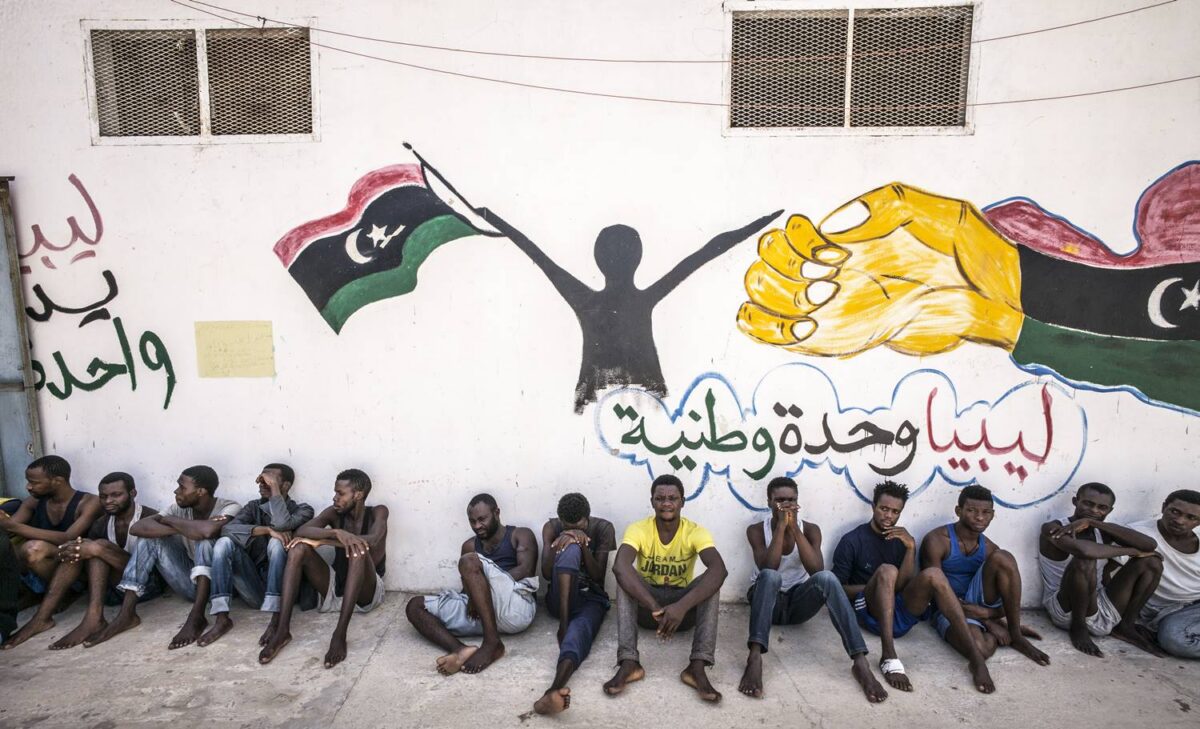
Rochester, NY: On the sun-scorched peripheries of Libya’s sprawling desert and inside its overcrowded detention compounds, the human rights crisis facing migrants has deteriorated into what the United Nations describes as a “business-as-usual” regime of brutality.
According to a newly released United Nations Human Rights Office (OHCHR) and UN Support Mission in Libya report, migrants — many fleeing conflict and poverty — are being abducted, tortured, raped, enslaved and extorted in blatant violation of basic human rights and international law.
The report, which was composed of interviews with over 100 survivors from 16 countries between 2024 and 2025, depicts a harrowing tapestry of abuse. One Eritrean woman who was detained at a trafficking house in Tobruk for more than six weeks expressed her desire to perish to investigators.
The voyage was a hellish experience, characterized by inconceivable suffering and repeated gang assaults. She stated that “girls as young as 14 were raped on a daily basis.”
Another Nigerian woman described being compelled into marriage and sexual servitude from a young age before ultimately escaping, a stark testament to the profound exploitation that is ingrained in Libya’s migrant detention system.
Survivors recounted how perpetrators employ degradation, forced labor, and public rape as instruments of terror. Men were compelled to labor without food or compensation, while women were nude and assaulted.
Additionally, children were separated from their mothers. The report concludes that these violations are neither isolated nor intermittent; rather, they are a component of a well-established illicit economy that capitalizes on human distress.
The OHCHR issued an urgent appeal to Libyan authorities to cease hazardous interceptions at sea, decriminalize irregular entrance, stay, and exit, and release arbitrarily detained migrants. These demands serve to emphasize the extent to which the violations have become entrenched.
Nevertheless, the responses of those who possess the authority to take action have been profoundly inadequate.
The representative of the UN mission in Geneva issued a warning that the Libyan Coast Guard, which frequently conducts interceptions at sea with the assistance of funding, equipment, and training from the European Union, frequently returns migrants to the system that subjected them to abuse.
Some senior agency voices concede the moral quandary, despite the fact that European officials prioritize border control and migration management. The executive director of Frontex, the EU’s border and coast guard agency, previously acknowledged that he wished returnees “didn’t have to be sent back to Libya.”
He also acknowledged that those who are returned frequently experience severe rights violations. However, he maintained that Frontex “sometimes has no choice.”
Human rights organizations have gone further, alleging that Europe’s migration policies have contributed to the catastrophe. Critics contend that the collaboration with Libya’s coast guard externalizes Europe’s border enforcement, sending vulnerable individuals back into a region that is plagued by extortion, torture, and trafficking.
Despite the accumulation of evidence that indicates otherwise, Libyan authorities have consistently denied the existence of systematic abuses.
They have resisted international scrutiny by expelling aid groups and accusing them of having ulterior motives. These actions have impeded independent monitoring and humanitarian assistance for migrants who are confined within the country.
Persistent violations by Libyan security forces are also documented by local civil society groups.
Libya’s authorities were urged to investigate arbitrary arrests, extrajudicial murders, and deliberate intimidation of humanitarian workers in March 2025, when the Libya Crimes Watch monitoring team reported an increase in arbitrary detentions and forced deportations in numerous western cities.
The fatal Mediterranean voyage itself further intensifies the terror. The central Mediterranean has been the site of at least 33,348 deaths or disappearances of migrants and refugees between 2014 and 2025, according to recent estimates from international migration databases. This figure is widely considered to be a significant undercount of the true toll of this difficult route.
The bleak discoveries are not limited to detention centers. In recent years, humanitarian actors and authorities have discovered mass graves in Libya’s desert regions that contain dozens of migrant bodies.
Some of the bodies exhibit indications of violent death prior to interment, serving as a stark reminder of the broader impunity that encompasses the country’s human trafficking economy.
Meaningful remediation remains elusive, despite the urgent demands from the UN and human rights organizations and the compelling evidence. Deterrence and border enforcement remain the primary objectives of European migration policy, frequently at the expense of fundamental protections.
In the interim, Libyan authorities continue to assert that they are collaborating on migration management, despite the fact that they are enforcing policies that reinforce vulnerability and abuse.
The cruelty that has been witnessed in Libya, from arbitrary detention to forced labor, sexual violence, and extortion, is more than a violation of human rights for the survivors whose testimonies are detailed in the most recent UN report.
It is a damning indictment of a world that has permitted such suffering to become normalized. Their voices serve as an urgent reminder that policies that reduce humanity to a commodity frequently neglect the most vulnerable in an era of widespread displacement.







