


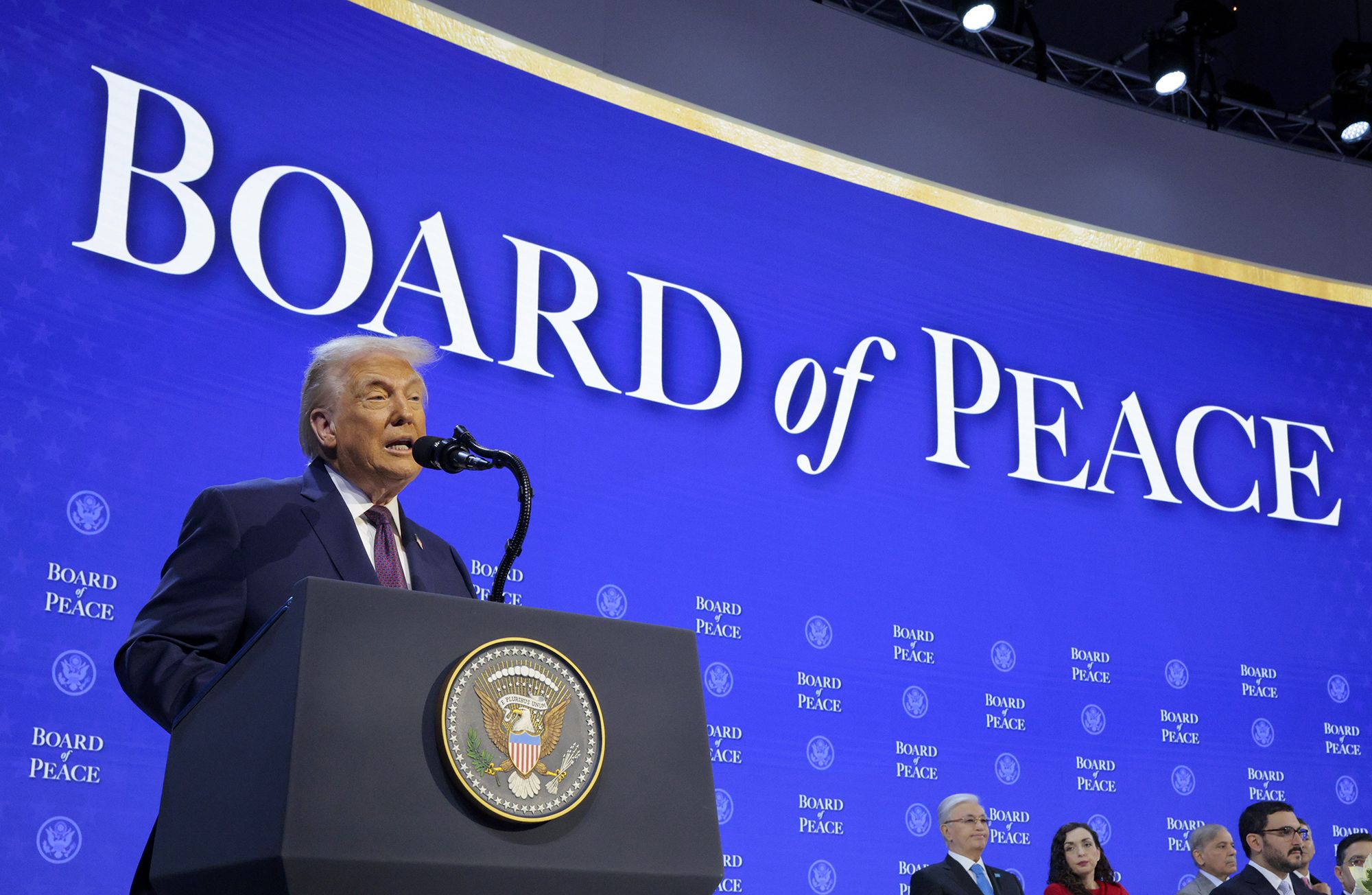
WASHINGTON, D.C: Imagine walking into the grand halls of Washington, D.C., on a crisp February morning, where world leaders gather not for a trade summit, not for a military alliance—but for something far rarer: a new global experiment in peace.
The Board of Peace has convened for the first time, bringing together countries from Asia, the Middle East, and beyond, yet leaving some traditional powers conspicuously absent.
The inaugural session of the Board of Peace convened in the American capital under the leadership of Donald Trump, marking what the White House described as a “historic reset” in global conflict management.
Held at the United States Institute of Peace, the meeting brought together representatives from nearly 50 countries, though the absence of several major Western powers underscored geopolitical friction beneath the ceremony’s ambitious rhetoric.
President Trump opened the session by announcing that the board had already secured a combined $7 billion in pledges from partner countries — including Kazakhstan, Azerbaijan, the United Arab Emirates, Morocco, Bahrain, Qatar, Saudi Arabia, Uzbekistan, and Kuwait — as part of a comprehensive relief and reconstruction package for Gaza.
The United States itself pledged $10 billion, pending the approval of Congress, bringing the initial total closer to monumental figures not seen in recent global peace initiatives. FIFA also committed to raising another $75 million for community and sporting projects in Gaza, and the United Nations pledged a further $2 billion toward humanitarian assistance.
“When you go to wars, it costs you a hundred times what it costs to make peace,” Trump told delegates, framing the initiative as both fiscally responsible and strategically necessary, adding “This is the most consequential board in terms of power and prestige that we have ever assembled for peace.”
The initiative, however, did not command universal support. France, Germany, and United Kingdom declined to participate as full members, citing concerns over duplication of United Nations mechanisms and the lack of clarity regarding governance structures.
Officials within the European Union expressed reservations that the Board of Peace might sideline multilateral consensus processes. Meanwhile, Belarus publicly stated that visa complications prevented its delegation from attending despite an invitation, raising procedural questions.
Among the most closely watched participants was Shahbaz Sharif. Pakistan’s prime minister used his address to emphasize humanitarian urgency in Gaza while advocating for a structured ceasefire enforcement mechanism. “This gathering can become a golden chapter in history,” Sharif remarked, urging immediate steps to halt civilian suffering and rebuild essential infrastructure.
He reiterated Pakistan’s longstanding support for a sovereign Palestinian state while stressing that any multinational stabilization force must operate under a clear peacekeeping mandate consistent with international law.
Sharif’s diplomacy carried additional weight due to his reference to the May 2025 escalation between Pakistan and India. In a notable moment, he credited Trump’s engagement during that crisis. According to Sharif, U.S. intervention helped avert a potentially catastrophic confrontation in South Asia.
However, officials in India have consistently denied formal U.S. mediation, maintaining that de-escalation was achieved through bilateral military channels. The divergence of narratives added a subtle undercurrent of strategic rivalry to the otherwise forward-looking summit.
President Trump amplified Sharif’s remarks during his own address, offering unusually direct praise. “I like this man,” Trump said, gesturing toward the Pakistani leader. He also commended Pakistan’s military leadership, specifically mentioning Asim Munir, whom he described as “a tough, serious fighter who understands strength but wants peace.”
The comment drew attention given the delicate balance between civilian diplomacy and military influence in regional politics. Trump suggested that decisive leadership in Islamabad had been instrumental in preventing wider instability in 2025.
The summit concluded with a joint declaration outlining commitments to accelerate debris clearance in Gaza, restore electricity and water systems, reopen hospitals and schools, and establish frameworks for longer-term political dialogue.
Delegates discussed the formation of an International Stabilization Force (ISF) composed of contributing nations from Asia and the Middle East, though operational details remain under negotiation.
Analysts noted that while headline pledges approach $17 billion, actual disbursement will depend on legislative approvals, security conditions on the ground, and coordination with existing humanitarian agencies.
Reactions after the meeting were mixed. Supporters characterized the Board as an innovative complement to established institutions, capable of mobilizing rapid funding without bureaucratic delay.
Skeptics argued that bypassing traditional multilateral forums risks fragmenting global governance.
Within diplomatic circles, debate now centers on whether the initiative represents a durable platform for peace building or a politically driven experiment tied closely to Trump’s leadership style.
For Pakistan, the summit marked a moment of diplomatic elevation. Sharif’s visible role and the public commendation from Trump signaled strengthened bilateral engagement with Washington. Yet Islamabad must also navigate regional sensitivities and domestic opinion, particularly regarding any overseas military deployment.
As delegates departed Washington, the first meeting of the Board of Peace left behind both optimism and uncertainty.
Financial pledges, public declarations and high-profile praise set an ambitious tone, but implementation will determine whether the initiative becomes a transformative force in conflict resolution or remains a bold but contested diplomatic chapter in modern geopolitics.







