


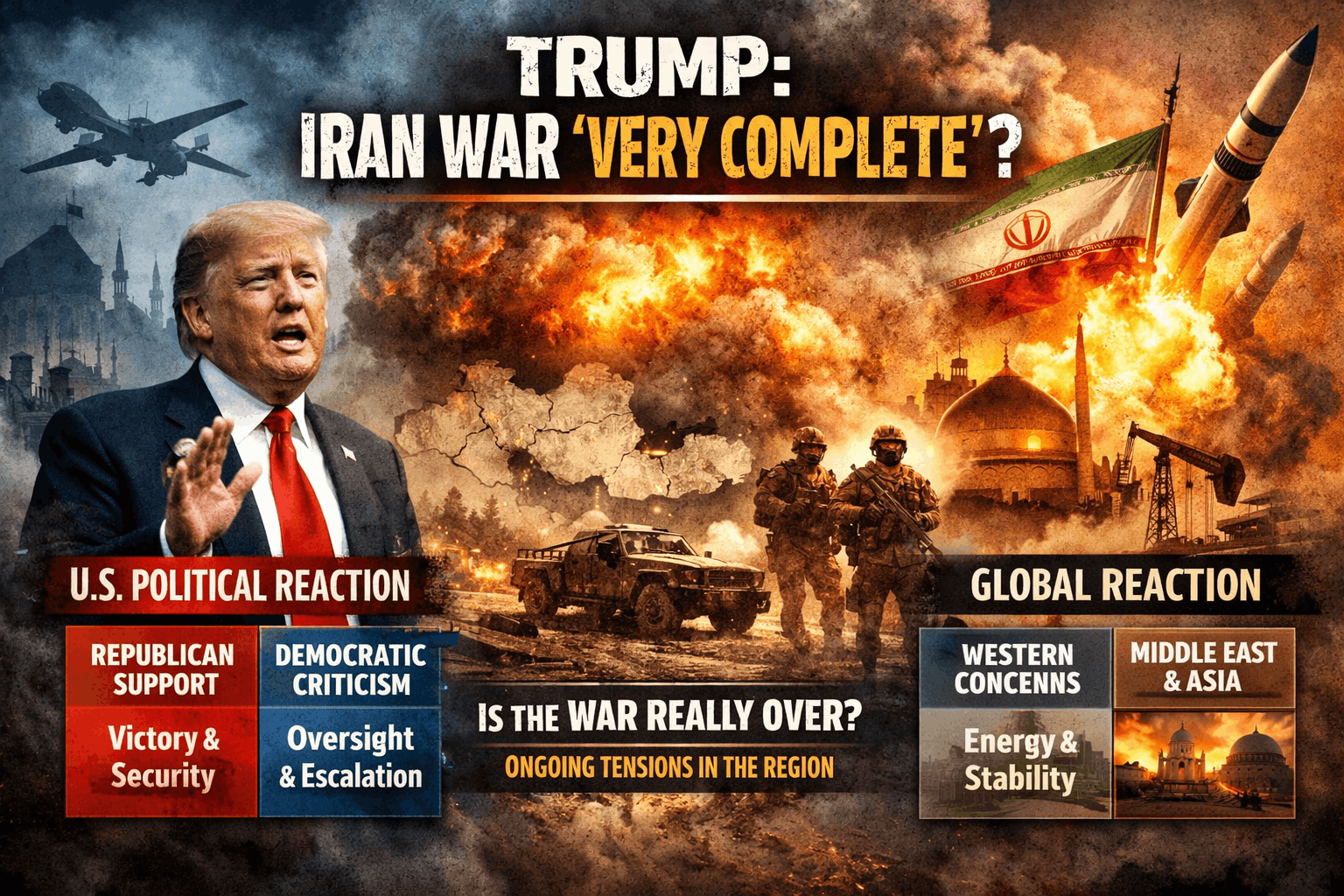
Rochester, NY: The assertion by U.S. President Donald Trump that the battle with Iran is almost over has lately sparked heated controversy. During his phone conversation with CBS News, Trump spoke with confidence about the conflict’s resolution, stating:
“In my opinion, the war is effectively over.”
He insisted that the combined American-Israeli operation had destroyed Iran’s military infrastructure. After dozens of attacks on military sites, Iran’s missile and drone capabilities were very well wiped out, and today the country has “no navy, no communications, no air force,” as Trump put it.
According to Trump, the US is “far ahead of schedule” in the campaign, and he has warned Iran not to retaliate any further since a further assault may be “the end of Iran.”
The president’s narrative, which his remarks support, is that Iran’s military capability has been severely diminished and that the battle may soon shift into a political phase instead of continuing in a military one.
Responses from American Politicians
Deep differences within American politics have been shown by Trump’s declaration that the battle is almost concluded.
Conservative Backing
Numerous Republicans have voiced their support for the military action, arguing that it is essential in order to eradicate the nuclear and missile dangers posed by Iran. Senate Majority Leader John Thune and Senator Lindsey Graham have voiced their support for the attacks, stating that it was crucial to fight Iran in order to secure the region and safeguard American interests.
A “devastating” regional danger would have been fall Israel had the US not intervened, according to House Speaker Mike Johnson, who also supported the action.
Republicans who support the attacks say they show the US is serious about deterring Iran from developing nuclear weapons and long-range missiles.
Analyzing Democratic Ideas
The battle and Trump’s assessment of it as “complete” have been heavily attacked by Democratic leaders and a few independent voices.
According to Representative Jim Himes, the operation was characterized as “a war of choice with no strategic endgame.”
Tim Kaine, a senator, has called for legislative supervision, stating that the president needs Congress’s approval to go to war.
Similarly, Senate Minority Leader Chuck Schumer deemed the administration’s justifications for the dispute to be “completely and totally inadequate.”
A number of Democratic senators like as Chris Murphy and Cory Booker have criticized the administration’s openness and called for public hearings on the war.
Concerned that the war may go on into another protracted battle in the Middle East, anti-war and activist groups in the US have also organized demonstrations.
Has the War Actually Been “Completed” from a Strategic Perspective?
The conflict is still very much ongoing, according to experts, despite Trump’s assurances.
Trump and Netanyahu have allegedly launched thousands of strikes, damaging Iranian infrastructure. Despite this, Tehran keeps threatening maritime routes via the Strait of Hormuz, a critical gateway for world oil supplies, and launches missile and drone assaults.
There have been over a thousand casualties, and many civilians have been forced to flee their homes as a result of the fighting.
According to military analysts, the confrontation might take new shapes because to Iran’s asymmetric strategy, which involves regional proxies and missile forces, even if its conventional weapons may be diminished.
The Global View on Trump’s Remarks from a Western Point of View
Many in Europe and the wider Western alliance are wary of Trump’s comments. Preventing interruptions to the world’s energy supply and safeguarding maritime routes have been the primary concerns of the governments of France, Germany, and Britain.
Already, the battle has sparked debates about potential multinational naval patrols in the Gulf and a spike in oil prices.
Claiming the conflict “complete” too soon risks underestimate Iran’s capability to maintain hybrid warfare, according to Western assessments.
Addressing the Middle East
Opinions vary greatly depending on one’s position in the regional geopolitical landscape in the Middle East.
- For the most part, Israel sees the American attack against Iran’s military installations as a strategic win.
- Fearing retribution against oil infrastructure and sea routes, Gulf powers like Saudi Arabia and the UAE remain wary.
- In their interpretation of Trump’s remarks, Iran and its allies are arguing that resistance will persist.
- With ongoing missile strikes and drone raids, the area is on high alert.
Central and Southern Asia
The energy security and regional stability of South and Central Asian states are the primary lenses through which they are seeing the war.
Central Asian republics, Pakistan, and India are worried about:
- Disturbances to the flow of oil across the Hormuz Strait
- Monetary shockwaves caused by rising energy costs
- Global powers may become even more politically divided
According to many regional experts, Trump’s declaration was more of a political statement meant to portray success and deterrence than a real conclusion to the conflict.
In summary
The assertion by President Trump that the conflict with Iran is “very complete” is indicative of the self-assured narrative propagated by the White House about the substantial achievement of U.S. military goals.
However, there are clear partisan differences in the US response; Republicans mostly back the operation, while Democrats call for monitoring and doubt its legitimacy.
The idea that the battle is almost done is still disputed by governments throughout the world. The wider strategic clash, which includes regional alliances, proxy battles, and energy security, implies that the crisis is far from over; even if Iran’s conventional military infrastructure may have taken a major hit.
Rather than signaling the end of the war, Trump’s announcement might be a political victory speech.







