


Rochester, NY/Dubai/Bahrain: Commercial maritime routes, Gulf infrastructure, and maybe Western economic assets in the Middle East are the next targets of Iranian strikes in the increasingly serious confrontation between Iran and the alliance of the US and Israel.
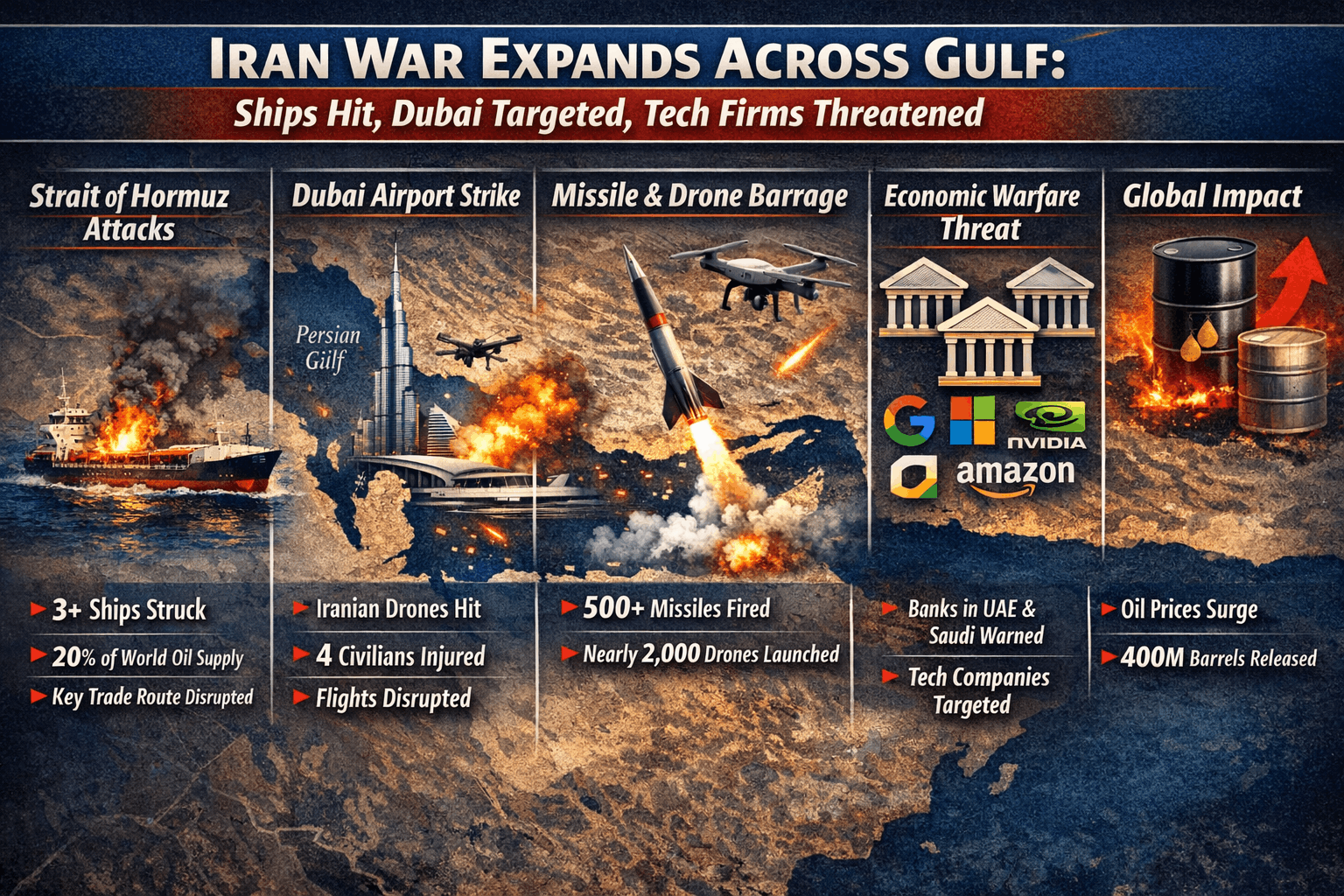
Recent events have included drone attacks near Dubai International Airport and strikes on cargo ships in the Persian Gulf. Tehran has warned that banks and major American tech companies, like Google and Microsoft, could be legitimate targets if the war escalates.
Commercial Ships Face Heightened Attacks
A number of commercial boats have been attacked by Iranian and allied troops in the Gulf area, especially in the strategically important Strait of Hormuz, a small waterway through which around 20% of the world’s oil supply flows.
Several members of the crew are either missing or wounded after three commercial ships, including a Thai bulk carrier, were reportedly hit near the strait.
Already, lives have been lost due to the maritime crisis:
- Attacks against tankers and marine infrastructure result in the deaths of eight seamen.
- Four or more oil tankers wrecked.
- Concerns over safety have caused a 70 percent decline in cargo transit via the channel of Hormuz, and more than 150 ships are now waiting outside the channel.
- In anticipation of potential more drone or missile attacks, international maritime companies have halted operations in the area.
Near Dubai Airport, Drones Land
Iranian drones attacked locations near Dubai’s primary airport, which is a very concerning trend.
A foreign individual was among four persons injured when two drones went down near the world’s biggest international airport, Dubai International Airport. Operations continued despite a temporary interruption to flights due to increased security measures.
The strike showed that Iran was prepared to attack important economic and transportation infrastructure in Gulf governments that were allies of the united governments.
Iran’s Danger to Financial Institutions and Economic Networks
Banks and financial institutions tied to the US and Israel throughout the Gulf might become targets, according to Iranian officials affiliated to the military.
According to reports, a spokesman associated with the Iranian military stated:
“Now that the door is open, the enemy can launch attacks on American and Zionist-affiliated financial institutions and economic hubs.”
A number of Gulf nations’ financial districts have been placed on high alert as a result of the threat, including the UAE, Qatar, and Saudi Arabia.
Tech Companies like Google, Microsoft, and Others Sought as Possible Victims
The war is spreading to other arenas, including the internet and the economy. Major American technology corporations with Middle Eastern operations and their infrastructure have been named as possible targets by Iranian state-linked media.
Reportedly included among the firms are:
- Microsoft
- Amazon
- Nvidia
The Iranian government has said that these businesses are involved in assisting Israeli intelligence and military activities in the area, although they have failed to provide any concrete proof of this.
Instead of physically attacking targets, security experts fear that Tehran may try to disrupt banking networks, cloud infrastructure, or data centers via cyber attacks.
U.S. and Israeli Attacks on Iran
Operation Lion’s Roar, a joint U.S.-Israeli operation that started on February 28, 2026, and targeted Iranian nuclear facilities and military installations, was the impetus for the present conflict.
Important parts of the process comprised:
- Strikes against military installations in Tehran and nearby cities by air and missile
- Threats against Islamic Revolutionary Guard Corps (IRGC) command and security facilities
- Damage or destruction to many locations of vital infrastructure
Iranian reprisals since the conflict’s inception have encompassed:
- 189 nuclear-armed missiles
- There were 941 drone assaults.
- The United States has launched three cruise missiles at the Gulf States and other regional targets.
Regional Deaths and Property Devastation
Significant human and economic costs have already been suffered by the increasing conflict:
Emirate of Dubai
- Six people tragically perished
- 122 people hurt
- Devastating damage to infrastructure in Palm Jumeirah and other parts of Dubai
Maritime Sector
- Transportation Industry
- Tragic loss of life among eight sailors
- Numerous tankers sunk
- Hormuz was a major bottleneck for cargo transit
Markets for Energy
Concerns over a possible interruption in oil supplies caused prices to skyrocket, with a barrel reaching a high of almost $126.
The International Energy Agency (IEA) declared an unprecedented withdrawal of 400 million barrels of oil from strategic reserves in an effort to stabilize markets.
Future Prospects
The expanding conflict may indicate a change in focus from open military combat to economic warfare and the destruction of global supply chains.
The policy that Iran is pursuing is shown by its targeting of maritime channels, Gulf infrastructure, and Western firms.
Altering the distribution of energy around the world
Making it more expensive for U.S. allies
Taking the fight to the financial and cyber realms
A wider global economic and cyber war might break out quickly, according to analysts, if assaults on multinational digital infrastructure or banks take place.







