


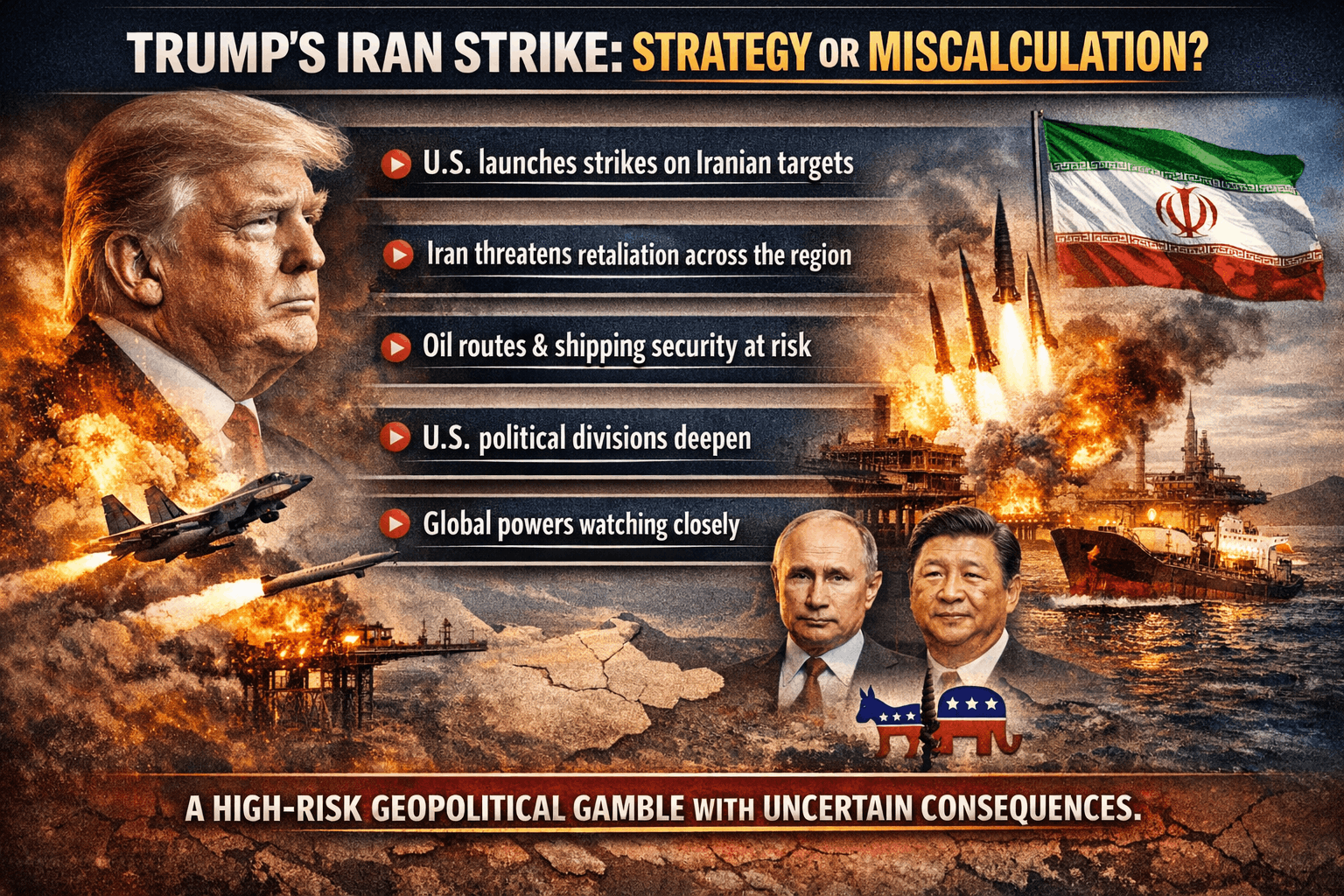
Rochester, NY: One of the most significant foreign-policy decisions of US President Donald Trump was his authorization of military operations against Iran. The limited military action that was initiated with the intention of weakening Iranian capabilities rapidly escalated into a more extensive regional conflict that encompassed missile exchanges, maritime disruptions, and escalating geopolitical tension throughout the Middle East.
The episode has incited a fervent debate in Washington and beyond: Did the Trump administration underestimate the repercussions of an attack on Iran? Or were the administration’s actions driven by structural pressures within the U.S. security establishment, regardless of the political risks?
This analysis investigates the strategic assumptions that underpinned the strike, the unforeseen obstacles that transpired, and the potential political repercussions for Trump’s future.
The Strike’s Strategic Assumptions
When authorizing the strikes, the Trump administration appeared to be operating under a number of critical assumptions:
1. Iran’s Retaliation Is Limited
A fundamental assumption was that Iran’s response would be primarily symbolic and restricted. In previous U.S. confrontations with Tehran, similar assumptions had been used to guide escalation, which frequently halted short of a full-scale conflict.
Nevertheless, the actuality was quite different. Iran responded by conducting drone and missile attacks in numerous countries, which aimed to disrupt regional shipping routes and target regional assets. The Gulf and beyond were rendered unstable by the escalation.
2. Military pressure would necessitate negotiations
Another expectation was that targeted strikes could compel Tehran to make concessions regarding its nuclear and regional policies.
Nevertheless, analysts caution that external assaults frequently have the opposite effect, namely, strengthening domestic unity within the targeted states rather than undermining them..
3. Regional Allies Would Completely Align
Additionally, it appeared that Washington believed that regional partners would be adequately prepared for the repercussions. However, several Gulf States reportedly expressed frustration that they had not been adequately informed prior to the assaults, which left them vulnerable to retaliation.
These developments indicate that strategic planning may have underestimated the broader regional repercussions and Iran’s response capability.
The Political Repercussions of Domestic Events in the United States
Sharp divisions within the United States have also resulted from the Iran assaults.
Reactionary reaction from Congress
The missions were launched without appropriate congressional authorization, which reignited long-standing debates about presidential war powers, according to a number of legislators.
The action was criticized by a few members of Congress from both parties as potentially unconstitutional and hazardous, as it could potentially lead the United States into another extended Middle East conflict.
Divisions within the political constituency of Trump
The criticism from segments of Trump’s own political coalition is perhaps more startling.
Trump’s ascent to power was partially facilitated by his pledge to put an end to the “endless wars” in the Middle East. Consequently, certain conservative commentators and activists perceived the Iran strike as incompatible with that assurance and expressed concern regarding the security of U.S. forces stationed throughout the region.
This internal debate underscores a more extensive tension within American politics: the need to reconcile public fatigue over extended overseas conflicts with interventionist national security policies.
Strategic Implications beyond the Battlefield
The strike has had a far-reaching impact that extends beyond military calculations.
1. Uncertainty regarding the global
Volatility in energy markets and international trade routes was precipitated by disruptions in the Strait of Hormuz and concerns regarding a broader conflict.
2. Alliance strain
The absence of prior consultation with certain Gulf allies raised concerns regarding Washington’s coordination with regional partners.
3. Possibility for rival powers
Global competitors, including Vladimir Putin and Xi Jinping, may indirectly benefit from the escalation in the Middle East, as they may acquire diplomatic leverage as the United States becomes increasingly entangled in regional conflicts.
Leadership Failure or Influence from the “Deep State”?
In political discourse, some supporters of Trump contend that the escalation is a result of the pressure exerted by the “deep state,” which is entrenched national security institutions. Presidents are restricted by intelligence agencies, military leadership, and geopolitical alliances that drive them toward intervention, according to this argument.
Nevertheless, this framing is contested by a significant number of analysts.
Institutional reality
While the military and U.S. intelligence agencies offer strategic assessments, the president ultimately has the authority to authorize military operations.
Accountability in politics
Consequently, the administration’s decision remains a political one, despite the existence of institutional pressures.
The majority of scholars contend that the Iran strike should be interpreted as a complex policy decision that was influenced by competing pressures, rather than as a conspiracy of concealed actors.
- strategy of deterrence
- alliance obligations
- calculations regarding domestic politics
- evaluations of intelligence
Political Consequences for Trump’s Future
The long-term political repercussions of the Iran conflict will likely be contingent upon the course of events.
Scenario 1: Rapid strategic triumph
Trump could portray the operation as a demonstration of decisive leadership if the strikes substantially impair Iran’s military capabilities without inciting a protracted conflict.
Scenario 2: Extended regional conflict
The political cost could increase significantly if the confrontation escalates or results in sustained U.S. military involvement. Historically, American voters have been opposed to conflicts that appear to be unresolved or lacking in a distinct purpose.
Scenario 3: Debate regarding party realignment
The episode may exacerbate a more extensive debate within the Republican Party regarding the future of U.S. foreign policy, which is currently divided between interventionist conservatives and the more isolationist faction that contributed to Trump’s initial political ascent.
Last thoughts
The consequences of military decisions frequently extend beyond the battlefield, as evidenced by the U.S. assaults on Iran. Despite the fact that the Trump administration likely believed it could manage escalation and compel strategic concessions from Tehran, the subsequent retaliation and geopolitical turbulence indicate that the risks may have been substantially underestimated.
Whether this episode ultimately results in a strategic success, a costly miscalculation, or merely another chapter in the protracted U.S.–Iran conflict will be contingent upon the course of the conflict in the months ahead.
The political implications are equally significant for Trump. The Iran decision has the potential to either solidify his reputation as a decisive leader or intensify discussions regarding the expenses of military intervention in a time when many Americans are apprehensive about the prospect of new conflicts.







