


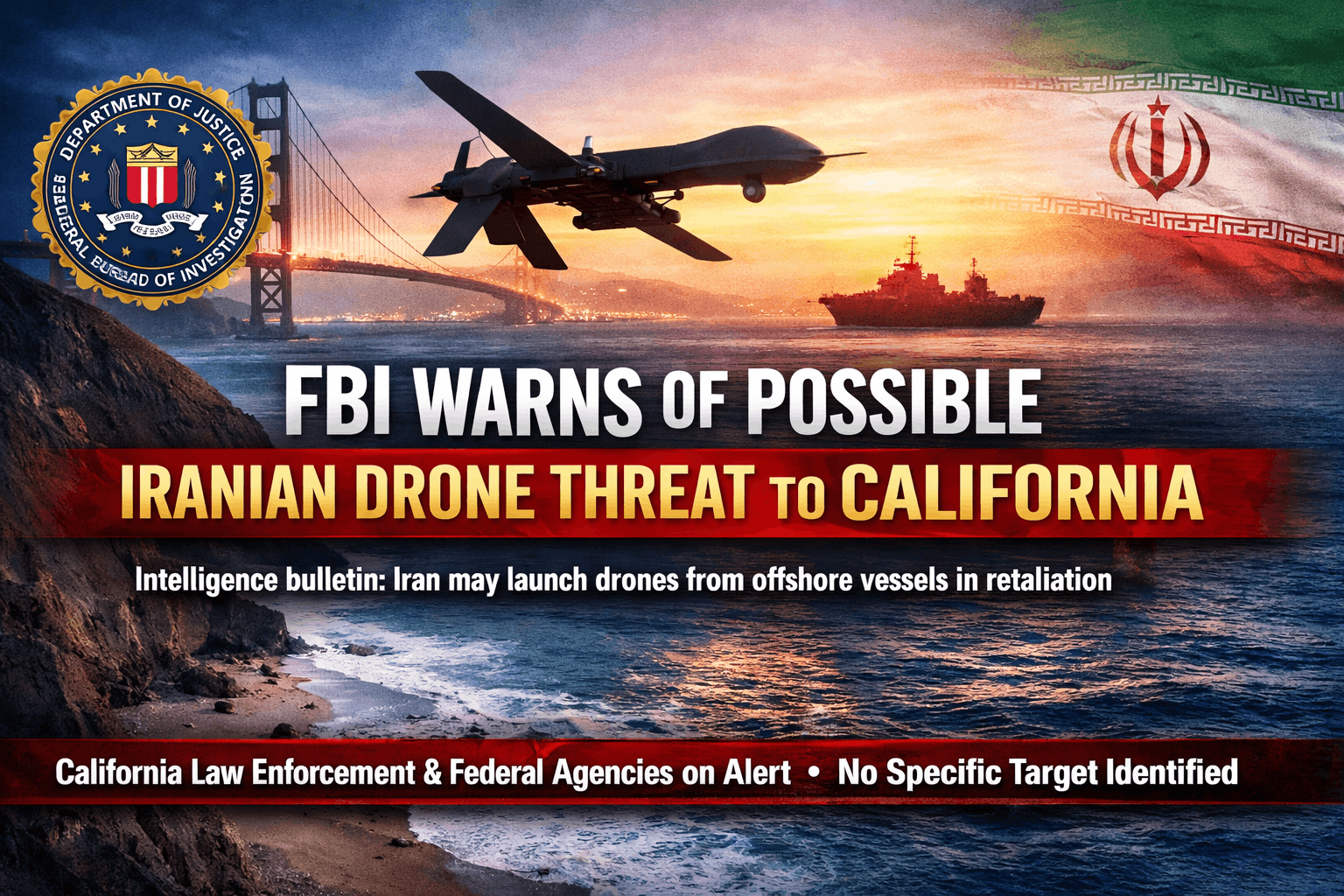
Rochester, NY/Los Angeles, CA: The Federal Bureau of Investigation (FBI) has issued a security bulletin warning U.S. law-enforcement agencies that Iran could attempt a retaliatory drone strike against targets along the American West Coast, particularly in California, amid the escalating conflict between Washington and Tehran.
According to a federal alert circulated to police departments and security agencies, U.S. intelligence recently obtained information suggesting Tehran may have considered launching unmanned aerial vehicles (UAVs) from an offshore vessel positioned off the U.S. coastline if the United States carried out military strikes against Iran.
The bulletin reportedly stated:
“We recently acquired information that as of early February 2026, Iran allegedly aspired to conduct a surprise attack using unmanned aerial vehicles from an unidentified vessel off the coast of the United States homeland, specifically against unspecified targets in California.”
The alert added that authorities do not currently have specific information regarding timing, targets, or perpetrators, but warned that the scenario should be considered in preparedness planning.
California Authorities and Police Agencies Placed on Alert
Following the FBI memo, multiple California law-enforcement agencies and emergency management officials were notified through federal counter-terrorism networks, including the Joint Terrorism Task Force (JTTF).
The office of Gavin Newsom, governor of California, confirmed that state authorities were reviewing the intelligence and coordinating with federal agencies.
Newsom said state security officials were evaluating contingency plans and maintaining communication with Washington.
“It’s all about a posture of preparedness for the worst-case scenario,” Newsom said while discussing coordination between state and federal security agencies.
Despite the warning, California officials emphasized that no imminent threat has been identified.
A spokesperson for California’s Office of Emergency Services said the state is “prepared to protect its communities” and continues to share intelligence with federal partners including the FBI.
Local leaders have also acknowledged the alert. Daniel Lurie, mayor of San Francisco, stated that city officials were monitoring the situation closely and coordinating with federal security authorities.
FBI Response and Official Silence
While the alert circulated among law-enforcement partners, FBI regional offices have declined to publicly confirm details of the intelligence.
Cameron Polan, a spokesperson for the FBI’s San Francisco field office, said the agency would not comment on the report, reflecting the bureau’s policy on sensitive intelligence bulletins.
Similarly, the FBI’s Sacramento office stated it would “neither confirm nor deny” the existence of the warning.
Such internal bulletins are common within U.S. counter-terrorism networks and are often issued when fragmentary or unverified intelligence emerges, allowing law-enforcement agencies to increase vigilance without signaling an immediate threat.
Strategic Context: Rising U.S.–Iran Conflict
The security warning comes amid an expanding regional conflict between the United States, Israel and Iran that erupted in late February 2026 after U.S.-Israeli strikes on Iranian targets.
Iran has since conducted missile and drone strikes across the Middle East, targeting U.S. and allied positions. In Bahrain alone, Iranian attacks involved dozens of missiles and drones, damaging infrastructure and injuring civilians.
The conflict has also triggered wider geopolitical tensions and disruptions in global energy markets around the Strait of Hormuz, a critical oil shipping route.
Security analysts say that if Tehran were to retaliate against the U.S. homeland, drone attacks launched from covert maritime platforms or proxy networks would be among the most plausible methods.
Why Drones Pose a Growing Homeland Security Concern
Counter-terrorism experts note that low-cost drones have become a central tool in Iran’s asymmetric warfare strategy.
Iran and its allied groups have widely used UAVs in conflicts across the Middle East, including attacks on shipping lanes and military installations.
Several factors make drones a potential threat to the U.S. homeland:
Low detection profile: Small drones can evade traditional radar systems.
Maritime launch capability: UAVs could theoretically be launched from civilian vessels offshore.
Proxy networks: Iran has historically relied on non-state actors to conduct operations abroad.
However, U.S. homeland defense systems—including coastal radar, maritime patrol aircraft, and integrated air defense networks—make a successful attack extremely difficult.
Federal and State Security Posture
Despite the alarm generated by the FBI memo, officials across multiple agencies stress that the warning should not be interpreted as evidence of a planned or imminent attack.
Federal authorities say the alert is part of routine intelligence sharing designed to ensure that state and local law enforcement remain vigilant during periods of geopolitical crisis.
Still, the development underscores a key concern for U.S. security planners: the possibility that future conflicts with state adversaries could extend beyond overseas battlefields to the American homeland.







