


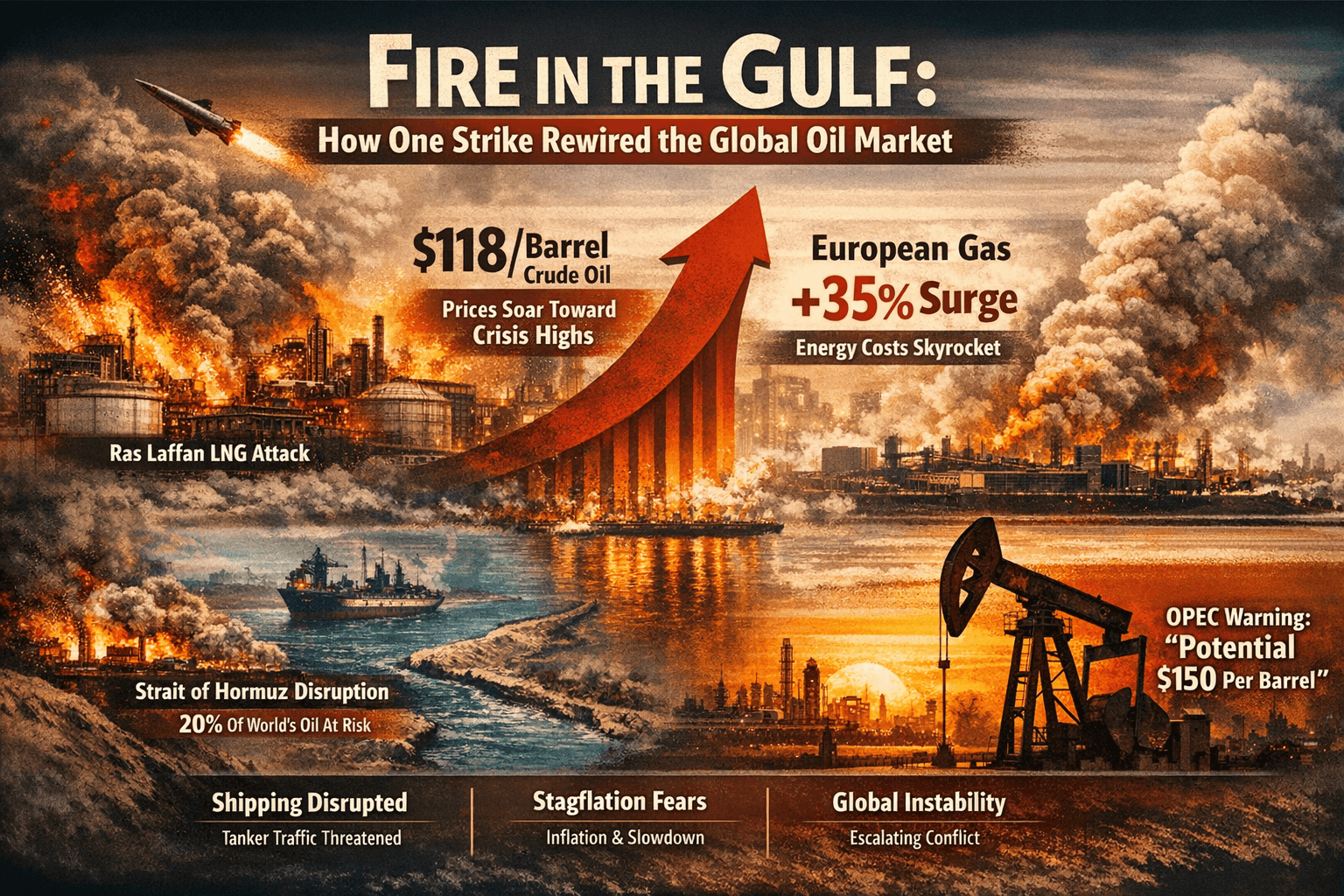
Rochester, NY: The global oil market has entered one of its most volatile phases in decades, triggered not by gradual supply-demand imbalances but by a sudden geopolitical rupture. The Iranian strike on Qatar’s Ras Laffan complex—the world’s largest LNG export hub—has done more than disrupt gas flows; it has fundamentally altered expectations about energy security.
European gas prices surged by as much as 35% within hours, while crude oil climbed toward $114–$118 per barrel, extending a rally that has already added nearly 60% since the outbreak of war in late February 2026.
This is not merely a price spike—it is a re-pricing of risk across the entire energy complex. Markets are now factoring in prolonged infrastructure damage, supply chain fragmentation, and the weaponization of energy assets in ways not seen since the 1970s oil crisis.
The LNG Shock That Reshaped Oil Expectations
The immediate trigger of this turmoil lies in the scale of disruption to Qatar’s LNG capacity. The Ras Laffan facility alone accounts for a significant share of global liquefied natural gas supply, and early assessments suggest that up to 17% of Qatar’s exports could be offline for years, not months.
Qatar Energy CEO Saad al-Kaabi warned that repairs could take three to five years, underscoring the structural nature of the shock rather than a temporary outage. His earlier warning that prolonged conflict could “bring down economies of the world” now appears less like rhetoric and more like a baseline scenario.
For oil markets, the implications are immediate. Gas shortages in Europe and Asia are forcing a substitution effect, with utilities and industries turning back to crude-derived fuels. This dynamic alone is pushing additional demand into an already constrained oil system.
Strait of Hormuz: The Chokepoint That Defines the Crisis
Overlaying the LNG shock is the growing instability in the Strait of Hormuz, through which roughly 20% of global oil supply normally flows. Disruptions in tanker traffic, attacks on merchant vessels, and the effective militarization of the corridor have turned a logistical artery into a geopolitical fault line.
Shipping activity has already dropped sharply, with dozens of vessels idling outside the strait. Even partial closures are enough to tighten global supply, pushing traders to price in worst-case scenarios—namely a sustained blockade.
Energy analysts are increasingly warning that if Hormuz flows are curtailed for weeks rather than days, oil could surge toward $150 per barrel, a level already being discussed in financial markets.
Oil Majors and Market Sentiment: A Shift toward Crisis Mode
Executives across the energy industry are signaling a shift from cautious optimism to outright concern. The shutdown of key facilities, including Shell-linked operations in Qatar, has reinforced the vulnerability of even the most sophisticated energy infrastructure.
Major oil companies are quietly recalibrating their outlooks. Traders at global firms are increasing hedging activity, while upstream producers are preparing for extended periods of elevated prices. The consensus emerging from industry voices is clear: this is not a short-lived spike but the beginning of a structurally tighter market.
At the same time, OPEC producers—particularly Saudi Arabia and the UAE—face a paradox. While higher prices boost revenues, their own infrastructure has come under attack, limiting their ability to stabilize markets.
Europe at the Epicenter of Demand Shock
Europe’s energy vulnerability has once again been exposed. Despite diversification efforts after the Russia-Ukraine war, the continent still relies heavily on LNG imports, with Qatar playing a central role.
The 35% surge in gas prices is not just a headline figure—it is a signal of deep structural fragility. Storage levels remain relatively low after winter, and competition from Asian buyers is intensifying.
European Central Bank officials have already warned that energy-driven inflation could push euro zone inflation back toward 4%, complicating monetary policy and delaying any hopes of rate cuts.
Political Leadership and Strategic Narratives
Global leaders are framing the crisis in stark terms. Western governments, including the United States under Donald Trump, have warned of severe retaliation if attacks on energy infrastructure continue, signaling the risk of further escalation.
European leaders such as Emmanuel Macron have called for an immediate halt to strikes on energy facilities, recognizing that the targeting of such infrastructure represents a dangerous escalation from conventional warfare into economic warfare.
Meanwhile, central banks and international institutions are increasingly aligned in their warnings: this crisis carries the hallmarks of stagflation—high energy prices coupled with slowing growth.
A Market Rewritten by Geopolitics
What distinguishes this crisis from previous oil shocks is the simultaneous disruption of both oil and gas systems. Historically, markets could absorb shocks in one segment by leaning on the other. Today, both are under pressure.
The destruction of production capacity, combined with shipping disruptions and geopolitical uncertainty, has created a feedback loop of volatility. Oil is no longer priced solely on supply-demand fundamentals but on the probability of further escalation.
In effect, the global oil market has transitioned into a geopolitical market. Prices now reflect not just barrels available, but missiles launched, straits threatened, and infrastructure destroyed.
Conclusion: The Dawn of a New Energy Order
The surge in European gas prices following Iran’s strike is not an isolated event—it is a defining moment in the evolution of global energy markets. The era of relatively predictable supply chains and stable pricing mechanisms is giving way to one of chronic instability.
If current trends persist, the world may be entering a prolonged period of elevated oil prices, structural supply constraints, and geopolitical risk premiums embedded into every barrel traded.
In this new reality, energy is no longer just a commodity—it is a strategic weapon, and the global oil market is its battlefield.







