


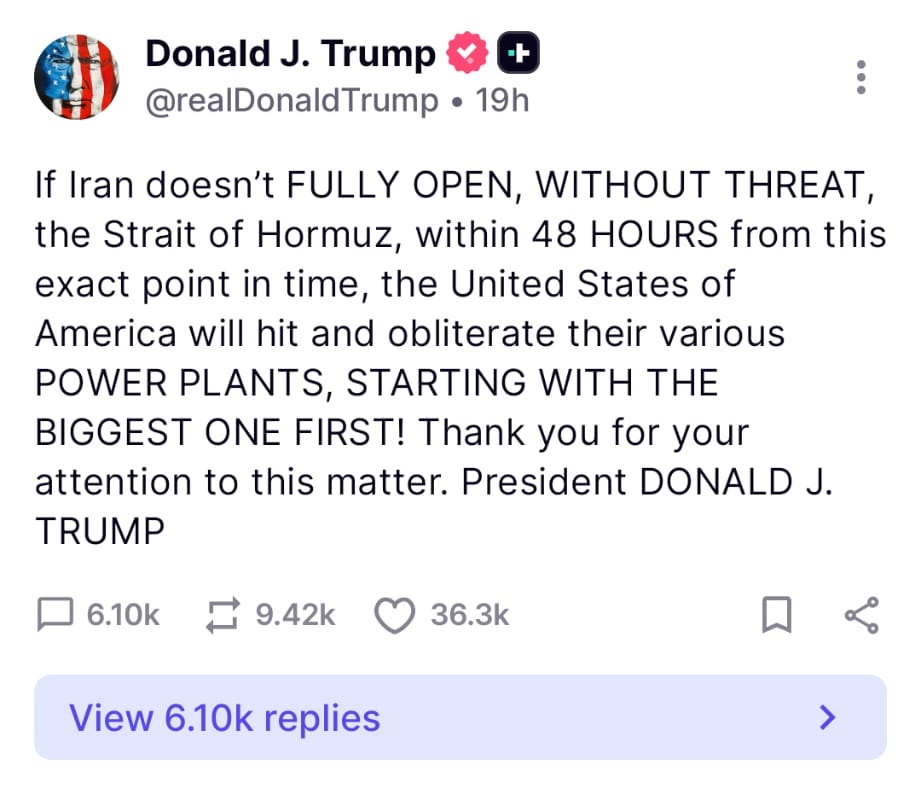
Rochester, NY/Washington, D.C: : The latest escalation in the ongoing U.S.–Iran war has entered a decisive and deeply volatile phase after Donald Trump issued a stark 48-hour ultimatum demanding that Iran reopen the Strait of Hormuz. The warning—threatening to “obliterate” Iran’s power plants—signals a sharp shift from conventional military pressure toward targeting critical national infrastructure. This moment represents more than a tactical escalation; it reflects a transformation of the conflict into one where economic paralysis and systemic disruption are now central objectives.
Strait of Hormuz: the World’s Most Dangerous Chokepoint
At the heart of this confrontation lies the Strait of Hormuz, one of the most strategically vital chokepoints in the global energy system. Nearly one-fifth of the world’s oil supply and a substantial portion of liquefied natural gas shipments pass through this narrow corridor. Iran’s recent restrictions on maritime traffic have triggered immediate shockwaves across global markets. Shipping activity has slowed dramatically, insurance premiums have surged, and oil prices have spiked amid fears of prolonged disruption. The 48-hour deadline has intensified uncertainty, turning an already fragile situation into a high-risk countdown.
Washington’s Strategy: Coercion through Infrastructure Targeting
Washington’s threat to strike Iranian power plants reflects a calculated doctrine of coercive pressure. By targeting the country’s electricity grid, the United States aims to undermine Iran’s military-industrial capacity while simultaneously creating domestic instability. Such strikes would affect civilian life, disrupt industrial production, and weaken governance structures. This approach marks a departure from traditional battlefield engagements, signaling a strategy designed to force rapid compliance by inflicting systemic internal costs.
Tehran’s Calculated Response and Asymmetric Doctrine
Tehran is not treating the ultimatum as symbolic rhetoric. Iranian leadership is assessing the threat through a framework shaped by decades of asymmetric warfare and strategic endurance. Officials have warned that any attack on Iran’s energy infrastructure would trigger a broad and potentially uncontrollable retaliation across the region. This could include strikes on oil facilities, shipping routes, and critical infrastructure in neighboring states. Iran’s approach is rooted in deterrence through escalation, ensuring that any attack on its territory results in consequences that extend far beyond its borders.
Controlled Disruption: Iran’s Measured Use of Leverage
At the same time, Iran appears to be pursuing a calibrated strategy rather than an all-out blockade. By selectively allowing certain vessels to pass while restricting others, Tehran maintains pressure without fully crossing into a complete shutdown of the strait. This nuanced approach allows Iran to preserve strategic ambiguity, avoiding an immediate large-scale military response while still leveraging its geographic advantage. It also provides Tehran with a narrative of defensive action, aimed at maintaining some degree of international legitimacy.
Global Powers on Edge: Divisions and Diplomatic Strain
The international community is increasingly alarmed by the rapid deterioration of the situation. Major European powers, including France, United Kingdom, and Germany, are evaluating maritime security responses, including naval deployments and coordinated escort missions. However, divisions persist over how aggressively to confront Iran. While some allies align closely with Washington’s hardline stance, others advocate restraint, fearing that escalation could spiral into a full-scale regional war.
Humanitarian and Environmental Risks Intensify
Beyond the geopolitical calculations, the crisis carries significant humanitarian and environmental risks. Targeting power infrastructure could lead to widespread civilian hardship, particularly in urban areas dependent on stable electricity supplies. Furthermore, the proximity of military operations to sensitive industrial and nuclear facilities raises concerns about long-term environmental damage. Any large-scale disruption in energy infrastructure could trigger cascading effects, including water shortages and healthcare system breakdowns.
Global Economic Shockwaves and Energy Market Turmoil
The economic consequences are already unfolding at a rapid pace. The disruption of shipping through the Strait of Hormuz has created bottlenecks in global supply chains, affecting not only oil but also a wide range of goods. Energy-importing nations are facing rising costs and potential shortages, while inflationary pressures are beginning to build across global markets. Fuel prices are climbing, transportation costs are increasing, and industries reliant on stable energy supplies are experiencing uncertainty.
Energy markets are undergoing what analysts describe as a structural shock rather than a temporary spike. The combination of physical supply disruption and geopolitical uncertainty has introduced a sustained risk premium into oil and gas prices. Liquefied natural gas markets are tightening, and alternative supply routes are struggling to compensate for reduced flows through the Gulf. Strategic reserves may provide short-term relief, but they are not a long-term solution to sustained instability.
A High-Stakes Equilibrium and the Risk of Miscalculation
From a strategic perspective, the ultimatum reflects a broader shift in U.S. policy toward compellence—forcing immediate behavioral change through credible threats. However, this approach assumes that Iran will prioritize economic survival over strategic resistance, an assumption that remains uncertain. Tehran’s history suggests a willingness to endure economic hardship while maintaining its geopolitical stance.
What is emerging is a fragile and dangerous equilibrium. The United States wields overwhelming military power and the ability to target critical infrastructure, while Iran holds the capacity to disrupt a vital artery of the global economy. Both sides possess escalation tools that extend beyond conventional warfare, increasing the likelihood of miscalculation.
The Countdown to a Defining Moment
As the 48-hour deadline approaches, the world is witnessing a moment of intense geopolitical brinkmanship centered on one of the most critical waterways on the planet. Whether this confrontation leads to limited military strikes, negotiated de-escalation, or a broader regional conflict will shape not only the future of the Middle East but also the stability of global energy systems and the wider economic order.







