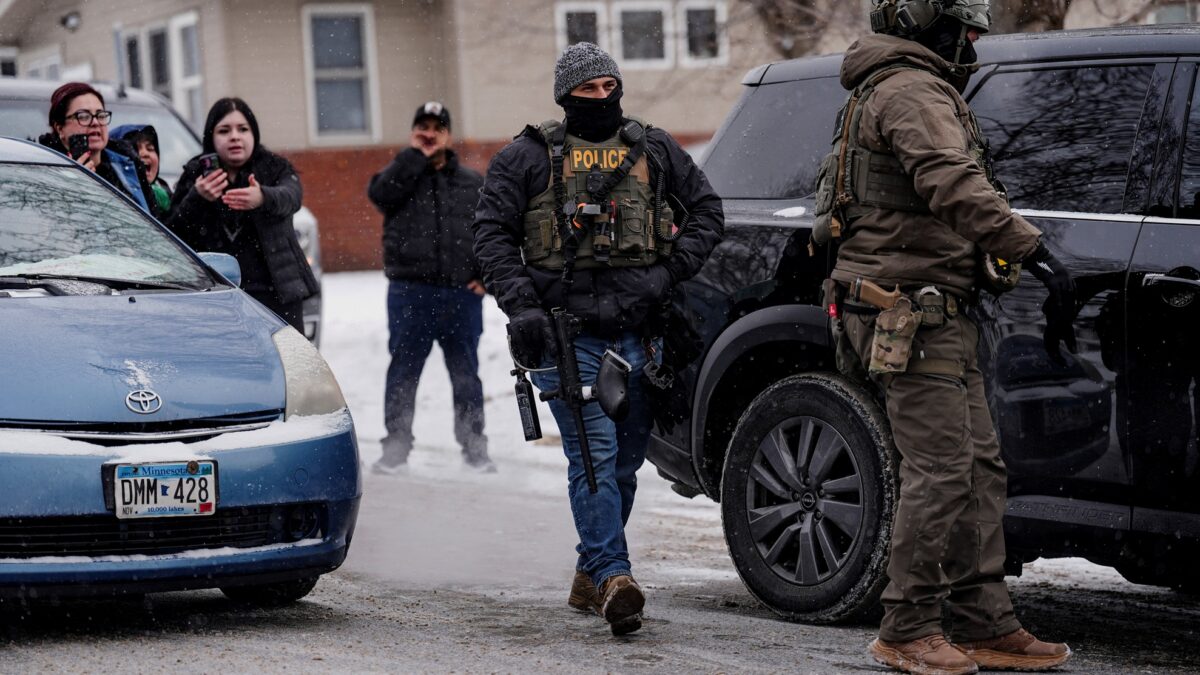
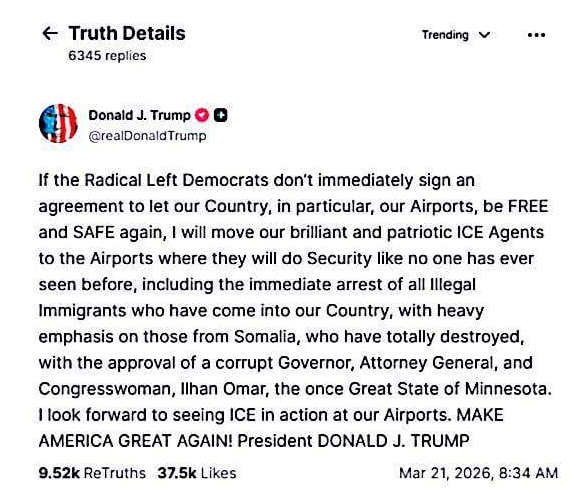
Rochester, NY/Washington, D.C: Donald Trump’s declaration that Immigration and Customs Enforcement (ICE) personnel would be deployed at U.S. airports starting Monday signifies a significant increase in both immigration enforcement and internal security policies.
The decision comes during a lengthy government shutdown that has crippled the Transportation Security Administration, resulting in thousands of underpaid agents and serious personnel shortages.
Airport terminals in major cities have witnessed hours-long wait waits, with whole checkpoints shutting owing to absence.
To cover operational shortfalls, the administration has resorted to ICE, which has historically been in charge of immigration enforcement and deportation.
While authorities claim that ICE will not undertake screening operations, the president’s language implies a larger mission, including the identification and arrest of illegal migrants on airport grounds.
This combination of immigration enforcement with normal airport security marks an unprecedented duty overlap, posing basic concerns about civil rights, operational competency, and political purpose.
Impact on ordinary Americans and travelers
The ordinary American citizen’s instant reaction to ICE deployment is likely to be a combination of relief and concern.
On the one hand, more people might shorten lines and restore some efficiency to airport operations damaged by the closure. On the other hand, the presence of an enforcement agency associated with arrests and raids adds a further layer of concern to an already stressful situation.
Air travel in the United States has long been managed by uniform, predictable processes overseen by the Transportation Security Administration.
The presence of ICE agents, who are not trained specifically for passenger screening, risks blurring these lines. Critics claim that this might result in uneven enforcement procedures, confusion at checkpoints, and possible profiling situations.
For many residents, especially those from minority groups, the psychological effect might be considerable. Airports, which were formerly thought to be neutral travel zones, may now seem more like places of police enforcement inspection.
Immigrants versus Non-Immigrants: A Culture of Fear
The ruling has even more serious ramifications for both legal and undocumented immigrants, as well as international tourists. Although ICE’s presence at airports is not new in terms of technology, its enlarged and very visible function changes the environment into one of increased monitoring.
The president’s statements hinting that agents would arrest “all illegal immigrants” have heightened anxiety in immigrant communities.
Undocumented people may now face detention even while traveling domestically. Legal immigrants and visa holders are more concerned about misidentification, bureaucratic problems, or harsh interrogation than about arrest.
This environment is exacerbated by previous enforcement operations like as “Operation Salvo” and “Operation Midway Blitz,” which greatly increased ICE involvement in metropolitan areas and resulted in massive arrests and demonstrations.
These tactics, along with high-profile events, such as an ICE agent fatally shooting a US citizen, have already damaged public faith in the organization.
For overseas passengers, the sight of highly armed immigration inspectors at airports may harm the United States’ image as an open and inviting place.
Political Reactions: Sharp Partisan Divide
The political reaction to Trump’s decision has been quick and divisive. Republican leaders have mostly justified the action as a necessary and pragmatic solution to a crisis caused by the budget standoff. The administration claims that Democrats’ failure to approve financing for the Department of Homeland Security necessitated extreme measures.
Trump himself framed the deployment in dramatic terms, stating that ICE will assist TSA officials and accusing “Radical Left Democrats” of jeopardizing national security by withholding funding.
Democrats, on the other hand, have criticized the idea as irresponsible and hazardous. House Minority Leader Hakeem Jeffries cautioned that deploying “untrained ICE agents” at airports might endanger people and exacerbate tensions.
Other Democratic members have called for measures such as stronger monitoring, court warrants for enforcement activities, and better identity of federal agents.
The disagreement underscores a larger ideological divide: Republicans prioritize law enforcement and border security, while Democrats prioritize civil liberties and accountability.
ICE’s troubled history and public perception
To completely comprehend the public response, it is necessary to review ICE’s previous history. Established in 2003 under the Department of Homeland Security, the agency has become one of the most contentious branches of federal law enforcement.
Under Trump’s second term, ICE activities have grown substantially, frequently using coercive techniques. Large-scale raids, detentions, and deportations have triggered protests in numerous states, including major rallies in Minnesota and statewide strikes asking for the agency’s dissolution.
The death of people during law enforcement operations, as well as charges of racial profiling, have further harmed the agency’s credibility. Polls show a deepening public division, with many Americans concerned about ICE’s practices while others applaud its strict approach.
This backdrop explains why the mere presence of ICE officers, even in a support capacity, may instill widespread anxiety among ordinary individuals.
Kristi Noem’s Factor and Policy Turbulence
The scandal also has implications for Kristi Noem’s political career, since she played a key role in growing ICE operations via harsh enforcement techniques. During her tenure, large crackdowns were launched, and the approach to immigration control became more military.
Her exit from office, which came amid rising criticism of these policies and their results, has added another layer of uncertainty. While the government continues to pursue similar policies, the leadership transition reveals internal conflict and the political cost of such extreme actions.
A Nation at a Crossroad
The deployment of ICE at airports is more than just a technical solution to a staffing shortage; it illustrates how profoundly immigration enforcement has infiltrated daily American life. Airports, previously shielded from larger political battles, are now front-line sites in the country’s immigration debate.
For some Americans, this is a vital expression of law and order. Others see it as a deterioration of civic standards and a hazardous extension of police authorities into public settings.
As the strategy goes into action, its true impact will be measured not only in shorter security lines or more arrests, but also in how it reshapes public trust, civil rights, and the lived experience of millions of people who travel through America’s airports.