


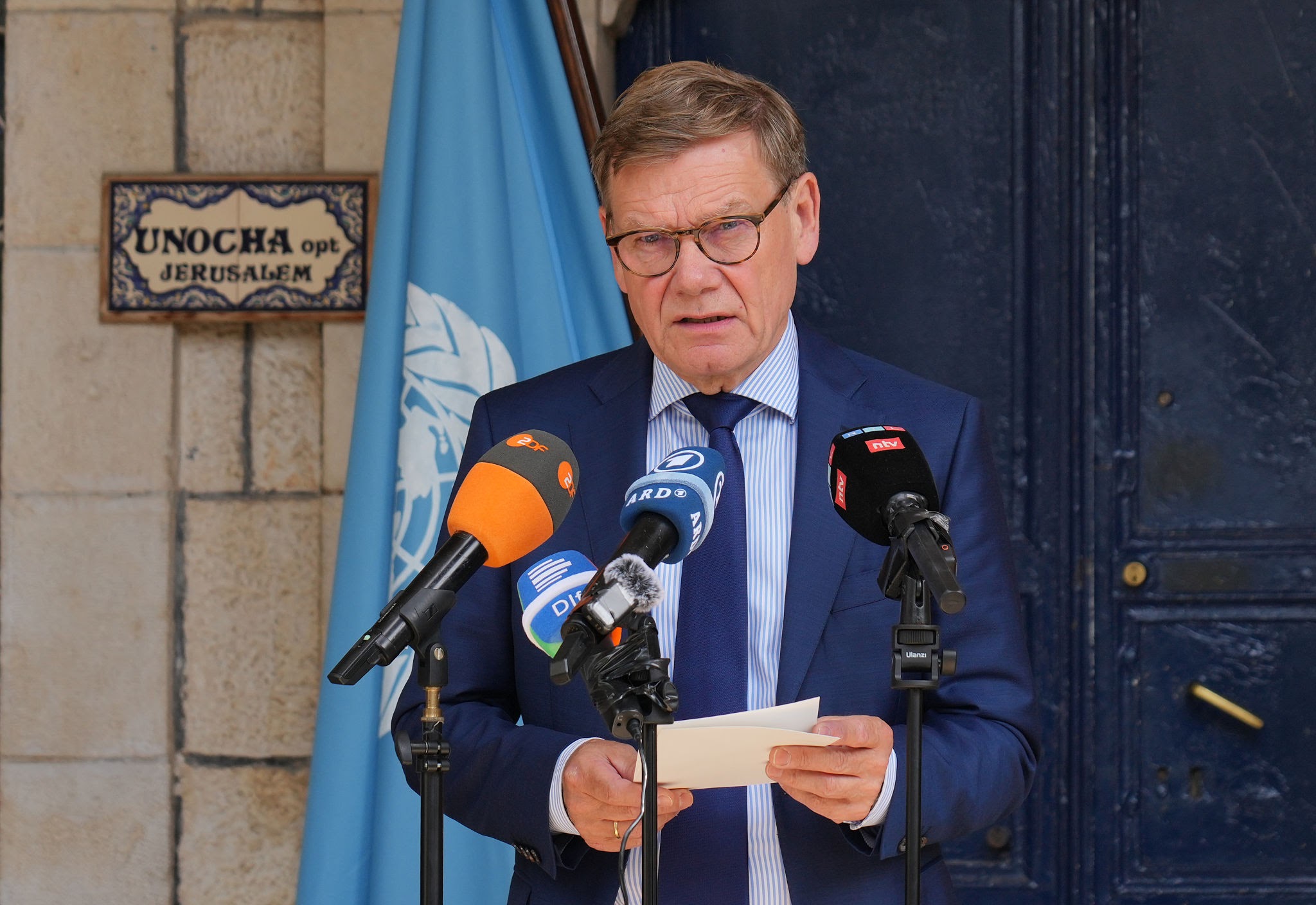
Berlin, Germany: In a moment that underscores the widening strategic divide across the Atlantic, Germany’s foreign minister Johann Wadephul has reportedly refused to support a U.S.-led military confrontation with Iran under Donald Trump.
The decision is not merely a diplomatic disagreement—it represents a calculated assertion of European autonomy in matters of war, peace, and global stability.
From Berlin’s perspective, the risks of escalation in the Gulf far outweigh any immediate strategic gains. Germany, long committed to diplomacy-first engagement with Tehran, views military intervention as a trigger for regional destabilization, energy disruption, and potential spillover into Europe itself.
The refusal signals a deliberate effort to avoid being drawn into a conflict that European policymakers increasingly see as driven by U.S. unilateralism rather than collective Western consensus.
A Blow to U.S. Strategic Leverage
For Washington, Germany’s stance complicates the broader architecture of coalition-building that has historically underpinned American military interventions. The United States has long relied on European allies—especially Germany, a central player in both the European Union and NATO—to legitimize and operationalized its global security agenda.
Berlin’s refusal weakens the perception of Western unity, a critical component of U.S. deterrence strategy. Without strong European backing, any potential U.S. action against Iran risks appearing isolated, potentially emboldening adversaries such as Tehran while complicating diplomatic messaging to allies in the Middle East and Asia.
Moreover, Germany’s decision may encourage other European states to adopt similar positions, thereby limiting Washington’s ability to present a unified Western front. This fragmentation could reduce the effectiveness of sanctions regimes, intelligence sharing, and coordinated military planning.
Europe’s Strategic Autonomy Comes into Focus
Germany’s stance is emblematic of a broader shift within Europe toward what policymakers call “strategic autonomy.” This concept, increasingly discussed within EU institutions, reflects a desire to reduce reliance on the United States for security decisions and to pursue independent foreign policy objectives.
European leaders have grown wary of being entangled in conflicts that directly impact their economic and security environments without sufficient input. The memory of past interventions—particularly those that led to prolonged instability in the Middle East—continue to shape European caution.
For Europe, the Iran question is not abstract. Any escalation threatens vital energy routes, including the Strait of Hormuz, and risks triggering refugee flows and economic shocks that disproportionately affect European economies. Germany’s refusal can therefore be seen not as defiance, but as a pragmatic recalibration of national and regional interests.
NATO under Strain
The implications for NATO are profound. The alliance, built on the principle of collective defense and shared strategic vision, faces increasing difficulty reconciling divergent threat perceptions among its members.
While the United States continues to view Iran as a central security challenge, many European nations prioritize stability, diplomacy, and economic continuity. This divergence raises fundamental questions about NATO’s future role: Is it a global intervention force aligned with U.S. priorities, or a defensive alliance focused on Euro-Atlantic security?
Germany’s decision highlights the risk of NATO evolving into a two-speed alliance, where political unity masks operational fragmentation. If key members refuse to participate in major U.S.-led initiatives, the alliance’s credibility and cohesion could erode over time.
The Future of U.S.-EU Relations
The transatlantic relationship is unlikely to collapse under the weight of this disagreement, but it is undeniably entering a more transactional and less predictable phase. The era of automatic European alignment with U.S. foreign policy appears to be fading.
For the European Union, Germany’s stance may serve as a rallying point for greater internal cohesion on foreign policy. For the United States, it presents a strategic dilemma: adapt to a more independent Europe or risk further alienation of key allies.
At the same time, both sides remain deeply interconnected through trade, intelligence cooperation, and shared democratic values. This interdependence will likely prevent a complete rupture, but it will not eliminate friction.
A Turning Point in the Western Alliance
Germany’s refusal to join a potential U.S.-Iran conflict is more than a policy disagreement—it is a signal of a shifting global order. The balance of influence within the Western alliance is changing, with Europe asserting a stronger voice and the United States facing new limits to its leadership.
For NATO, for the European Union, and for Washington, the challenge now lies in redefining cooperation in an era where unity can no longer be assumed. The outcome of this recalibration will shape not only the future of transatlantic relations but also the broader dynamics of global power in the years ahead.







