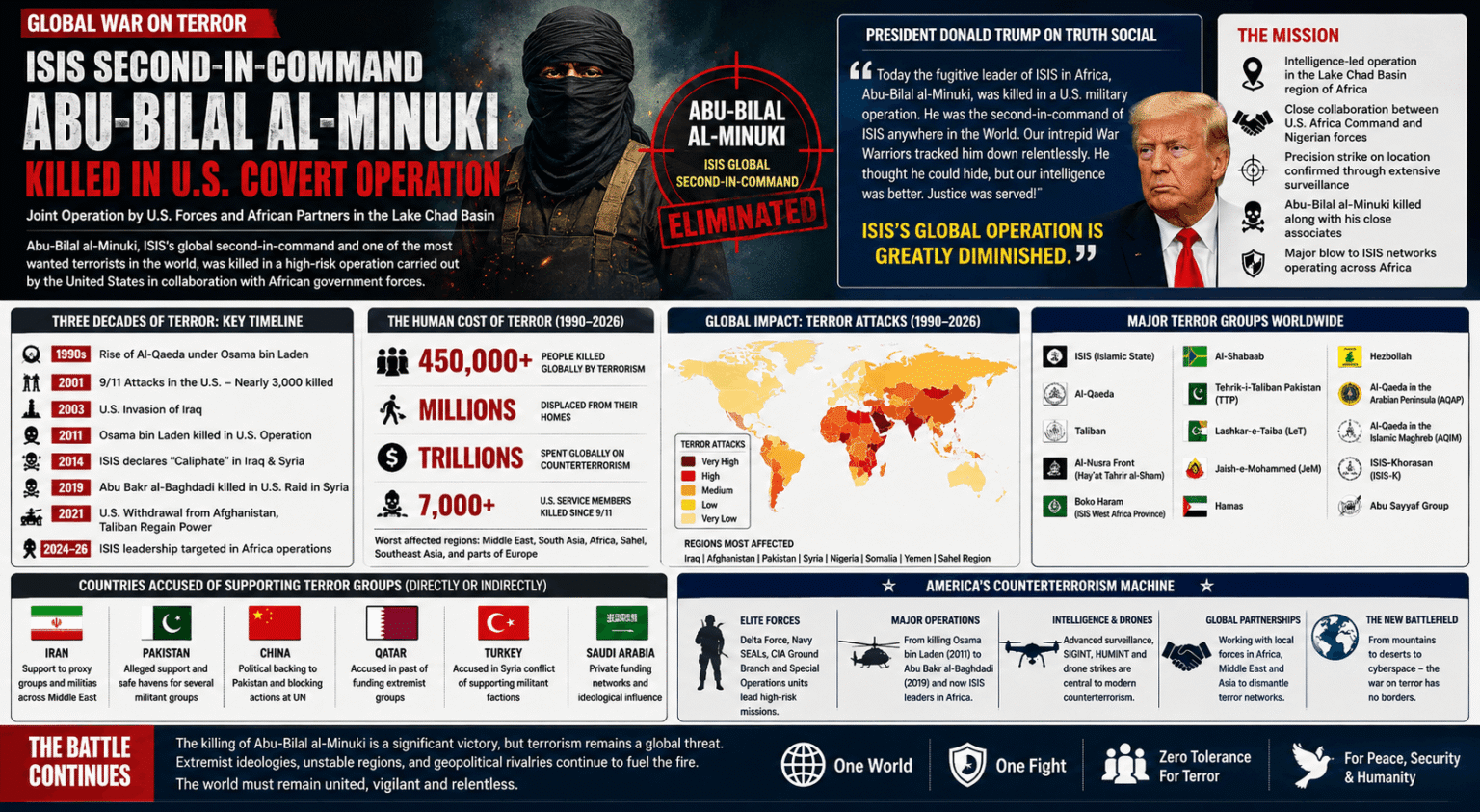
Rochester, NY: The killing of ISIS global second-in-command Abu-Bilal al-Minuki in a covert joint operation by United States and Nigerian forces marks another dramatic chapter in the international campaign against transnational terrorism.
According to reports from American and Nigerian officials, the operation was carried out in the Lake Chad Basin region after extensive intelligence surveillance and coordination between U.S. Africa Command and Nigerian security forces.
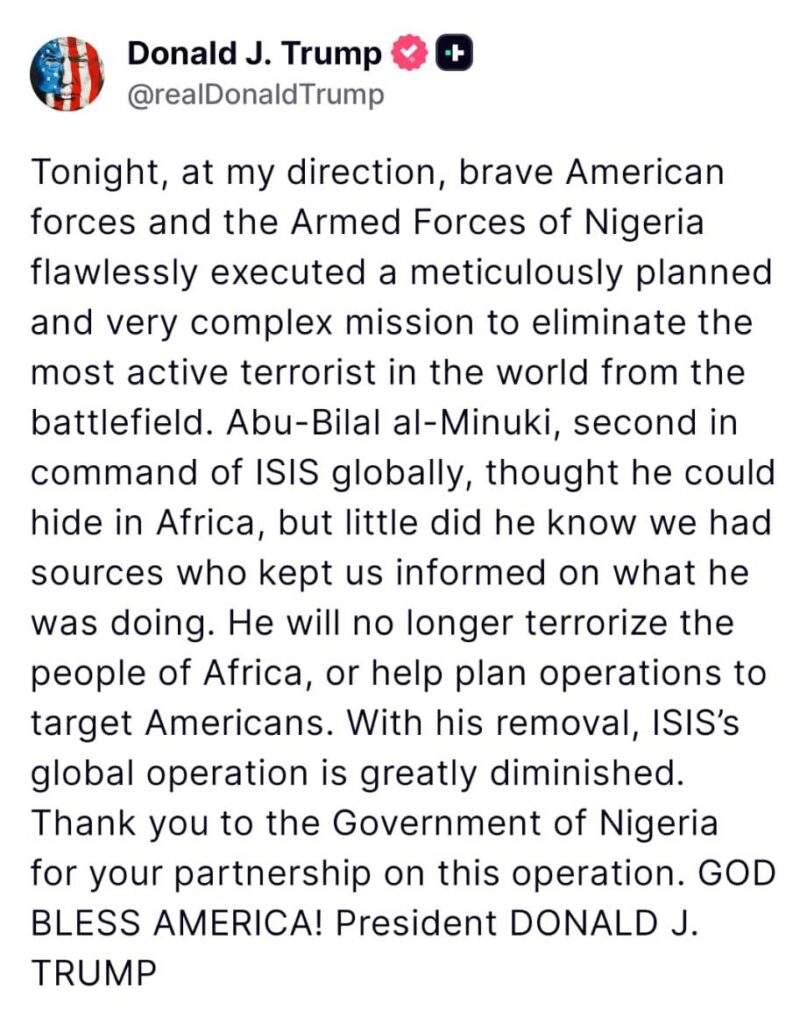
President Donald Trump described the mission as a “meticulously planned and very complex mission” on Truth Social, adding that al-Minuki “thought he could hide in Africa” but American intelligence sources tracked his movements closely. Trump further claimed that “ISIS’s global operation is greatly diminished” following the strike.
The operation reflects how the battlefield against extremist organizations has shifted from the mountains of Afghanistan and deserts of Iraq and Syria to the unstable regions of Africa’s Sahel, Nigeria, Somalia, and the Lake Chad Basin.
Although Washington declared victory against ISIS years ago after the collapse of its so-called caliphate in Iraq and Syria, the ideology and operational networks of extremist organizations survived through regional affiliates and sleeper cells.
From Al-Qaeda to ISIS: The Evolution of Global Terror Networks
The modern era of international terrorism accelerated with the rise of Al-Qaeda under Osama bin Laden during the late 1980s after the Soviet-Afghan war. What began as a militant network evolved into a transnational ideological movement that carried out attacks across the Middle East, Africa, Europe, South Asia, and the United States?
The September 11, 2001 attacks in New York and Washington changed global security doctrine permanently, killing nearly 3,000 people and triggering the U.S.-led “War on Terror.”
Following the American invasion of Afghanistan, Al-Qaeda fragmented into regional franchises. Yet the vacuum created by wars in Iraq and Syria gave birth to Islamic State, which became even more brutal and media-driven than its predecessor.
Under Abu Bakr al-Baghdadi, ISIS declared a caliphate in 2014, controlling large territories across Iraq and Syria before eventually losing its territorial dominance through multinational military operations.
At the same time, other militant organizations continued operating under different names and regional banners. Taliban regained control of Afghanistan after the withdrawal of U.S. forces in 2021, while Al-Nusra-Front transformed into newer Syrian militant factions.
Meanwhile, groups such as Boko Haram, ISIS-West Africa Province, Al-Shabaab, Tehrik-i-Taliban Pakistan, Lashkar-e-Taiba, Jaish-e-Mohammed, Hamas, Hezbollah, and Al-Qaeda in the Arabian Peninsula, Al-Qaeda in the Islamic Maghreb, ISIS-Khorasan, Abu Sayyaf, and numerous regional offshoots continued to destabilize fragile states through insurgencies, suicide bombings, kidnappings, and sectarian warfare.
Three Decades of Terror: Death and Destruction
Over the last three decades, terrorism has claimed hundreds of thousands of lives globally.
According to international security databases and counterterrorism studies, more than 450,000 people have been killed in terrorist incidents worldwide since the early 1990s, while millions have been displaced.
Iraq, Afghanistan, Syria, Pakistan, Nigeria, Somalia, Yemen, and parts of the Sahel region became epicenters of militant violence.
The United States alone spent trillions of dollars on military campaigns in Afghanistan, Iraq, Syria, and broader counterterrorism operations. Tens of thousands of American troops were deployed over two decades, while more than 7,000 U.S. service members died in post-9/11 conflicts.
Civilian casualties in conflict zones reached staggering levels, especially in Iraq and Syria where ISIS massacres, sectarian killings, and coalition airstrikes devastated entire communities.
Nigeria’s northeastern regions became another symbol of prolonged extremist violence. Boko Haram and ISIS-West Africa Province carried out massacres, school kidnappings, attacks on churches and mosques, and assaults on military installations.
Somalia continued facing attacks from Al-Shabaab, while Afghanistan endured continuous suicide bombings under Taliban-era instability and ISIS-K activities.
The Question of State Sponsors and Strategic Rivalries
One of the most controversial dimensions of the global terror debate remains the accusation that some states indirectly enabled militant organizations for geopolitical influence.
Western intelligence agencies and regional governments have repeatedly accused countries such as Iran of supporting armed proxy groups across the Middle East, particularly Hezbollah and allied militias in Iraq and Syria.
Pakistan has historically faced allegations from India, Afghanistan, and some Western analysts regarding militant sanctuaries operating near border regions, though Islamabad consistently rejected accusations and itself suffered massive casualties from terrorism.
Similarly, Gulf States were criticized in earlier decades for private funding channels that allegedly reached extremist organizations in Syria and Afghanistan.
The Syrian civil war became a complex battleground where multiple regional and international powers backed competing armed factions, allowing extremist networks to thrive amid chaos.
These geopolitical rivalries transformed terrorism from a purely security issue into a strategic instrument within broader regional conflicts.
Intelligence operations, covert funding allegations, proxy warfare, and ideological radicalization all contributed to the survival of militant ecosystems despite repeated military defeats.
America’s Special Operations Doctrine
The United States reshaped modern counterterrorism through elite special operations campaigns. Missions carried out by Joint Special Operations Command, Navy SEAL Team Six, Delta Force, CIA paramilitary units, and drone warfare programs became central to Washington’s strategy.
The 2011 operation that killed Osama bin Laden in Abbottabad, Pakistan, and the 2019 raid that eliminated Abu Bakr al-Baghdadi in Syria demonstrated America’s ability to conduct precision intelligence-based missions deep inside hostile territory.
The Baghdadi operation involved helicopters, Delta Force operators, drones, and extensive intelligence coordination.
Recent operations in Africa indicate that U.S. strategy is increasingly focused on preventing extremist groups from rebuilding territorial safe havens. The strike against Abu-Bilal al-Minuki follows earlier U.S. operations in Somalia and the Sahel targeting ISIS facilitators and Al-Shabaab commanders.
Terrorism without Borders
Despite the deaths of senior leaders, extremist organizations continue adapting. ISIS no longer operates like a traditional state but functions as a decentralized global insurgency with franchises across Africa and Asia.
Al-Qaeda survives through ideological affiliates, while Taliban-controlled Afghanistan remains under intense international scrutiny over militant sanctuaries.
The elimination of Abu-Bilal al-Minuki represents a tactical success for Washington and its African partners, but it also highlights an uncomfortable reality: after nearly three decades of war, terrorism has not been fully defeated. Instead, it has evolved into a borderless network capable of regenerating in weak states, conflict zones, and regions suffering from poverty, corruption, sectarianism, and political instability.
The global counterterrorism campaign has removed many notorious figures, dismantled training camps, and prevented large-scale attacks, yet the persistence of extremist ideology suggests that military victories alone cannot end the cycle.
The battlefield now extends beyond conventional warfare into intelligence operations, cyber propaganda, economic instability, and ideological radicalization.
For the United States and its allies, the killing of ISIS’s second-in-command is a reminder that the “War on Terror” never truly ended; it simply entered a more fragmented, unpredictable, and globalized phase.