


New York City, NY: Since the outbreak of direct military confrontation between the United States and Iran earlier this year, global financial markets have been moving in tandem with every missile strike, diplomatic signal, and development around the Strait of Hormuz.
Investors across New York, London, Frankfurt, Tokyo, Shanghai, and the Gulf have increasingly treated the Middle East conflict not merely as a regional security crisis but as a direct threat to global energy supplies, inflation, economic growth, and corporate profitability.
The immediate reaction was predictable but severe. Stock markets sold off sharply as traders rushed toward safe-haven assets such as gold, government bonds, and defensive sectors.
Energy markets experienced the most dramatic response, with Brent crude and WTI prices surging as fears mounted that oil shipments through the Strait of Hormuz could be disrupted.
Nearly one-fifth of global oil trade normally passes through the strategic waterway, making any threat to shipping a matter of global economic concern.
Wall Street’s Initial Shock
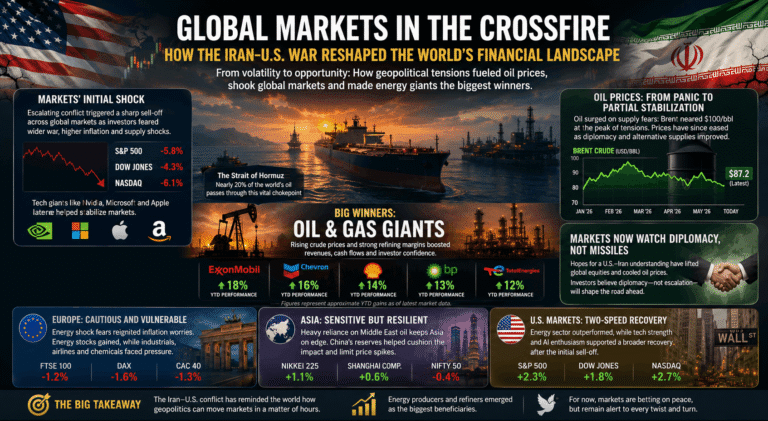
The first weeks of the conflict triggered heavy volatility on Wall Street. Major indices including the S&P 500, NASDAQ, and Dow Jones suffered significant losses as investors feared a broader regional war and higher inflation caused by rising energy prices.
At one point, hundreds of billions of dollars in market value were wiped out as traders reacted to escalating military exchanges and uncertainty surrounding U.S. policy.
However, unlike previous geopolitical crises, technology giants such as Nvidia, Microsoft, Apple, and Amazon eventually helped stabilize broader U.S. indices. Strong earnings and continued enthusiasm around artificial intelligence partially offset concerns over energy-driven inflation.
This created a two-speed market: technology stocks remained relatively resilient while sectors exposed to transportation, travel, manufacturing, and consumer spending faced increased pressure.
Energy Stocks Become the Biggest Winners
While many sectors struggled, oil and gas companies emerged as the clear winners of the conflict.
Major U.S. energy giants such as ExxonMobil and Chevron saw investors pour money into their shares as oil prices climbed. Rising crude prices translated into expectations of stronger revenues, improved cash flow, and larger shareholder returns through dividends and buybacks.
Analysts reported that the energy sector became the best-performing segment of the S&P 500 during much of the conflict period.
The war premium embedded in oil prices significantly boosted sentiment toward producers, refiners, and pipeline operators. Investors viewed energy companies as one of the few sectors capable of directly benefiting from geopolitical instability.
At the same time, refiners gained from widening margins as fuel prices rose globally. Demand for diesel, jet fuel, and refined petroleum products increased in many markets seeking alternatives to disrupted Middle Eastern supplies.
The U.S. became an increasingly important exporter of refined products, strengthening the outlook for American refiners.
Europe Faces a Difficult Balancing Act
European markets experienced a more complicated reaction.
Europe remains highly vulnerable to energy shocks following years of supply disruptions linked to the Russia–Ukraine conflict.
As tensions in the Gulf intensified, European investors worried about rising oil and LNG costs, which threatened to reignite inflation just as central banks were beginning to regain control over price pressures.
Major European indices such as the FTSE 100, DAX, and CAC 40 experienced repeated bouts of volatility. Energy companies benefited, but industrial manufacturers, airlines, transportation firms, and chemical producers faced higher operating costs.
European gas prices also surged as traders factored in potential supply disruptions from the Gulf region.
The European market’s greatest fear has been a prolonged closure or restriction of the Strait of Hormuz, which could significantly increase import costs and weaken already fragile economic growth.
Asian Markets and the Oil Dependency Problem
Asian stock markets reacted even more sensitively because the region imports vast amounts of Middle Eastern energy.
Countries such as China, Japan, South Korea, and India closely monitor developments in the Gulf because disruptions directly affect industrial production and transportation costs.
Japanese refiners reportedly sought access to strategic reserves while governments across Asia explored alternative supply routes to reduce dependence on Hormuz traffic.
Chinese markets displayed relative resilience due to strategic stockpiles and lower-than-expected oil demand. Analysts suggest China’s large reserves helped moderate global price spikes and reduced some of the pressure that many traders had expected from a prolonged conflict.
Despite these buffers, investor sentiment across Asia remained highly sensitive to developments involving Iran, the United States, and Gulf shipping routes.
Oil Prices: From Panic to Partial Stabilization
The defining economic story of the conflict has been oil.
During periods of heightened tension, Brent crude repeatedly surged as traders priced in the possibility of major supply disruptions. Some analysts warned that prices could move well above $100 per barrel if Hormuz remained restricted for an extended period.
Yet the market also demonstrated remarkable resilience. Increased production elsewhere, strategic reserve releases, alternative shipping arrangements, and signs of diplomatic engagement prevented the worst-case scenarios from materializing.
As a result, oil prices have retreated from their conflict highs in recent weeks. Brent crude recently traded near $87 per barrel, while WTI crude moved closer to $85 per barrel after falling sharply from peak war-related levels.
This decline reflects growing expectations that negotiations between Washington and Tehran may eventually produce a framework capable of reducing regional tensions.
The Current Situation: Markets Watching Diplomacy More Than Missiles
The latest market trend suggests investors are increasingly responding to diplomatic signals rather than battlefield developments.
Recent reports that President Donald Trump may be pursuing a broader understanding with Iran have encouraged investors.
Global equities have generally recovered from their worst losses, while oil prices have softened as traders anticipate reduced risks to energy supplies.
Markets have repeatedly rallied whenever prospects for negotiations improved and sold off when talks appeared to stall.
This reflects a broader reality: investors now believe the future trajectory of global markets depends less on military operations and more on whether Washington and Tehran can establish a sustainable diplomatic arrangement.
Conclusion: Energy Giants Remain the Key Beneficiaries
The Iran–U.S. conflict has produced one of the most significant geopolitical market shocks of recent years. Global stock markets experienced intense volatility, inflation fears resurfaced, and investors reassessed the security of global energy supplies.
Yet amid the uncertainty, oil producers and refiners emerged as the principal beneficiaries.
Companies such as ExxonMobil, Chevron, and other major energy firms enjoyed stronger earnings expectations and investor demand as crude prices rose. Meanwhile, broader equity markets endured a prolonged period of uncertainty driven by fears of inflation, recession, and supply-chain disruption.
As of today, global markets are cautiously optimistic. Investors are betting that diplomacy will ultimately prevail over escalation.
However, the experience of the past months has demonstrated how quickly geopolitical tensions in the Gulf can reverberate through every major stock exchange, commodity market, and corporate balance sheet across the world.
Stay ahead of emerging trends and international developments with trusted reporting and analysis from The Variant. Simply click here!







