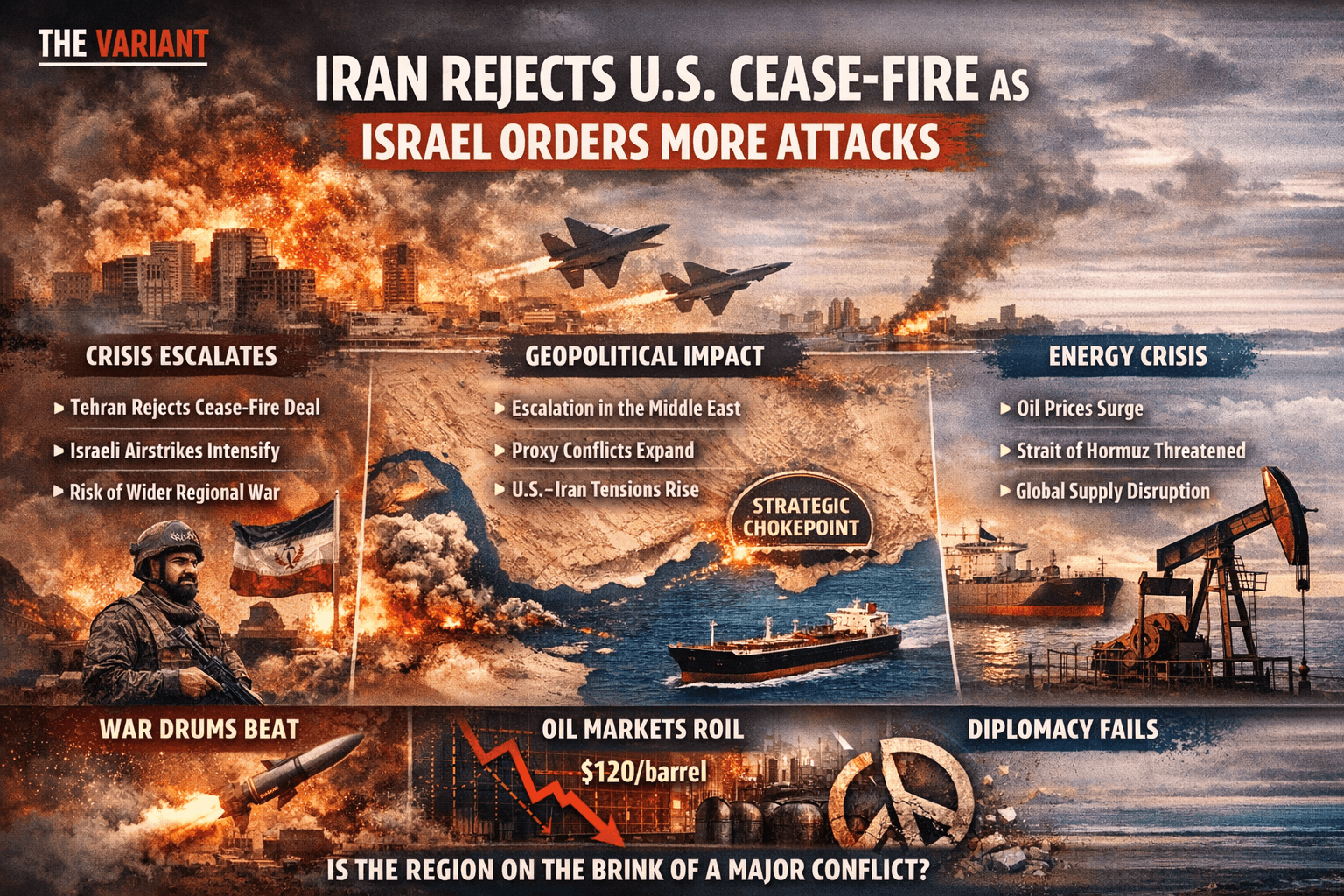
Diplomatic efforts falter amid mounting strikes, exposing the fragile balance between deterrence and full-scale war. Strategic calculations on all sides harden positions, raising the stakes for regional security and global energy flows.
The rejection of a U.S.-backed cease-fire proposal by Iran, coupled with intensified military operations ordered by Israel, marks a decisive shift in the trajectory of the ongoing confrontation.
What once appeared as a volatile but containable crisis is now evolving into a prolonged and deeply entrenched geopolitical conflict. The language of diplomacy, while still present in official statements, is increasingly overshadowed by the logic of escalation, deterrence, and strategic signaling.
A Calculated Rejection and the Politics of Defiance
Tehran’s dismissal of the cease-fire offer is less an impulsive act of defiance and more a reflection of calculated statecraft. For the Iranian leadership, accepting a cease-fire under current conditions would risk projecting weakness both domestically and regionally.
The influence of the Islamic Revolutionary Guard Corps has grown significantly in shaping Iran’s wartime posture, reinforcing a doctrine that prioritizes resistance over compromise. In this context, the refusal becomes a strategic message: Iran seeks not merely a pause in hostilities but a renegotiation of power dynamics in the region.
The United States, under Donald Trump, appears to have pursued the cease-fire as a means to contain escalation while preserving its broader strategic interests in the Gulf. However, Washington’s approach reveals a persistent miscalculation—an underestimation of Iran’s willingness to absorb economic and military pressure in pursuit of long-term leverage.
The absence of mutual trust, compounded by years of sanctions and diplomatic breakdowns, renders any immediate agreement fragile at best.
Israel’s Expanding Campaign and the Escalation Spiral
While diplomatic overtures falter, Israel’s decision to intensify its military campaign introduces a new layer of urgency and unpredictability. Israeli leadership appears convinced that sustained pressure is necessary to degrade Iran’s strategic capabilities and deter future threats.
Yet this approach risks creating a self-reinforcing cycle in which each strike invites retaliation, and each retaliation justifies further escalation.
The interplay between Israeli offensives and Iranian responses is gradually transforming the conflict into a broader regional confrontation. What began as targeted engagements increasingly resembles a shadow war breaking into the open, with implications that extend far beyond the immediate battlefield.
The possibility of miscalculation—an unintended strike triggering a wider war—looms large over every military decision.
An Uncertain Future for U.S.–Iran Relations
The future of the conflict between the United States and Iran now appears defined by ambiguity and instability. A direct, full-scale war remains unlikely due to the immense costs involved for both sides, yet the absence of a diplomatic breakthrough ensures that tensions will persist. The most probable trajectory is a prolonged hybrid conflict characterized by indirect engagements, proxy involvement, and periodic escalations.
In such a scenario, neither side achieves decisive victory. Instead, the conflict becomes a test of endurance, with economic resilience, regional alliances, and domestic political stability determining the balance of power.
Occasional attempts at negotiation may emerge, often mediated by regional actors, but these efforts are likely to produce only temporary de-escalation rather than lasting resolution.
The Global Energy Market on a Precipice
Perhaps the most immediate and far-reaching consequences of this confrontation are being felt in the global oil and gas economy.
The strategic significance of the Strait of Hormuz cannot be overstated. As one of the world’s most critical energy chokepoints, any disruption to its flow reverberates across international markets.
As tensions escalate, fears of supply disruptions have already begun to reshape energy pricing and trade patterns. Oil markets, highly sensitive to geopolitical risk, react swiftly to even the perception of instability in the Gulf.
A prolonged or intensified conflict could trigger price surges reminiscent of past energy crises, placing additional strain on economies already grappling with inflationary pressures.
The impact is uneven but universally significant. Energy-importing regions, particularly in Asia and parts of Europe, face the prospect of rising costs and supply uncertainty.
For the United States, increased domestic production offers some insulation, yet it cannot fully shield the economy from global market volatility. The interconnected nature of energy markets ensures that no major economy remains untouched.
A Crisis without a Clear Exit
What emerges from this unfolding situation is a conflict that resists easy resolution. Iran’s rejection of the cease-fire and Israel’s continued military actions reflect deeper structural tensions that cannot be addressed through short-term agreements alone.
The strategic objectives of the involved actors remain fundamentally misaligned, and the mechanisms for de-escalation appear increasingly fragile.
In this environment, the risk is not merely of continued conflict but of gradual normalization of instability. As hostilities persist, the international community may find itself adjusting to a new reality in which periodic crises in the Gulf become an enduring feature of global politics.
The consequences—economic, political, and strategic—will extend far beyond the region, shaping the contours of international relations for years to come.