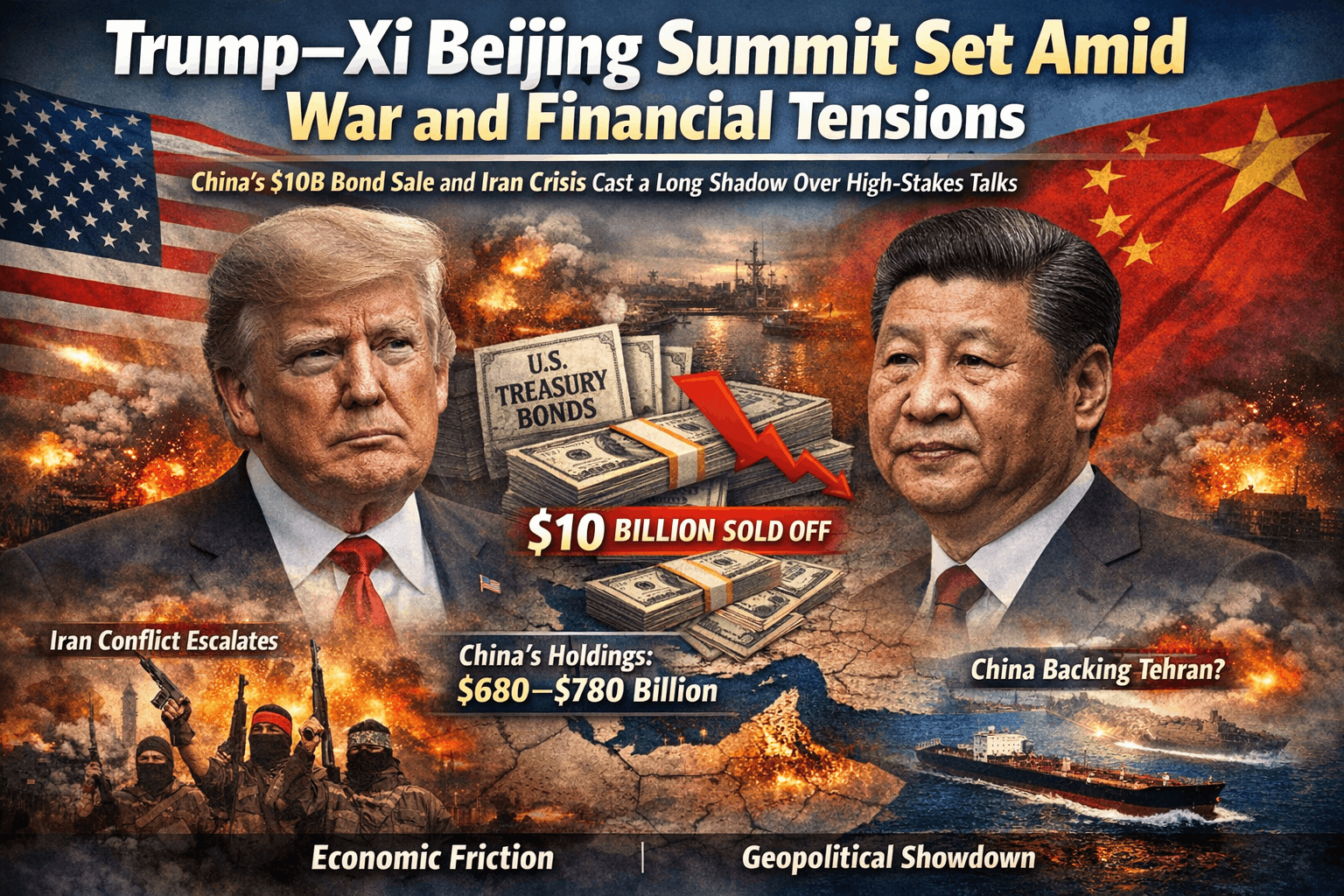
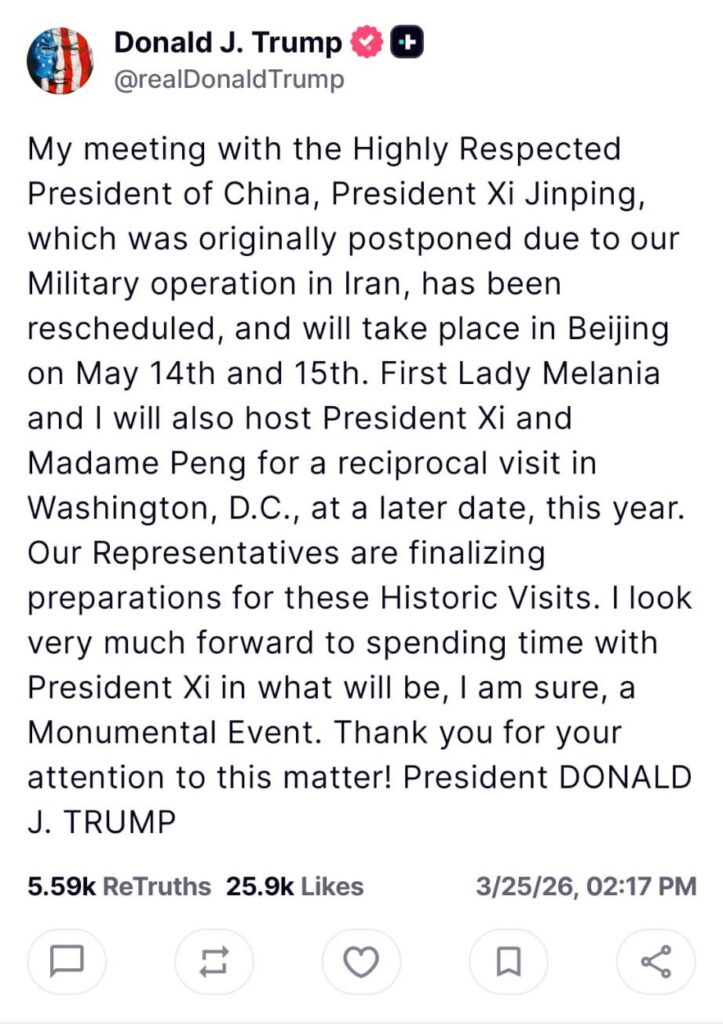
Rochester, NY/Washington, D.C/Beijing, China: The announcement that Donald Trump will meet Xi Jinping in Beijing on May 14–15 comes at a moment of extraordinary geopolitical strain, originally delayed due to the escalating war involving Iran, the rescheduling of this high-stakes summit signals not stability, but urgency.
Washington appears eager to re-engage Beijing diplomatically even as global tensions—from the Middle East to financial markets—continue to intensify.
According to official statements, the visit had been postponed as the United States focused on its military and strategic posture in the Iran conflict, yet the decision to fix new dates suggests that both powers recognize the need to prevent a broader systemic breakdown in U.S.–China relations.
China’s $10 Billion Bond Sale: A Threat, Not a Shock
At the center of economic tensions lies China’s reported sale of approximately $10 billion in U.S. Treasury bonds. While this figure may appear modest relative to the scale of global markets, its significance is largely symbolic and strategic.
China remains one of the largest holders of U.S. debt, with current holdings estimated around $680–$780 billion, though this figure has been steadily declining over recent years.
At its peak, China held well over $1 trillion in U.S. Treasuries, underscoring how deeply interdependent the two economies once were.
The recent sale must therefore be understood not as an isolated financial transaction, but as part of a broader pattern.
Beijing has been gradually reducing its exposure to U.S. debt, encouraging domestic institutions to diversify away from dollar-denominated assets and limit future purchases.
In this context, the $10 billion move serves as a calibrated signal—one that communicates strategic intent without triggering immediate market panic.
Impact on the U.S. Economy: Limited in the Short Term, Structural in the Long Term
In the immediate sense, a $10 billion sell-off is unlikely to destabilize the U.S. economy. The American Treasury market is vast, exceeding $30 trillion, and continues to attract strong global demand from other investors.
Even recent declines in Chinese holdings have not caused significant disruptions, as other countries and institutional buyers have stepped in to absorb supply.
However, the long-term implications are far more serious. A sustained reduction in Chinese participation could gradually push U.S. borrowing costs higher by increasing yields on Treasury bonds. This, in turn, would affect everything from mortgage rates to government deficit financing.
More importantly, the move reflects a deeper strategic shift. China’s efforts to internationalize its currency and reduce reliance on the U.S. dollar point toward a slow erosion of dollar dominance, rather than a sudden financial crisis.
The risk for Washington lies not in a single sale, but in a cumulative trend that reshapes global financial architecture over time.
Economic Interdependence under Strain
Despite these tensions, the U.S. and China remain economically intertwined. China’s holdings still represent a significant portion of foreign-owned U.S. debt, even if they account for only a small percentage of total U.S. liabilities.
Any aggressive liquidation by Beijing would also harm China itself by reducing the value of its remaining assets and strengthening its currency—an outcome it traditionally seeks to avoid.
This mutual vulnerability explains why financial confrontation between the two powers tends to remain measured. The bond market, for now, reflects this reality, showing resilience even amid geopolitical friction.
Middle East Crisis Overshadowing Global Diplomacy
The backdrop to the Trump–Xi meeting is the ongoing war involving Iran, which has already reshaped global priorities. The United States and Israel remain engaged in military operations, while Tehran continues to resist cease-fire efforts.
The conflict has disrupted key energy routes, particularly the Strait of Hormuz, intensifying fears of a global oil supply shock.
In this volatile environment, China’s role has come under increasing scrutiny. As a major importer of Iranian energy and a strategic partner of Tehran, Beijing is widely perceived—particularly in Western policy circles—as offering indirect support to Iran.
While China has not openly backed Iranian military actions, its diplomatic positioning and economic ties have fueled speculation that it seeks to counterbalance U.S. influence in the region.
China, Iran, and the Geopolitical Chessboard
The perception that China is backing Iran reflects a broader strategic alignment rather than a formal alliance. Beijing’s approach appears rooted in three objectives: securing energy supplies, expanding its influence in the Middle East, and challenging U.S. dominance without direct confrontation.
For Washington, this raises critical concerns. If China is seen as enabling Iran—economically or diplomatically—it complicates any effort to isolate Tehran.
At the same time, Beijing is unlikely to fully align itself with Iran in a way that risks direct conflict with the United States, preferring instead to operate within a space of strategic ambiguity.
A Summit Shaped by Crisis
The upcoming meeting in Beijing is therefore not just a diplomatic engagement; it is a convergence point for multiple global crises.
Trade tensions, financial competition, and the Middle East conflict are no longer separate issues—they are interconnected elements of a broader geopolitical struggle.
For Trump, the summit represents an opportunity to pressure China on both economic and security fronts, including its stance on Iran. For Xi, it is a chance to assert China’s role as a global power capable of influencing outcomes in both financial markets and regional conflicts.
Conclusion: Between Cooperation and Confrontation
As May 14–15 approaches, the Trump–Xi meeting carries the weight of a shifting world order. China’s gradual retreat from U.S. debt holdings, the intensifying Iran conflict, and the growing perception of geopolitical rivalry all point toward a future defined less by cooperation and more by strategic competition.
Yet, the very fact that both leaders are meeting suggests that neither side is ready for a complete rupture. Instead, the world may be entering a prolonged period of managed tension—where diplomacy continues, but trust remains elusive, and every economic or military move carries implications far beyond its immediate impact.