


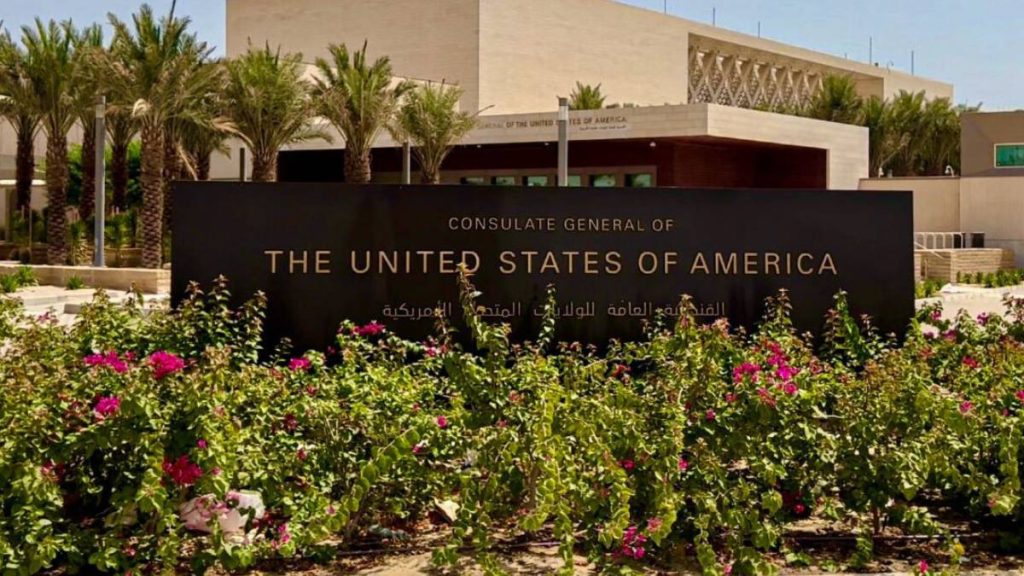
Rochester, NY/Riyadh, SA: Early on Tuesday, the diplomatic quarter of Riyadh, Saudi Arabia — home to embassies from across the world — was shaken by explosions as two unmanned aerial vehicles (drones) struck the United States Embassy compound.
According to a statement from the Saudi Ministry of Defense, the attack caused “limited fire and minor material damage,” but no injuries were reported because the embassy was not occupied at the time of the assault.
Saudi air defenses also intercepted additional UAVs over the city as part of what security officials described as a coordinated offensive.
This incident marks a significant escalation in a rapidly expanding regional conflict that began on February 28, 2026, after joint U.S.–Israeli military strikes on Iranian military sites and the reported killing of Iran’s Supreme Leader, Ayatollah Ali Khamenei, sparked Iran’s fiercest retaliation campaign in decades.
The U.S. diplomatic mission in Riyadh immediately issued a “shelter in place” advisory for Americans in Riyadh, Jeddah, and Dhahran, and restricted non-essential travel to military installations across the region.
Secretary of State Office later directed American citizens in multiple Middle Eastern nations — including Saudi Arabia — to prepare for possible evacuation amid the growing threat environment.
President Donald Trump, addressing the nation shortly after the attack, warned that “retaliation will come very soon” and hinted that the United States was considering a range of diplomatic and military options.
He stressed that Washington’s response would be measured yet decisive, emphasizing America’s commitment to defending its people and interests abroad. “We will do everything possible … and America will avenge their deaths and deliver the most punishing blow to the terrorists who have waged war against, basically, civilization,” Trump said in a prepared video message.
From Riyadh’s side, the Saudi government swiftly issued a strong condemnation of the strike, labeling it a “flagrant breach of international diplomatic norms” and an act that, if left unchecked, could further destabilize a region already teetering on the brink of broader war.
Saudi officials stopped short of explicitly naming Iran in their initial public statement, but their rhetoric made clear that they view the attack as part of Iran’s broader campaign of regional aggression.
The Kingdom’s defense ministry reiterated its sovereign right to defend Saudi territory and warned that any future attacks would be met with appropriate action.
The attack on the U.S. Embassy in Riyadh is not an isolated incident. It followed Iranian missile and drone strikes on energy infrastructure and U.S. bases in Gulf nations, including Kuwait, Bahrain, Qatar, and the UAE, which were they in retaliation for the initial U.S.–Israeli operation against Tehran.
The 2026 Iranian strikes on Saudi Arabia officially began on 28 February and have included attempts to hit strategic targets such as the Ras Tanura oil refinery and key military installations. Saudi officials claim to have intercepted most of these threats, though some have caused fires and minor damage.
Saudi Arabia’s leadership has found itself in a delicate position. On the one hand, Riyadh has consistently sought to avoid direct military confrontation with Iran and previously expressed support for diplomatic engagement rather than escalatory strikes.
A Saudi diplomatic source recently denied reports that the Kingdom had lobbied the U.S. to launch the initial offensive against Tehran, asserting that Riyadh has “been consistent in supporting diplomatic efforts to reach a credible deal with Iran” and had not pressed for military action in discussions with Washington.
On the other hand, Riyadh’s condemnation of the drone strike reflects a growing concern that Iran’s tactics are increasingly targeting not just military and symbolic national assets, but also vital diplomatic partnerships and regional stability.
Saudi officials have signaled a willingness to enhance defensive cooperation with Western allies, including the United States, while also urging the international community to pursue de-escalation and collective action.
This could potentially lead to stronger Saudi-Western strategic alignment in confronting Iranian military provocations, although Riyadh remains cautious about formalizing direct military involvement beyond defensive cooperation.
Analysts note that the incident could have far-reaching consequences for the geopolitical dynamics of the Middle East. The attack on the U.S. Embassy in Riyadh — a cornerstone of American diplomatic presence in the Gulf — underscores how deeply entangled regional alliances have become.
It reinforces perceptions in Riyadh that Iranian proxies and direct Iranian military actions now pose a shared threat to Gulf Arab states and Western partners alike. As Saudi Arabia weighs its next steps, there are indications that the Kingdom may deepen security coordination with the United States and other Western countries to deter further Iranian aggression while seeking diplomatic avenues to prevent an outright regional war.
For ongoing coverage and detailed analysis of international affairs, visit The Variant regularly for the latest updates.







