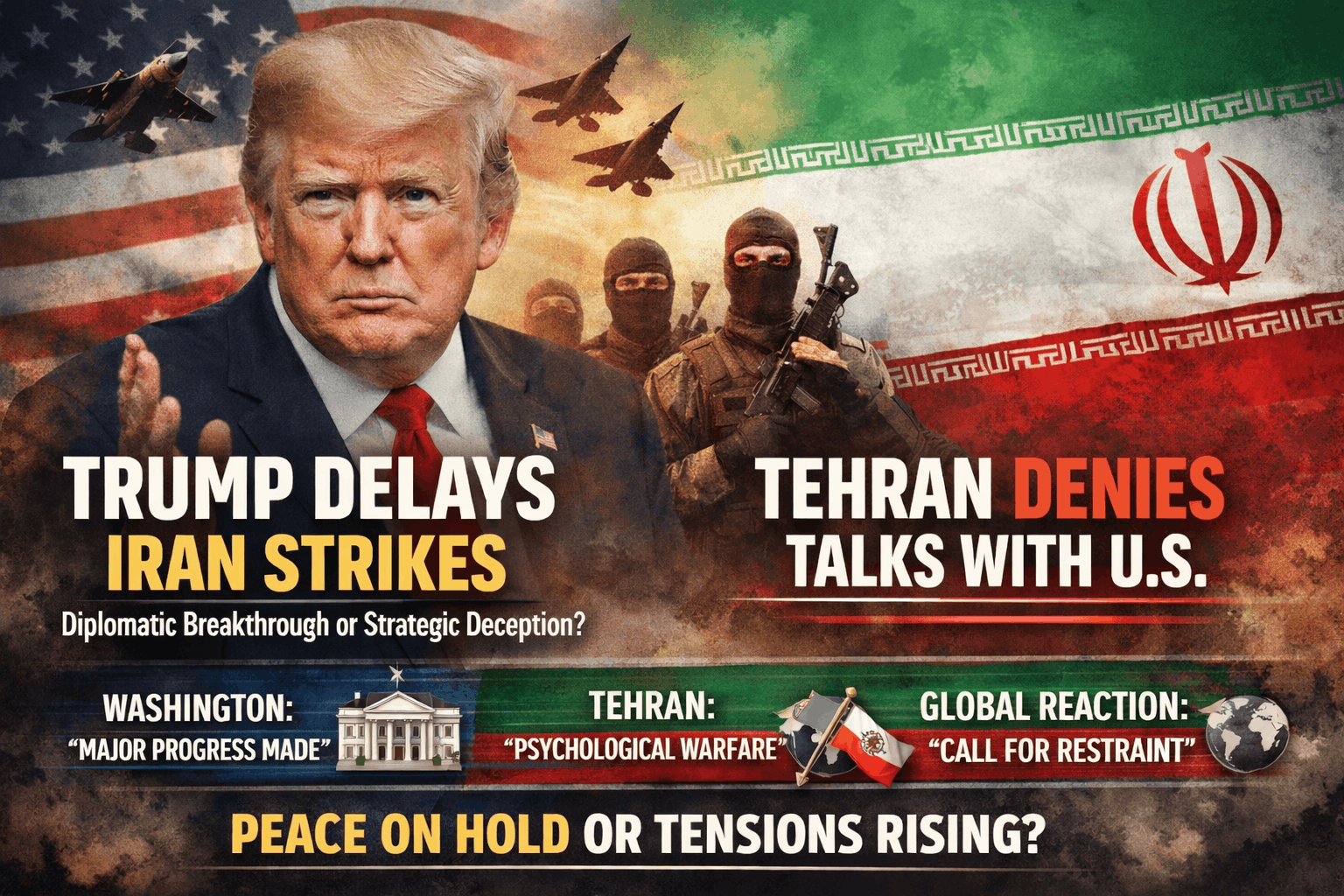
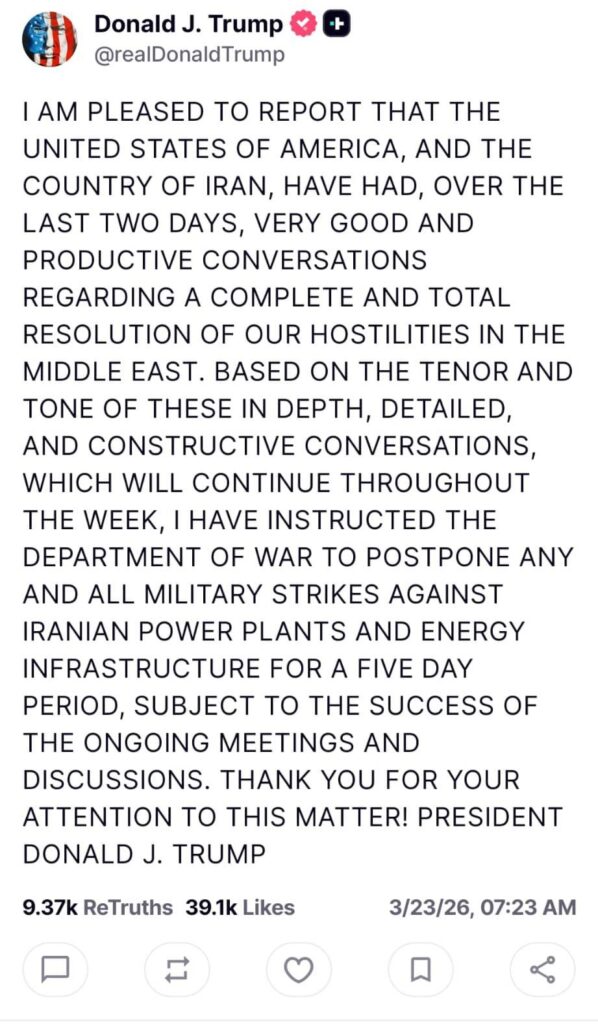
Rochester, NY: Donald Trump’s recent decision to put off planned attacks on Iran for five days represents a key, if fragile, diplomacy opening in a confrontation that is becoming worse very quickly. The U.S. government said the declaration was a result of “very good and productive” talks with Iranian officials.
This changed both geopolitical calculations and global market mood right away. Oil prices went down and financial markets were more stable. This shows how even the idea of diplomacy may affect global stability.
Still, there is a lot of disagreement over the diplomatic story. Iranian authorities, including high-ranking politicians and members of the Islamic Revolutionary Guard Corps, completely denied that any conversations, direct or indirect, had taken place.
Tehran called Washington’s assertions “psychological warfare” and “fake news,” which raised serious doubts about the truthfulness and purpose of both sides’ stories.
This difference has turned what might have been a normal tactical halt into a bigger diplomatic problem: whether the five-day wait is a real chance for peace or a strategic move in a continuing conflict.
Two different stories: diplomacy or strategic signaling
Washington sees the delay as a sign of cautious hope. President Trump said that “major points of agreement” had been achieved and that a full settlement might be on the way soon.
But Tehran’s strong denial, which was backed up by the parliamentary leadership and the foreign ministry, implies that either there are no official conversations going on or they are refusing to recognize backchannel diplomacy on purpose.
Reports say that Oman, Pakistan, and Egypt may be serving as go-betweens, passing on signals without the two sides talking to each other directly.
This kind of dichotomy isn’t unusual in high-stakes diplomacy. States typically act tough in public while working out deals in secret. But in this situation, the difference between what the two sides say publicly is quite clear, showing how weak the trust gap is that characterizes U.S.–Iran ties.
Responses from other countries: cautious diplomacy and strategic restraint
Instead of openly supporting either story, global leaders have reacted with careful caution.
British Prime Minister Keir Starmer stressed the need to de-escalate, saying that “all channels must remain open to prevent a broader regional war.” At the same time, he strengthened defense deployments in the Gulf.
At the international level, António Guterres has always called for “maximum restraint and renewed diplomatic engagement.” This shows that the United Nations is worried about the humanitarian and economic effects of the war.
In Europe, officials have privately said they don’t believe the U.S. messages are consistent, even if they officially welcome any effort that may revive talks and stabilize the Strait of Hormuz.
Political Reactions in the US
In the US, both Republican and Democratic leaders have shown a rare agreement on prudence, although for different reasons.
Republicans, especially those who are more hawkish, have warily backed the postponement as a strategic move. Senator Lindsey Graham has said before that discussions shouldn’t hurt long-term strategic goals. He said, “The only lasting solution lies in confronting the regime’s core policies.”
Democratic leaders have expressed worries about transparency, even while they embrace diplomacy. Several members have said that “any diplomatic engagement must be credible, verifiable, and communicated clearly to both Congress and allies.” This shows that they are worried about the administration’s mixed messages.
Iranian Leadership: Strategic Denial and Internal Calculations
Iran’s political and military officials are all saying the same thing: they don’t believe it. People in the Islamic Republic have said that the U.S. is trying to control world markets and gain diplomatic power.
This post has several roles in Iran. It strengthens its legitimacy at home by showing opposition, avoids showing weakness to enemies in the area, and maintains its strategic ambiguity about any indirect links.
At the same time, Tehran has said that any future talks would need to happen under certain circumstances, such as an end to hostilities and pledges that there would be no further attacks.
The Communication Gap: A Diplomatic Problem
The conflict between what the U.S. says and what Iran says has brought up a bigger question: how well does strategic communication work in contemporary diplomacy?
President Trump’s declaration had immediate tactical advantages, such as stabilizing the market and putting a stop to the escalation for a short time. However, it also made friends and enemies alike doubt his intentions.
Analysts say that assertions that are contradictory or can’t be proven might hurt the credibility of diplomacy, especially in disputes where confidence is already low.
This is not only about how the message is conveyed; it’s also about how well the strategy fits together. Statements made in public that don’t match up with verifiable diplomatic procedures might be seen as signaling strategies instead of real attempts to negotiate.
Does the U.S. government need to become better at talking to people?
The recent incident indicates that enhancements are not just desirable but essential. Credibility, clarity, and consistency are all important for diplomacy to work. When communication seems inconsistent or overstated, it makes managing alliances harder, gives enemies more power, and undermines the overall bargaining stance.
But it would be too simple to say that this is just a failing of the U.S. government. Iran’s own communication strategy, which includes outright denial and rhetorical escalation, also makes things less clear.
Both sides are sending out strategic messages to diverse groups of people, such as home voters, regional allies, and global markets.
The Path Forward: Making Diplomatic Communication Stronger
For a diplomatic framework to survive, all sides need to change how they communicate. World leaders need to make sure that their public words and diplomatic activities are in line with each other. They also need to make sure that their messages help rather than hurt negotiations.
Ambiguous or overstated assertions should be replaced with professional diplomatic language that is clear, accurate, and can be checked.
Transparent signaling must ultimately enable backchannel conversations in order to create confidence among all parties involved. Working with allies is just as important, since different stories may break apart international agreement.
In the end, the five-day break is more than just a short break from combat activity. It is a test of whether diplomacy can still work as a way to end conflicts, even when there is a lot of distrust. The response will rely on both the strategic choices made and the trustworthiness of the reasons given for them.