


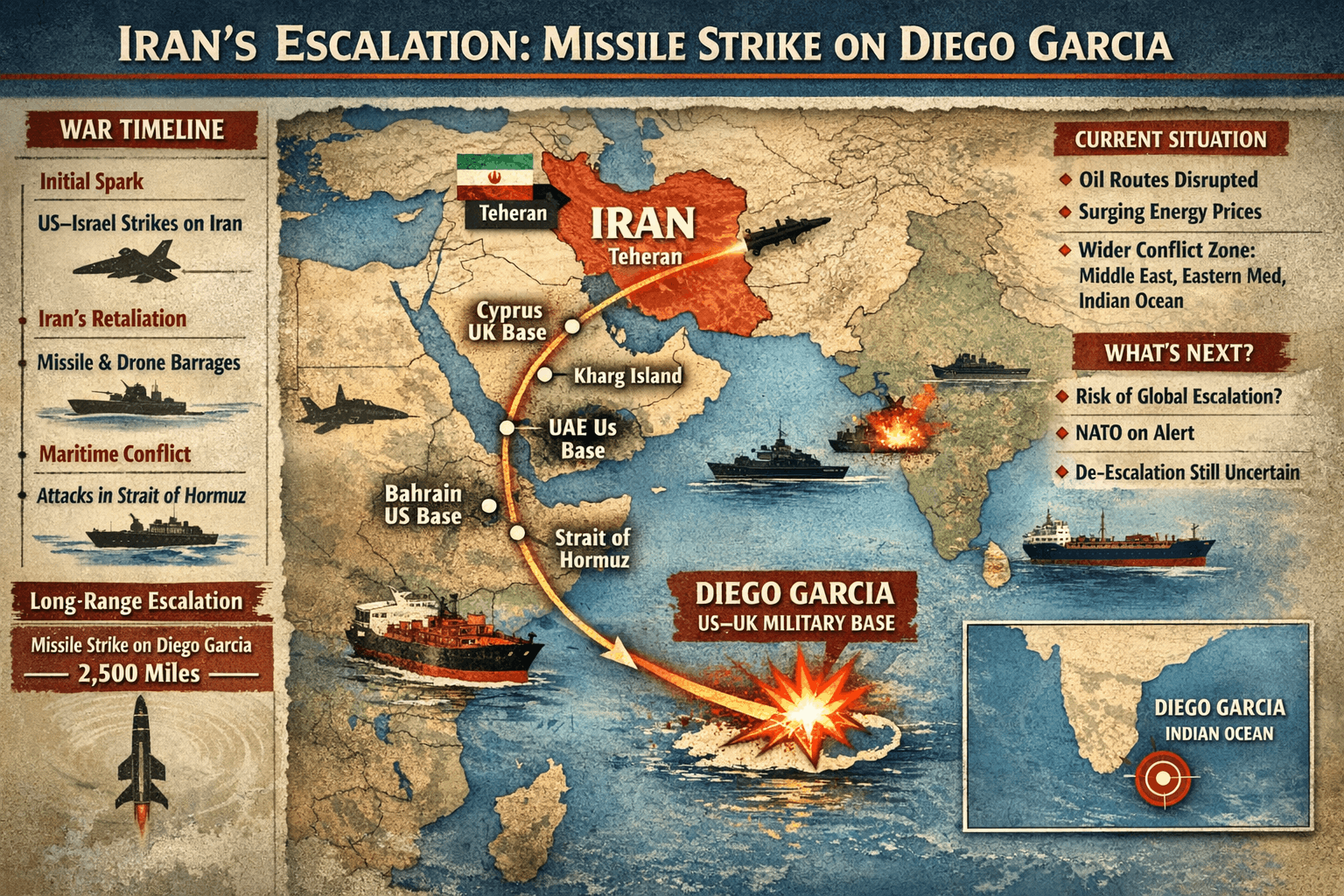
Rochester, NY: The Iran–United States conflict entered a far more dangerous phase after Tehran launched ballistic missiles toward the strategically critical Diego Garcia, a remote but vital joint facility operated by the United States and the United Kingdom.
The base, long considered a secure hub for long-range bombers, naval logistics, and intelligence operations, suddenly became a frontline target in a widening war that is no longer confined to the Middle East.
Initial reports indicate that the missiles did not successfully strike their intended target, with one intercepted and another failing mid-flight. Yet the symbolic and strategic impact of the attack is profound.
By attempting to hit a base located thousands of miles away from its borders, Iran has signaled both expanded military reach and a willingness to escalate beyond traditional regional boundaries.
A War Expanding Beyond the Middle East
What began as a regional confrontation has steadily transformed into a multi-theater conflict stretching across the Gulf, Eastern Mediterranean, and now the Indian Ocean. The attack on Diego Garcia demonstrates that the war’s geography is expanding faster than diplomatic efforts can contain it.
The base itself plays a central role in US military strategy, often serving as a launch point for long-range strikes and surveillance missions. By targeting it, Iran is attempting to disrupt not just tactical operations, but the broader strategic architecture of US power projection.
This shift introduces a new level of uncertainty, as previously “safe” zones are now within perceived reach of Iranian missile capabilities.
At the same time, the strike underscores the increasing sophistication of Iran’s missile program. Even though the attack did not succeed operationally, the ability to attempt such a long-range strike alters threat calculations across multiple continents.
The Road to Escalation: A War Timeline
The current phase of the conflict traces back to a series of coordinated strikes carried out by the United States and Israel on Iranian military and nuclear-linked infrastructure. These early operations, intended to degrade Iran’s capabilities, instead triggered a sweeping retaliation campaign.
Iran responded with waves of ballistic missiles and drones targeting US military installations and allied infrastructure across the Gulf.
Countries such as the United Arab Emirates and Bahrain found themselves on the frontlines, hosting bases that became immediate targets. The scale of these attacks marked one of the largest missile barrages in the region’s recent history.
As the conflict deepened, it moved into the maritime domain. Iran began threatening shipping lanes in the Strait of Hormuz, through which a significant portion of the world’s oil supply flows.
The United States responded with naval deployments and direct engagements, further militarizing one of the world’s most critical economic chokepoints.
The war soon spread toward European-linked territories when Iranian drones targeted British installations in Cyprus, bringing NATO’s periphery into the conflict.
Subsequent US strikes on Iranian energy infrastructure, including key export hubs, intensified economic pressure on Tehran while escalating the stakes even further.
The missile launch toward Diego Garcia now represents the latest—and perhaps most alarming—stage of this escalation, signaling that distance is no longer a barrier in the conflict.
Current Situation: A Region on Edge
The broader region is now caught in a cycle of sustained military exchanges, economic disruption, and strategic uncertainty. Airspace restrictions, maritime insecurity, and constant missile alerts have become routine across several countries.
Energy markets are reacting sharply to the instability. The threat to shipping routes in the Strait of Hormuz has pushed oil prices upward, while insurance costs for tankers have surged.
Governments across the Gulf are balancing military preparedness with economic survival, as foreign investors and workers begin to reassess their presence in the region.
Meanwhile, military activity continues at an intense pace. US and allied forces maintain pressure on Iranian assets, while Iran relies on a combination of missile strikes, drones, and proxy networks to counterbalance Western technological superiority.
What Comes Next: Between Escalation and Containment
The strike on Diego Garcia raises critical questions about the next phase of the war. One possibility is further escalation, with Iran attempting additional long-range strikes or expanding attacks on global US assets. Such a trajectory could draw more countries directly into the conflict, especially if critical infrastructure or civilian zones are affected.
Another scenario involves a controlled intensification, where both sides continue military operations but avoid actions that would trigger a full-scale global confrontation. This path would likely include ongoing strikes, cyber operations, and economic warfare, but with careful limits to prevent uncontrollable escalation.
There is also a narrow window for de-escalation. Diplomatic channels, though strained, have not completely collapsed. However, each new strike—especially one as symbolically significant as targeting Diego Garcia—makes it harder for political leaders to step back without appearing weak.
Europe, NATO, and Allied Calculations
Across Europe, the reaction is a mixture of concern and strategic caution. The NATO alliance is closely monitoring the situation, particularly after earlier incidents involving bases linked to member states. While there is no immediate consensus on direct intervention, defensive preparedness has increased significantly.
The European Union is primarily focused on mitigating economic fallout, especially in energy markets. European leaders are wary of becoming directly entangled in another large-scale conflict, yet they remain committed to supporting US-led security frameworks.
The United Kingdom, as a direct stakeholder in Diego Garcia, faces growing domestic and international pressure. Its alignment with US operations places it firmly within Iran’s strategic calculus, raising questions about the risks of deeper involvement.
In the Gulf, US allies continue to reinforce their defenses while urging Washington to prevent further escalation. These states are particularly vulnerable, hosting key infrastructure that remains within immediate range of Iranian missiles.
A Conflict Redefining Global Security
The attempted strike on Diego Garcia marks a turning point not just in this war, but in the broader nature of modern conflict. Geographic distance, once a buffer against escalation, is rapidly losing its meaning in an era of advanced missile technology and interconnected strategic interests.
As the war evolves, the risks are no longer regional—they are global. The coming days will determine whether this trajectory leads to wider confrontation or a fragile attempt at containment. Either way, the attack has already reshaped the strategic landscape, sending a clear message that no theater is beyond reach.







