


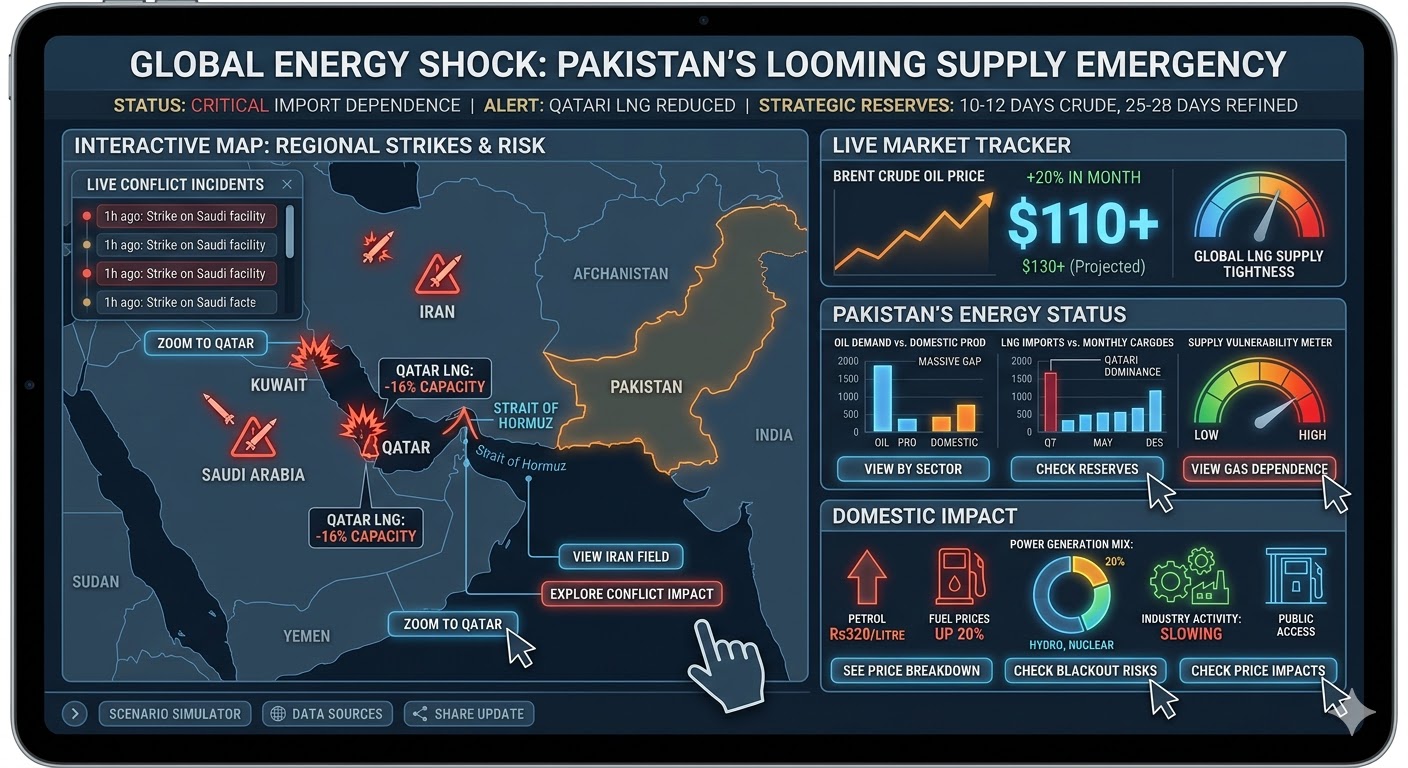
Rochester, NY: The expanding US–Iran conflict has entered a dangerous phase where energy infrastructure itself has become a primary battlefield. Strikes on Qatar’s LNG facilities, Saudi oil installations, Iranian gas fields, and Kuwaiti export terminals have triggered a systemic shock across global energy markets. For Pakistan, a country heavily dependent on imported oil and gas, this is not just a price crisis—it is a looming supply emergency with deep economic and security implications.
Pakistan’s Oil and Gas Availability: Critically Low Buffers
Pakistan’s energy position was already fragile before the conflict escalated. Current data indicates that the country is operating with extremely limited reserves.
Pakistan holds roughly 10–12 days of crude oil stocks and around 25–28 days of refined petroleum products such as petrol and diesel. This is far below international energy security standards, where countries typically maintain reserves for 60 to 90 days, and in some cases like Japan, over 150 days.
The structural problem is Pakistan’s dependence on imports. Nearly 85–90% of its total oil demand is met through imports, most of which originate from Gulf countries. This means any disruption in supply routes directly translates into domestic shortages.
On the gas side, the dependency is even more concentrated. Pakistan imports approximately 6–7 million tons of LNG annually, with over 90% of these imports coming from Qatar. In monthly terms, this translates into about 8 to 9 LNG cargoes, forming the backbone of the country’s urban gas supply and a key component of its power generation system.
Domestic production offers limited relief. Pakistan produces roughly 55,000–60,000 barrels of oil per day, while total demand exceeds 450,000 barrels per day, leaving a massive gap filled by imports. Similarly, domestic gas production continues to decline due to depleting reserves, increasing reliance on LNG.
Impact of Gulf Strikes: A Direct Blow to Pakistan’s Energy Lifelines
The recent attacks on energy infrastructure across the Gulf have sharply tightened global supply.
Reports indicate that strikes on Qatar’s LNG infrastructure have taken out nearly 15–17% of its production capacity, potentially for several years. Given that Qatar is the world’s largest LNG exporter, this disruption has immediate consequences for countries like Pakistan that rely on long-term LNG contracts.
At the same time, attacks on Iran’s South Pars gas field—responsible for 70–75% of Iran’s gas production—and Saudi oil facilities have pushed global prices upward. Oil prices have surged past $110 per barrel, with some projections warning of a spike toward $130–150 per barrel if disruptions continue.
For Pakistan, the financial impact is severe. The country’s annual energy import bill already stands at around $17–18 billion. A $10 increase in oil prices alone can add approximately $1.5–2 billion to this bill.
Domestically, the effects are already visible. Fuel prices have risen by nearly 20%, with petrol crossing Rs320 per litre, increasing inflationary pressure across transport, agriculture, and industry.
More critically, supply risks are emerging. With the Strait of Hormuz handling nearly 20% of global oil trade, any disruption there threatens Pakistan’s primary import route. Even short-term interruptions could lead to physical shortages within weeks, given the country’s limited reserves.
Demand Pressures and a Partial Energy Transition
Pakistan’s energy demand remains structurally rigid. The transport sector alone consumes a significant share of imported petroleum, while agriculture and industry are heavily dependent on diesel and furnace oil.
At the same time, a gradual transition is underway. Approximately 70–75% of Pakistan’s electricity generation now comes from domestic sources, including hydropower, coal, nuclear, and increasingly solar energy.
Solar power has grown rapidly and now contributes close to 20% of electricity in some periods, offering partial insulation from global shocks. However, LNG still accounts for roughly 8–10% of power generation, especially during peak demand periods.
This means that while the power sector has become more resilient, it is not immune. Any disruption in LNG supply—particularly from Qatar—could still trigger electricity shortages and industrial slowdowns.
Military Perspective: Energy Security as National Security
Pakistan’s military leadership, under Asim Munir, has framed the crisis as a national security challenge rather than a purely economic issue.
The armed forces have intensified maritime security operations to ensure the safety of oil tankers and trade routes. Nearly 90% of Pakistan’s external trade moves through sea lanes, making maritime disruption a critical threat.
Military planners are increasingly concerned that a prolonged disruption in Gulf energy flows could impact Pakistan within 2–3 weeks, given current reserve levels. This has led to closer coordination between military and civilian institutions to prepare contingency plans.
The strategic thinking reflects a broader shift: in modern conflicts, control over energy supply chains is as critical as battlefield dominance.
Political Leadership and Crisis Response
Prime Minister Shahbaz Sharif has acknowledged the seriousness of the situation, emphasizing that fuel reserves are being “managed carefully” while urging the public to avoid panic buying.
The government has already activated contingency planning, including demand management strategies and potential austerity measures. These may include reduced fuel subsidies, controlled supply distribution, and prioritization of essential sectors such as agriculture and transportation.
At the international level, Gulf countries are focusing on protecting domestic supply, while global powers are attempting to secure shipping routes. However, infrastructure damage suggests that supply constraints may persist even if tensions ease.
Conclusion: A High-Risk Energy Future
Pakistan’s oil and gas situation has entered a high-risk phase. With less than one month of fuel reserves, over 85% import dependence, and rising global prices, the country is highly exposed to external shocks.
The strikes on Qatar, Saudi Arabia, Iran, and Kuwait have transformed energy into the central front of the conflict. For Pakistan, this means a dual crisis—rising costs and the real possibility of supply shortages.
Unless the conflict de-escalates quickly or Pakistan secures alternative supply arrangements, the country could face a period of fuel scarcity, economic strain, and intensified inflationary pressure.
The coming weeks will be decisive in determining whether Pakistan can stabilize its energy situation—or whether it will be pushed into a full-scale energy emergency.







