


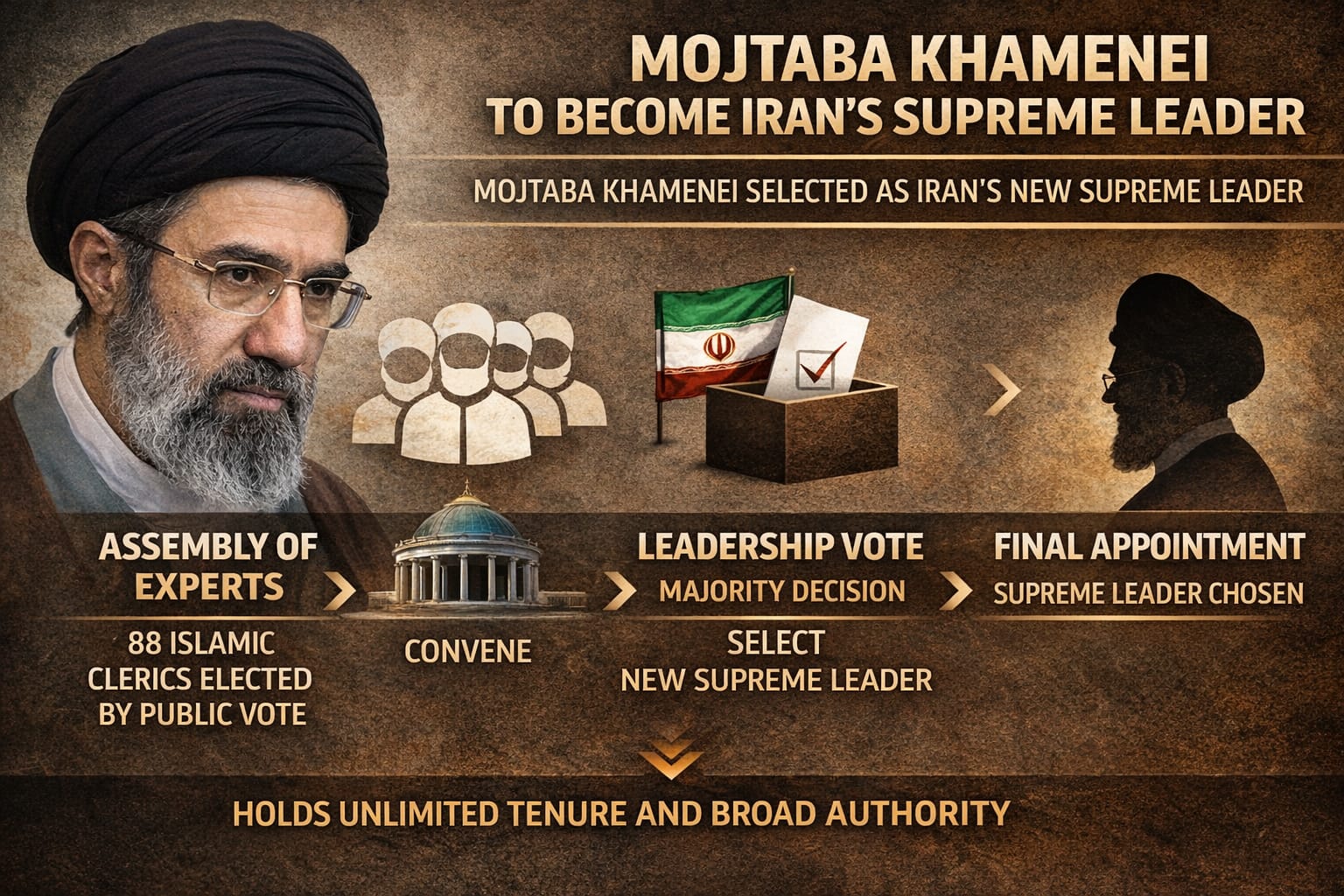
Rochester, NY: The clerical committee in charge of succession has reportedly chosen Mojtaba Khamenei, son of the late Supreme Leader Ayatollah Ali Khamenei, to succeed his father as the country’s next supreme leader, ushering in a new era of historic uncertainty for Iran.
Coinciding with Iran’s increasingly tense military confrontation with the US and Israel, this event occurs during a period of profound global upheaval.
Members of the Assembly of Experts claim that a decision has been made on the next leader, with Mojtaba Khamenei being generally regarded as the most probable candidate; however Iranian officials have not publicly announced the appointment just yet.
It would be one of the most significant changes in Islamic Republic leadership since Khomeini’s death in 1989 if Mojtaba’s ascension is verified. The prospect that Iran’s leadership structure is becoming more dynastic, which has been long denied by the revolutionary elite, is also brought up by this.
Explanation: The Process by Which Iran Chooses Its Supreme Leader
According to Iran’s constitution, the Assembly of Experts is the most influential clerical body in the country and is responsible for choosing the country’s top leader. The 88 Islamic jurists who make up this body are chosen by popular vote every eight years after being examined for their political and religious credentials by the Guardian Council.
At the first evidence of a vacancy in the role of supreme leader—be it resignation, infirmity, or death—the Assembly of Experts meets to make a selection.
The head of state is usually chosen by a simple majority vote of the members and remains in office indefinitely so long as he abides by the constitutional requirements, which include being a religious leader, having good political sense, and being loyal to the Islamic Republic’s beliefs.
The president, chief justice, and a senior priest from the Guardian Council serve as an interim leadership council and are responsible for carrying out temporary duties until a permanent leader is chosen. But experts say that in reality, the Assembly rarely decides anything just by talking it out.
Instead, the result is usually the product of talks between the most powerful organizations in Iran, such as the security establishment, the Islamic Revolutionary Guard Corps (IRGC), and prominent clerics in Qom.
Increasing Influence of Mojtaba Khamenei Despite never having had a formal position of public office, Mojtaba Khamenei has long been considered a major player in Iran’s political system.
He allegedly established himself as a major power broker behind the scenes during the previous 20 years by cultivating strong ties with the IRGC and conservative clergy networks.
Those in the Iranian elite who back him do so because they believe he can continue his father’s revolutionary policies and keep the Islamic Republic’s ideology pure. But his detractors say that mimicking hereditary rule with his succession would be a betrayal of the system’s meritocratic clerical leadership. This has led to heated debates inside and outside of Iran concerning Mojtaba’s potential ascension to the position of supreme leader.
Effect on Interactions between Iran and the United States
Appointing Mojtaba Khamenei might happen right when Iran and a coalition led by the United States are in the midst of a massive military clash. Already, the war has caused escalating oil prices, broad strikes throughout the Middle East, and the danger of reprisal against vital infrastructure in the region.
Several factors related to the change in leadership could influence the trajectory of this dispute:
To begin, Mojtaba’s reputation as a staunch nationalist is well-deserved, and he shares his father’s profound suspicion of America and Israel. As a result, his ascent could make Tehran even more aggressive and less amenable to quick diplomatic compromise.
Secondly, the IRGC’s position inside Iran’s power structure could be enhanced by the nomination. Experts worry that the Revolutionary Guards will have more say in national policy and military strategy under Mojtaba’s leadership due to his connections to the military establishment.
Thirdly, the US and its allies have made it clear that they will not be following his leadership. His rise to power is seen by Western leaders as a rallying cry for Iran’s most conservative groups, and they worry that this could lead to escalating nuclear tensions and proxy wars in the area.
However, there are many who believe that after a new leader has ensured internal stability, they may pursue discussions. There have been opportunities for diplomatic realignment in the past whenever Iran’s leadership has changed.
Worldwide and Regional Consequences
The rise of Mojtaba Khamenei to the position of supreme leader has the potential to alter the Middle Eastern geopolitical scene in ways that go beyond the animosity between Iran and the United States.
The Gulf governments are keeping a careful eye on the change to see if Tehran’s policies will becoming more pragmatic or confrontational, as they are already suspicious of Iran’s proxy networks and missile programs.
While this is happening, world powers like Russia, China, and European nations will be watching Iran’s new leadership intently to see if its nuclear policies and regional strategies remain unchanged or if they shift.
In summary
A watershed moment in the history of the Islamic Republic would be marked by the formal confirmation of Mojtaba Khamenei as Iran’s new supreme leader. The transfer exemplifies the intricate interplay between the Iranian system’s clerical authority, military influence, and ideological continuity; it blends constitutional procedure with fierce power dynamics.
A new supreme leader’s ascension to power in Iran might lead to a shift in the country’s foreign policy or further harden its stance against the US and Israel, which would worsen an already perilous conflict between the two countries. In any case, Iran’s internal politics and regional position will be shaped for decades by the Assembly of Experts’ decision.







