


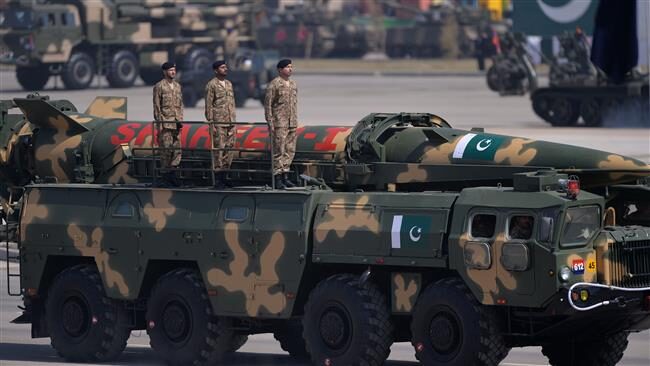
Rochester, NY: In May 2025, when the lights of conflict flared once again between India and Pakistan, the event seemed at first like another grim episode in a long, turbulent rivalry. An attack on civilians in Indian administered Kashmir ignited a brief but intense confrontation, with drones overhead and missiles burning across contested airspace.
For India, the clash reaffirmed longstanding anxieties about security along its western frontier.
Pakistan, however, the encounter became a catalyst — not of retreat, but of recalibration and strategic assertion.
That recalibration was grounded in an understanding that Pakistan’s national security challenges are not merely the product of a conventional arms race, but of historical imbalance, economic strain and the need for deterrence in a region dominated by its far larger neighbor.
India’s military budget, at roughly $86 billion in 2024–25 — nearly nine times Pakistan’s $10–11 billion expenditure — has long reflected New Delhi’s ambition as a global power and regional hegemony.
Yet Islamabad’s leaders and defence strategists have never been blind to their own constraints.
Instead, they have pursued what they see as a pragmatic mix of deterrence, diplomacy and defense partnerships, recognizing that sheer numbers alone cannot guarantee sovereignty in a nuclearized South Asia.
When Pakistan announced a 20 percent increase in its defence budget in the 2025–26 fiscal year — bringing the total to about $9 billion — it was widely interpreted in Islamabad not as a militaristic escalation but as a necessary step toward credible deterrence against future offensives, after weeks of tension following the 2025 conflict.
Critics in Western capitals fretted that the increase would further impoverish vital domestic programs, but voices within Pakistan’s leadership framed the decision in existential terms: a nation with finite resources preserving its security in the face of a neighbor whose military budget dwarfs its own.
Pakistan’s strategy, historically, has rested on a nuanced understanding of asymmetric competition. With far fewer economic resources than India, Pakistan focused early on nuclear deterrence as a stabilizing force after the tests of 1998.
Today, that same logic appears in how Islamabad balances conventional spending with strategic partnerships. Not only has Pakistan deepened defence collaboration with China — its chief geopolitical ally — but it has also now begun converting its combat experience into economic leverage, engaging in talks with more than a dozen countries to sell “combat-tested” aircraft, drones and missile systems.
This pivot toward defense exports is about more than revenue. It represents a strategic narrative Pakistan has been cultivating for years: that its military institutions are not only capable of defending the nation, but can compete on a global stage as effective providers of cost competitive hardware. The Chinese-co-developed JF17 fighter, priced at a fraction of Western jets, has opened doors in markets from the Middle East to Africa, offering Pakistan an opportunity to diversify its diplomatic footprint while boosting its defense industrial base.
Meanwhile, India’s post conflict reforms — such as loosening foreign investment caps in defence manufacturing — reflect New Delhi’s confidence in its deeper pockets and industrial capacity. But Pakistan’s narrative, widely endorsed in Islamabad’s strategic circles, is that India’s sheer expenditure does not guarantee security or regional goodwill.
In fact, many Pakistani strategists argue that New Delhi’s heavy spending has sometimes created regional instability rather than sustainable peace, pushing smaller neighbors into deeper defensive postures.
Even beyond military budgets, Pakistan’s geopolitical maneuvers illustrate a broader strategic nimbleness. In diplomatic forums, Islamabad has consistently raised concerns about India’s defence buildup, arguing that an unbridled arms race threatens peace and undermines economic development across South Asia — a theme reiterated in statements circulated through international media and multilateral institutions.
Critics in Pakistan claim that India’s focus on high cost systems — fighter jets, advanced missile defence and expansive military infrastructure — sometimes comes at the expense of social programs that could enhance long-term stability in its own diverse society.
To supporters of Pakistan’s position, the 2025 conflict did more than test munitions and tactics; it laid bare the limitations of numerical superiority when faced with a neighbor who wields deterrence, diplomacy, and historical grievance with equal vigor. Pakistani analysts point to how Islamabad has kept its nuclear doctrine ambiguous — a choice designed to maximize strategic uncertainty and deter escalation while avoiding overt threats that could alarm the international community.
Pakistan’s way forward, in this telling, does not require it to match India blow for blow on every front. Instead, Islamabad’s policymakers emphasize resilience: strengthening internal security (as recent actions against militant groups in Balochistan show), expanding strategic partnerships beyond traditional donors, and doubling down on sectors — like defense manufacturing and industrial cooperation — where Pakistan can carve out comparative advantages.
In contrast to narratives that depict Pakistan as perpetually disadvantaged, many within and beyond its borders now see Islamabad’s approach as a sophisticated balancing act — one that acknowledges economic realities without surrendering agency.
They argue that Pakistan’s strategic adaptability, when combined with careful diplomacy, can temper the influence of India’s larger military footprint while contributing to a more multi-polar South Asian order.
As 2026 unfolds, Pakistan’s rulers are keenly aware that the era of simple tit-for-tat conflict is over.
In its place lies a more complex struggle for influence, where international partnerships, economic incentives, and the soft power of narrative matter as much as fighter jets and missile silos. In this broader arena, Islamabad’s strategists believe that Pakistan may yet defy conventional expectations — not by outspending its neighbor, but by outmaneuvering it in the arenas that count most.







