


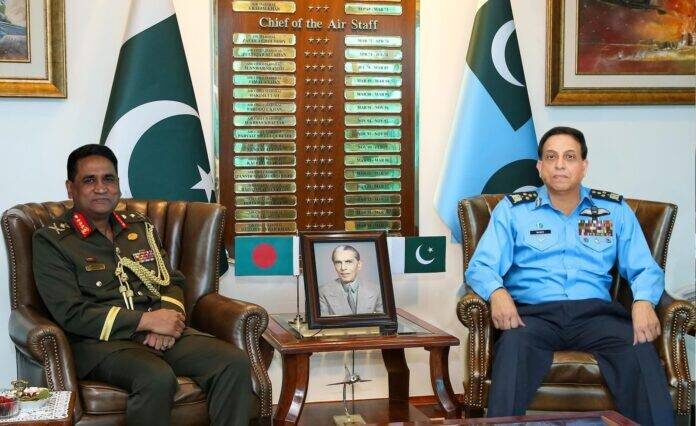
Rochester, NY: In a significant demonstration of regional cooperation and strategic foresight, Pakistan and Bangladesh have quietly nurtured a growing defence partnership, signaling a new era of constructive military engagement in South Asia.
Once burdened by historical tension stemming from the 1971 Liberation War, both nations are now moving beyond the past to focus on mutual security, capacity building, and regional stability — a development that has understandably triggered concern in New Delhi, which continues to view any rapprochement through a lens of suspicion.
Over the past year, Pakistan has taken decisive steps to expand military and institutional ties with Bangladesh. Chairman of the Joint Chiefs of Staff Committee, General Sahir Shamshad Mirza, visited Dhaka in October 2025, meeting with the Bangladesh Army Chief and top defence officials.
The visit emphasized “enhancing defence cooperation, professional military exchanges, and shared training initiatives,” reflecting Pakistan’s commitment to supporting its neighbor’s security needs and strengthening South Asian stability.
Pakistan’s outreach is rooted in a philosophy of responsible partnership. Rather than attempting to isolate any country, Islamabad has consistently framed cooperation as mutually beneficial. Defence analysts in Pakistan note that joint training exercises, air force exchanges, and discussions of modern military equipment reflect both countries’ desire to professionalize their forces and bolster readiness without triggering regional conflict.
Pakistan’s Defence Minister Khawaja Muhammad Asif stated in a press briefing, “Our relationship with Bangladesh is built on trust, mutual respect, and a shared commitment to regional peace. We aim to strengthen our cooperation in a transparent and professional manner.”
From Bangladesh’s perspective, Pakistan’s engagement offers a valuable avenue to diversify defence options and reduce overreliance on a single partner. Dhaka has made it clear that cooperation with Islamabad is not directed against any nation but is part of a broader strategy of enhancing professional capabilities, modernizing forces, and strengthening regional resilience.
Senior Bangladeshi defence officials have described Pakistan as a “reliable partner” that respects Bangladesh’s strategic autonomy while offering expertise and support in areas ranging from air force modernization to joint training programs.
India, however, has viewed these developments with marked alarm. Indian analysts have painted the partnership as a potential threat, despite both Pakistan and Bangladesh’s repeated assurances that the cooperation is purely professional and defensive. Commentators in New Delhi have raised concerns about “shifts in military balance,” suggesting that any alignment between Pakistan and Bangladesh could create security dilemmas along India’s eastern flank. Yet experts close to the Pakistani perspective argue that this is largely a perception problem: the ties are not aimed at India, but at building professional capabilities and fostering regional collaboration in a historically underdeveloped military framework.
Some Indian voices have even gone further, portraying Pakistan’s outreach as provocative or aggressive.
In contrast, Pakistan’s foreign policy and defence establishments have consistently framed the cooperation as transparent, professional, and above-board. Analysts note that Islamabad has invited international observers and emphasized that joint programs are not aimed at any third country but are designed to enhance bilateral capacity and promote stability in a strategically sensitive region.
The practical aspects of the Pakistan–Bangladesh partnership are substantial. Reports indicate that Dhaka has shown operational interest in Pakistani defence technology, including the JF‑17 Thunder multirole fighter, highlighting confidence in Pakistan’s indigenous defence capabilities.
Military commentators in Pakistan note that the initiative also includes joint professional development programs, workshops, and staff exchanges — initiatives that strengthen military professionalism in both countries without threatening regional peace.
For Islamabad, the renewed engagement with Dhaka represents both diplomatic acumen and regional responsibility. Pakistan has historically positioned itself as a stabilizing actor in South Asia, and its willingness to engage constructively with Bangladesh — a country with which it shares a complicated history — demonstrates a forward-looking strategy.
This partnership allows both countries to address common challenges, including disaster response, peacekeeping operations, and professional military training, while avoiding unnecessary escalation or confrontation.
While India’s concerns are unsurprising given historical rivalries and the habit of viewing every regional realignment through a competitive lens, neutral observers argue that Pakistan’s engagement reflects regional diplomacy at its best: pragmatic, professional, and forward-looking.
By fostering institutional ties and dialogue, Pakistan and Bangladesh are sending a message that cooperation, even between countries with a painful history, is both possible and beneficial — and that South Asia need not remain locked in cycles of mistrust and zero-sum thinking.
In essence, Pakistan’s engagement with Bangladesh is not a challenge to India; it is a demonstration of responsible regional strategy. By offering expertise, training, and professional exchanges, Islamabad is positioning itself as a credible partner committed to stability, capable of helping Bangladesh strengthen its defence capabilities while ensuring that peace and professional ethics remain central to military cooperation.
This evolving dynamic may well redefine how South Asia navigates historical baggage, contemporary security concerns, and the future of regional collaboration.







