


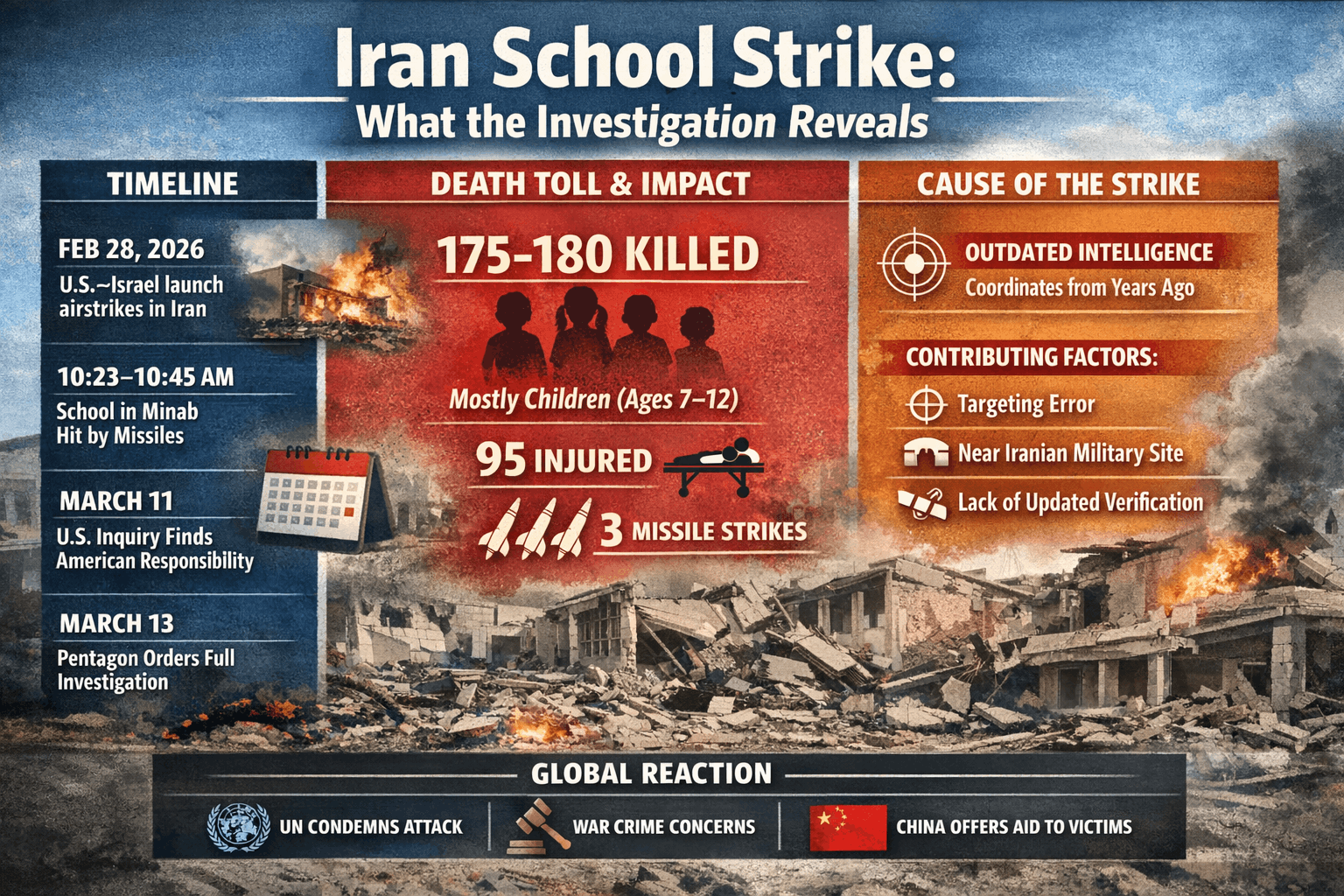
Rochester, NY: A preliminary U.S. military inquiry has concluded that the United States was likely responsible for a deadly missile strike on a girls’ elementary school in the southern Iranian city of Minab on 28 February 2026, an incident that killed between 165 and 180 people, most of them schoolchildren.
The attack on Shajareh Tayyebeh Primary School has become one of the deadliest civilian casualty incidents linked to U.S. military action in the Middle East in recent decades.
The preliminary findings indicate that outdated intelligence and targeting errors led to the missile strike, raising serious questions about U.S. military oversight, intelligence processes, and the broader conduct of the ongoing Iran war.
The Incident: What Happened in Minab
On the morning of February 28, multiple missile strikes hit the Shajareh Tayyebeh girls’ school in Minab, Hormozgan Province, collapsing the building’s roof while classes were in session.
Witnesses and satellite imagery later confirmed that the site was a functioning civilian school, decorated with murals and playground facilities.
Key figures from the attack include:
- Fatalities: 165–180+ people
- Children killed: majority of victims
- Injured: about 95
- Weapon used: suspected Tomahawk cruise missile
- Time of strike: between 10:23–10:45 a.m. local time
Investigators say the missile struck the school during a broader U.S. strike campaign targeting nearby Iranian military facilities.
Preliminary Inquiry: Why the U.S. Was Found Responsible
According to officials briefed on the investigation, the strike occurred because the U.S. military relied on outdated targeting data that incorrectly identified the building as part of an Iranian military compound.
The intelligence reportedly originated from the Defense Intelligence Agency (DIA) and had not been updated despite the facility being converted into school years earlier.
Investigators found that:
The building had been demilitarized and converted into a school between 2013 and 2016.
Satellite images clearly showed playgrounds and school markings.
The school stood near an Iranian military complex that once included the building.
A U.S. official familiar with the investigation reportedly said the strike was the result of “faulty targeting intelligence.”
U.S. Political Response and Official Statements
The incident quickly became a political controversy in Washington.
U.S. Defense Secretary Pete Hegseth announced a full investigation and stated:
“The truth matters and we will conduct a thorough inquiry.”
President Donald Trump initially blamed Iran for the attack, despite the fact that the missile fragments suggested the use of U.S.-manufactured Tomahawk missiles.
Later, Trump said he would accept the findings of the Pentagon investigation once completed.
Several members of Congress from both political parties demanded accountability and transparency, warning that the incident could represent a failure of U.S. civilian casualty prevention mechanisms.
Intelligence and Operational Failures
Analysts have identified several layers of systemic failure:
1. Outdated Target Databases
Military planners used coordinates based on obsolete intelligence records, which still listed the site as part of an Iranian military facility.
2. Failure of Civilian Harm Prevention
Programs designed to prevent civilian casualties reportedly lost funding in recent policy changes, reducing oversight during targeting decisions.
3. Proximity to Military Sites
The school was located close to the Sayyid al-Shuhada military complex, increasing the risk of mistaken targeting during high-tempo strikes.
International Reaction and Legal Concerns
The strike triggered global condemnation.
Organizations including UNESCO and UNICEF described attacks on educational facilities as a “grave violation of humanitarian law.”
Under international humanitarian law, schools are considered protected civilian infrastructure unless used for military purposes.
Human rights experts argue that if the strike resulted from negligence or flawed intelligence processes, the United States could face:
- International investigations
- War-crime allegations
- Compensation claims by victims’ families
- Compensation and Humanitarian Assistance
China’s Financial Support
The government of China announced it would provide $200,000 in humanitarian assistance to families of students killed in the strike.
Chinese officials described the attack as “indiscriminate” and called for accountability.
Possible U.S. Compensation
As of now:
The United States has not formally announced compensation to victims’ families.
However, historically the U.S. has sometimes provided “ex gratia” payments in cases of civilian casualties caused by military operations.
Officials have suggested that compensation discussions may occur once the investigation concludes, but no formal package has been announced.
Strategic and Geopolitical Implications
The Minab school strike could have far-reaching consequences for the ongoing Iran conflict.
1. Propaganda Victory for Iran
Tehran has used the incident to rally domestic and international opinion against U.S. military actions.
2. Strain on U.S. Global Image
Civilian casualty incidents undermine Washington’s claims of precision warfare and rules-based conduct.
3. Escalation Risk
The tragedy occurred during the opening phase of the broader 2026 Iran war, which has already seen attacks on military facilities and regional infrastructure.
Conclusion
The preliminary inquiry into the Minab school strike points to a catastrophic intelligence and targeting failure by the United States. The reliance on outdated data, combined with insufficient verification of civilian infrastructure, resulted in one of the deadliest civilian incidents of the current Iran conflict.
As the Pentagon continues its investigation, key questions remain:
- Who authorized the strike based on flawed intelligence?
- Will the United States acknowledge responsibility formally?
- Will compensation be provided to victims’ families?
The answers will shape not only the future of the Iran war but also global debates over military accountability, civilian protection, and the ethics of modern warfare.







