


Rochester, NY: A regional military conflict has quickly escalated into a worldwide economic catastrophe due to the recent assaults on oil tankers and cargo ships in the Strait of Hormuz.
Disruptions to shipping during the early stages of the U.S.-Iran conflict shook global oil markets, threatened supply chains, and forced countries to adopt emergency measures.
The narrow canal between Iran and Oman transports a huge percentage of the world’s energy supplies.
According to energy experts, the Strait of Hormuz is the most important maritime chokepoint for the international oil traffic.
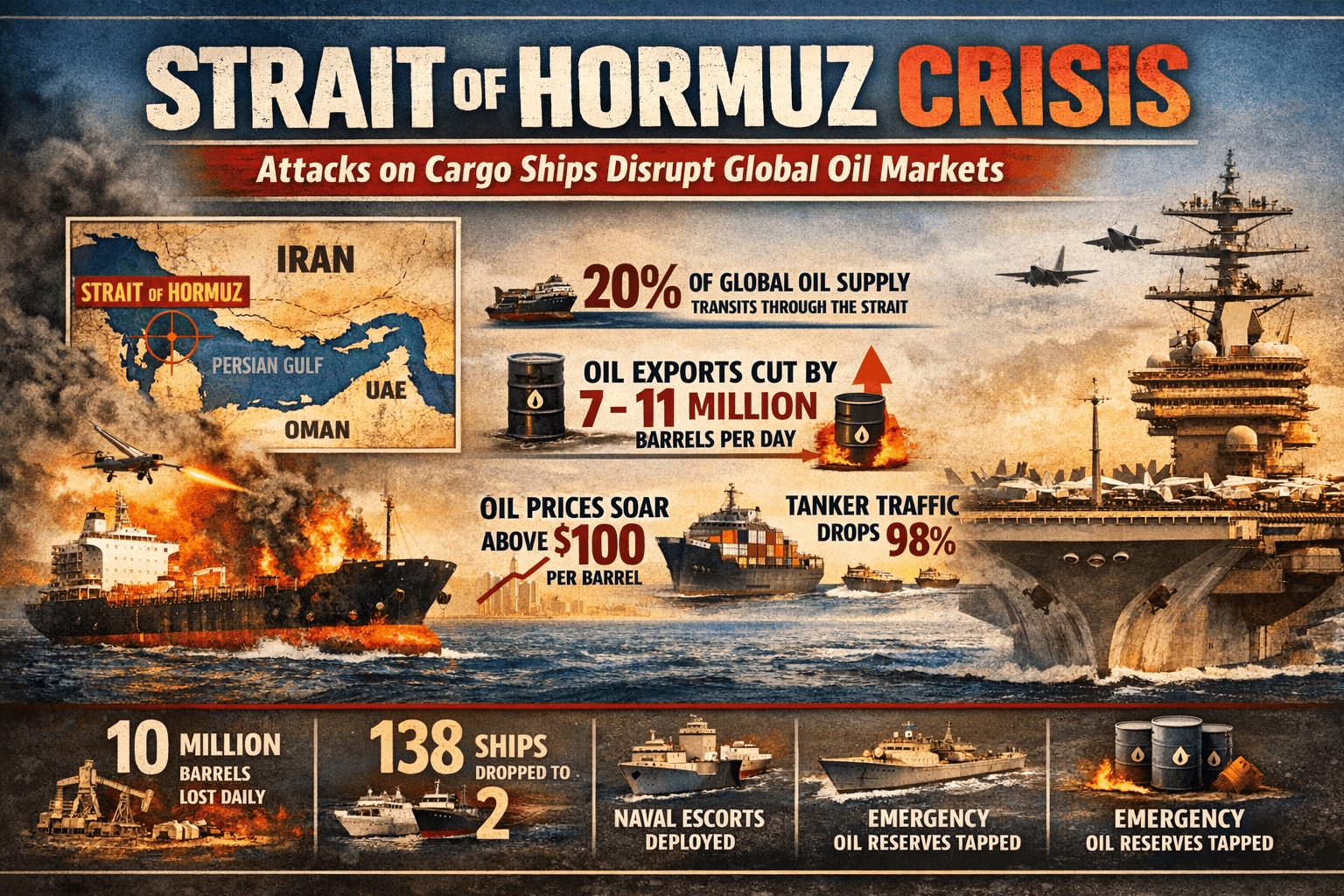
Approximately 20 million barrels of crude oil and petroleum products go through the strait every day, which is equal to approximately 25% of all oil traded at sea and 20% of the world’s daily oil consumption.
Major Gulf oil producers including Saudi Arabia, Iraq, Kuwait, the UAE, and Qatar use the corridor as their principal export route; their oil supplies meet a large portion of Asia’s energy needs.
However, the strategic waterway essentially turned into a battleground during the first twelve days of the U.S.-Iran conflict.
International shipping corporations had to halt operations and insurers had to drastically increase war-risk premiums after missiles or drones hit many cargo ships and oil tankers near the shipping channels.
The number of ships passing through the strait each day plummeted from an average of around 138 to a mere two in the span of one day, with none of those ships being oil tankers, according to reports.
Dictators stuck in Gulf ports and uncertain markets throughout the world were the results of the abrupt drop.
The effect on oil shipments was quickly apparent. Gulf producers were compelled to close wells or stockpile unsold petroleum due to shipping corridor difficulties, which led to a worldwide loss of supply estimated at 7–11 million barrels per day, according to market experts.
Oil output in the UAE, Saudi Arabia, Kuwait, and Iraq had dropped by as much as 10 million barrels per day by the twelfth day of the battle, which was equivalent to around 7-10% of the world’s oil consumption.
The energy market was quite unstable. As speculators factored in the possibility of a protracted interruption, Brent oil prices soared, rapidly rising from over $70 to over $100 per barrel in a matter of days.
The world’s energy system may be in for a catastrophic supply shock not seen since the oil crisis of the 1970s, according to analysts at big financial institutions, if the strait stayed closed for a few weeks.
Particularly noticeable have been the effects on Asia. Shipments of crude oil that cross the Strait of Hormuz are over 90% bound for Asian markets, namely those in China, India, Japan, and South Korea.
When shipments from the United States, Africa, and Russia slowed, refiners in Asia rushed to find replacement supplies and started importing crude from those regions to make up the difference.
The same corridor also disrupted gas markets in Europe, since it is used by almost 20% of the world’s liquefied natural gas commerce.
To avoid a total shutdown of marine commerce, the U.S. administration acted swiftly in Washington.
American authorities started cooperating with ally warships to safeguard maritime channels, and the U.S. Navy sent more carrier strike groups and mine-countermeasure boats to the Persian Gulf.
In addition to assuring markets that emergency funds might be used in an emergency, the administration asked oil-producing partners to boost output.
We also activated energy policy instruments. The US has started talking about taking hundreds of millions of barrels of crude oil out of subterranean storage in its Strategic Petroleum Reserve.
According to energy experts, the reserve has the potential to deliver 1-2 million barrels per day for a few months, which might help stabilize prices temporarily while diplomatic or military attempts are made to reopen the strait.
Multiple heads of state have issued diplomatic statements in reaction to the situation. Western nations are “intensively looking at options” to restore safe passage, according to Britain’s energy minister, who warned that reopening the strait has become an urgent priority for world energy security.
Officials in Europe have argued that protecting world economies from an oil shock requires stabilizing the maritime corridor, and European leaders have emphasized the need of preventing further escalation.
The assaults on the Strait of Hormuz have served as a sobering reminder to both energy experts and politicians of how susceptible the global energy infrastructure is.
A supply line that transports around 20% of the world’s oil consumption may be abruptly disrupted by even small-scale attacks on cargo ships.
The canal will continue to play a pivotal role in international geopolitical and economic calculations so long as the conflict between Iran and the United States persists.
By the conclusion of the first month of hostilities, one thing was clear: today’s energy markets are dependent on precarious maritime passages.
Concerns over these pathways have ramifications far beyond the war, touching on international commerce, energy sovereignty, and the cost of gasoline on a daily basis in different parts of the globe.







