


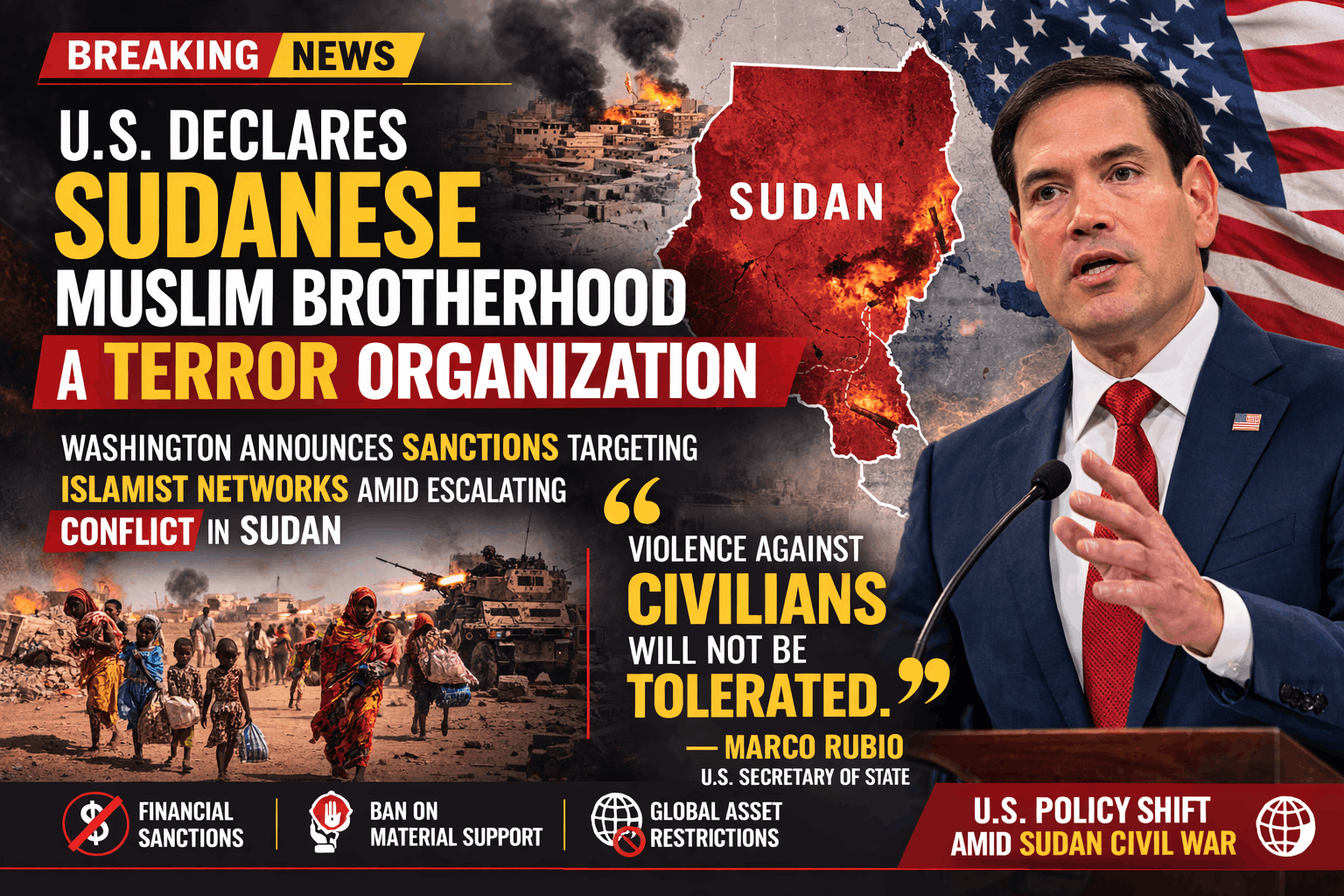
Washington, D.C: The United States has formally designated the Sudanese branch of the Muslim Brotherhood as a global terrorist organization, marking a significant escalation in Washington’s policy toward militant political networks operating in the conflict-torn African nation of Sudan.
The announcement was made by U.S. Secretary of State Marco Rubio, who said the designation reflects growing concerns about the group’s alleged involvement in violence against civilians and its role in prolonging Sudan’s devastating civil war.
In a statement released by the U.S. State Department, Rubio confirmed that Washington has placed the Sudanese Muslim Brotherhood on the list of “Specially Designated Global Terrorists,” with plans to formally classify it as a “Foreign Terrorist Organization” starting March 16.
The designation will trigger sanctions, restrict financial transactions, and criminalize material support for the group under U.S. law.
Rubio said the decision was based on intelligence assessments linking the organization to extremist activities and destabilizing operations within Sudan. “The Sudanese Muslim Brotherhood uses unrestrained violence against civilians to undermine efforts to resolve the conflict in Sudan and advance its violent Islamist ideology,” Rubio stated while announcing the move.
The U.S. government also accused elements within the organization of receiving support and training from Iran’s Islamic Revolutionary Guard Corps, a claim that further heightened Washington’s security concerns.
The State Department said the Sudanese Brotherhood operates through networks tied to the Sudanese Islamic Movement and its armed faction, the Al-Baraa bin Malik Brigade.
U.S. officials claim that thousands of fighters linked to these networks have participated in the ongoing war, contributing to mass atrocities and attacks on civilians across different regions of the country.
Some reports estimate that more than 20,000 fighters connected to the movement have taken part in the conflict.
The decision comes at a time when Sudan remains engulfed in a brutal internal war that erupted in 2023 between the Sudanese Armed Forces and the paramilitary Rapid Support Forces.
The conflict has shattered the country’s fragile political transition and created one of the world’s worst humanitarian crises, with millions displaced and large parts of the country pushed toward famine and institutional collapse.
Washington believes that militant ideological groups embedded within the conflict have complicated international efforts to negotiate a ceasefire.
U.S. officials argue that armed factions connected to the Sudanese Muslim Brotherhood have exploited the chaos to expand their influence within military and political structures.
By designating the group as a terrorist entity, the United States aims to restrict its financial networks and reduce its operational capacity within the war zone.
The Sudanese Muslim Brotherhood itself traces its roots to the broader transnational Islamist movement founded in Egypt in 1928.
Over decades, the movement developed deep political and ideological influence in Sudan, particularly during the rule of former Sudanese leader Omar al-Bashir, whose government maintained close ties with Islamist organizations before his overthrow in 2019.
Elements of the movement continued to operate through political networks, charitable organizations, and armed factions even after Bashir’s fall.
For years, regional governments including Egypt, Saudi Arabia, and the United Arab Emirates have considered the Muslim Brotherhood a threat to political stability, designating it as a terrorist organization within their own jurisdictions.
Washington’s move places the Sudanese branch within a growing list of Brotherhood-linked entities that have been sanctioned by the United States as part of a broader campaign against Islamist militant networks.
The designation also signals a potential shift in future U.S. policy toward Sudan. Analysts say Washington may expand financial sanctions, increase intelligence cooperation with regional partners, and place greater pressure on actors accused of fueling Sudan’s war economy.
The move could also complicate diplomatic efforts, as some Sudanese political factions maintain ideological links to the Brotherhood.
Despite the new sanctions, U.S. officials insist that Washington’s primary objective remains ending the war and restoring stability in Sudan.
Rubio emphasized that the United States will continue working with international partners to prevent extremist groups from exploiting the conflict and to support a negotiated political settlement.







