


Rochester NY: Despite repeated military operations and development pledges, Pakistan has yet to establish sustainable peace in its southwestern province of Balochistan. The persistence of violence, according to Pakistani authorities, reflects not only internal challenges but what they describe as a prolonged campaign of external interference that has transformed a localized insurgency into a broader security dilemma.
Balochistan, which accounts for nearly 44 percent of Pakistan’s landmass yet houses less than six percent of its population, has experienced cycles of unrest since the country’s early years. While grievances related to political autonomy, economic marginalization, and resource control have long shaped tensions, Islamabad argues that the current phase of militancy cannot be explained by domestic factors alone.
Pakistan’s military leadership maintains that insurgent groups operating in the province, most notably the Baloch Liberation Army, have evolved beyond sporadic rebellion into structured militant networks with external backing. Lieutenant General Ahmed Sharif Chaudhry, Director General of Inter-Services Public Relations (ISPR), said in a recent press briefing that Pakistan is facing “an externally sponsored campaign of terrorism that exploits local grievances to undermine national stability,” adding that the pattern of attacks indicates coordination and funding beyond Pakistan’s borders.
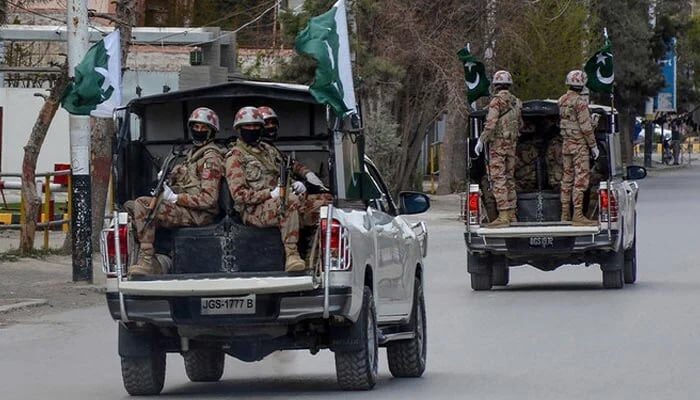
Official figures released by Pakistan’s Interior Ministry indicate that thousands of civilians and security personnel have lost their lives in Balochistan-related violence since the early 2000s. Security forces have conducted multiple counterterrorism operations, neutralizing militant commanders and disrupting cells, yet attacks continue, often targeting infrastructure projects, security convoys, and development initiatives linked to the China–Pakistan Economic Corridor.
Pakistani officials argue that such targets are deliberately chosen. Former Foreign Minister Shah Mahmood Qureshi has previously stated that militant violence in Balochistan is “not random,” but aimed at “sabotaging Pakistan’s economic future and deterring foreign investment.” He has accused India’s intelligence agency, the Research and Analysis Wing, of supporting anti-state elements as part of a broader regional rivalry. India has consistently rejected these allegations as baseless.
Islamabad’s claims gained international attention following the 2016 arrest of Kulbhushan Jadhav, whom Pakistan identified as a serving Indian intelligence officer involved in espionage and sabotage activities. Former Prime Minister Nawaz Sharif described the case at the time as “clear evidence of foreign interference in Pakistan’s internal affairs.” New Delhi acknowledged Jadhav’s nationality but denied the espionage charges, maintaining that Pakistan failed to provide credible proof.
For Pakistan’s military, such disputes underscore what it describes as the hybrid nature of the conflict. According to ISPR statements, militants in Balochistan operate with access to advanced weapons, encrypted communications, and cross-border facilitation, capabilities the military argues would be difficult to sustain without outside support. In one briefing, ISPR noted that arrested militants had confessed to receiving funding and guidance through intermediaries operating beyond Pakistan’s borders, claims that remain contested internationally.
At the same time, Pakistani officials acknowledge that military force alone cannot secure lasting peace. Former Army Chief General Qamar Javed Bajwa repeatedly emphasized during his tenure that “peace in Balochistan lies in development, political inclusion, and reconciliation,” while stressing that security operations were necessary to create space for those processes to function.
The government points to increased federal investment in the province, including road networks, port expansion, education initiatives, and health services. According to official budget data, development allocations for Balochistan have risen significantly over the past decade. Authorities argue, however, that progress is frequently disrupted by militant attacks intended to maintain instability and weaken public confidence in the state.
Human rights organizations continue to raise concerns over enforced disappearances and the conduct of security operations in the province. Pakistani officials reject allegations of systematic abuse, arguing that the military operates under legal frameworks in an active conflict zone. Former Interior Minister Rana Sanaullah has said that Pakistan’s security forces are “fighting an unconventional war imposed from outside,” and that their sacrifices are often overlooked in international discourse.
From Islamabad’s perspective, the failure to establish sustainable peace in Balochistan is not due to a lack of commitment or capacity, but the persistence of what it calls an externally fueled insurgency that adapts to every political or developmental initiative. Pakistani authorities maintain that meaningful reconciliation will remain difficult as long as militant proxies continue to receive support from abroad.
As regional tensions persist, Balochistan remains a test case for Pakistan’s ability to balance security, development, and political inclusion. Whether peace can ultimately be achieved will depend not only on domestic reform, but also on the broader regional environment in which Pakistan believes the conflict has been deliberately prolonged.







