Athens, Greece: Aegean sunlight drapes the rugged hills and olive groves of Lesbos, an island whose stones whisper stories from antiquity to the present. Known in Greek as Lesvos, this third-largest island in Greece rises from the northeastern Aegean Sea with nearly 400 km of coastline and a character shaped by centuries of change.
Its ancient olive trees stand beside the petrified remains of a forest older than human memory, protected within the Lesvos Geopark — a UNESCO Global Geopark celebrated for its geological and educational significance.
Lesbos’s roots run deep. In antiquity it was a cradle of culture, the birthplace of the poet Sappho — whose verses on love and longing echo still — and home to philosophers, artists, and traders. The very word lesbian in modern language draws from this heritage, specifically from the port town of Eresos where Sappho lived and composed.
By the early 21st century, Lesbos was a quietly flourishing Greek island, drawing visitors for its natural beauty, warm Mediterranean climate, and authentic villages. Like many Greek destinations, its height of tourism came in the summer months between April and September.
Yet unlike its more famous siblings such as Santorini or Mykonos, Lesbos offered a softer allure — thermal springs, untouched beaches, and local life unfettered by mass tourism.
The course of the island changed dramatically in 2015. In that year, the Syrian Civil War and other conflicts propelled what became Europe’s largest migration crisis since World War II. Lesbos, sitting just about seven miles from the Turkish mainland, became the first European soil that more than a million refugees reached by boat on their perilous journey west.
Fleeing violence in Syria, Afghanistan, Iraq, and beyond, thousands of people arrived at Lesbos’s shores in flimsy dinghies — at rates that at times reached several thousand people a day.
The initial impulse among many islanders was to help: fishermen guided exhausted survivors to shore, locals offered water and clothes, and humanitarian volunteers arrived from across the world. But as the tide of arrivals swelled, the infrastructure buckled.
Moria camp — intended for a fraction of those who ended up there — swelled into the largest refugee camp in Europe before it was destroyed by fire in 2020.
The refugee crisis left an imprint not just on Lesbos’s landscape but on its global reputation. In the following years, tourism — a pillar of the island’s economy — plummeted.
Arrival figures that once numbered in the hundreds of thousands stuttered; instead, arrivals dipped to figures in the tens of thousands as travelers steered toward destinations without the shadow of crisis lingering in online news feeds.
Yet Lesbos began to rebuild. By 2024–2025 resurgence was underway.
According to tourism industry reports, more than 100,000 arrivals from nearby Turkey were recorded by late 2025, with Turkish short-stay tourism emerging as a key driver of the island’s renewed visitor flows. In prior years, Turkish arrivals had already reached around 125,000, illustrating the growing cross-border interest in Lesbos as an accessible Aegean destination.
Air travel data from 2025 also shows a steady rise in visitor numbers, up by around 6 % compared to 2024, reflecting broader efforts by Greece and local stakeholders to promote sustainable tourism and infrastructure investment.
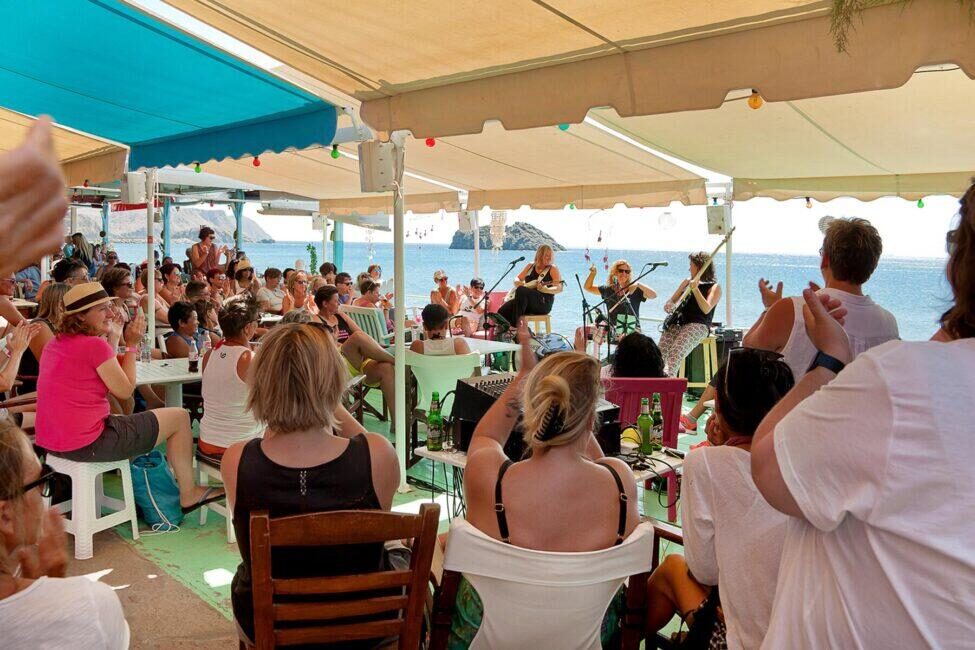
Amid all this, a unique cultural thread has made Lesbos a special place on the map of global identity and belonging. Every autumn, the village of Skala Eresos — known as Sappho’s birthplace — transforms into a vibrant stage of queer celebration and solidarity.
For decades it has drawn predominantly lesbian travelers from Europe and beyond, drawn by the poetry of Sappho and the sense of shared history.
Here, the International Eressos Women’s Festival brings together women from around the world for workshops, music, discussion, and community building. Though such events remain a niche compared to mainstream tourism, they underline how Lesbos’s ancient legacy still resonates in modern quests for identity and connection.
Yet it’s important to frame this within reality: while some LGBTQ+ women do make special pilgrimages to the island tied to Sappho’s memory and the festival, Lesbos is not universally viewed as a sacred site in a religious sense, nor does it function as an organized spiritual center for all LGBTQ+ people. Rather, its significance is cultural and symbolic — rooted in history and personal meaning for many visitors.
Against this backdrop of art and tourism, the Greek government has taken steps to safeguard Lesbos’s heritage and future.
In 2022, it pledged €2 million toward restoring and promoting tourism on Lesbos and other nearby islands affected by the refugee crisis, signaling a renewed governmental focus on sustainable economic revival.
Plans have also been articulated to boost cruise tourism, improve connectivity, and diversify the tourism offer to stabilize the island’s economy.
The island’s archaeological sites, monasteries, Byzantine churches, and folk architecture form another layer of its heritage, drawing visitors interested in history beyond its beaches.
However, conservation efforts remain ongoing, as many historic monuments face threats from time and environmental pressures — underscoring the need for sustained investment in preservation.
Life on Lesbos today is a portrait of contrasts: ancient olive groves and cutting-edge festivals; rising tourism figures alongside memories of boats washing ashore; warm hospitality meeting complex social tensions.
The scars of the past decade — from refugee camp crises to the impact on tourism — are visible, but so too is the resilience of a community determined to honor both its history and its future potential.
For travelers arriving now, Lesbos offers a richer story than most islands: a tapestry woven from myth, migration, survival, and renewal — inviting visitors not just to witness, but to reflect on how places endure and evolve across time.
For more news, expert commentary, and strategic analysis, explore the latest reports and features published by The Variant.