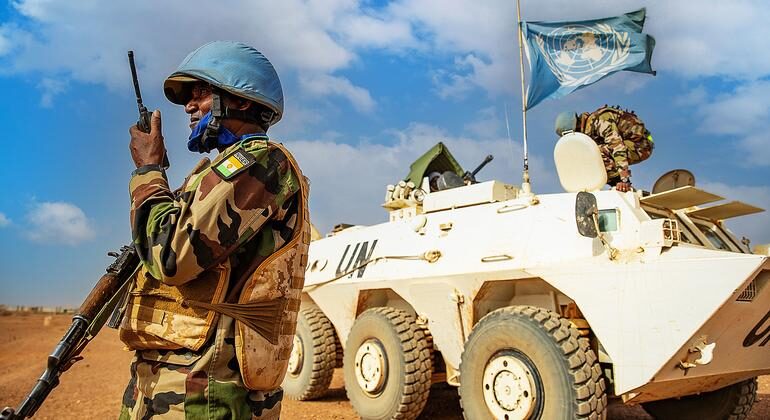
Timbuktu: In a country where terrorist groups have imposed blockades, disrupted access to vital supplies, and drastically worsened humanitarian conditions for civilian populations, the security situation is quickly worsening, said by Mahmoud Ali Youssouf, Chairperson of the African Union Commission.
According to various watchdogs such as the United Nations Population Fund (UNFPA), Africa Center for Strategic Studies, and the International Monetary Fund (IMF), Mali’s situation in 2025 is marked by heightened conflict and instability, a worsening humanitarian catastrophe, and a more severe political crackdown.
There has been an influx of internally displaced people due to violence in areas such as Ménaka, Gao, Mopti, and Timbuktu, and the military junta has disbanded political parties and repressed the media and opposition. Despite the beginnings of lithium production, the country is facing economic issues due to a mining dispute and climate shocks.
More people have been displaced and killed as a result of the escalating conflicts in several locations, including Ménaka, Gao, Mopti, and Timbuktu.
Several civilian deaths have been attributed to Malian soldiers and their Russian allies, leading to allegations of human rights crimes.
African Union Commission strongly denounces the intentional assaults on defenseless citizens, which have led to an intolerable number of casualties and increased unrest in the impacted areas.
The recent kidnappings, which included the kidnapping of three Egyptian individuals, are likewise condemned by the Chairperson, who demands their unconditional and immediate release. Human rights and humanitarian law are blasphemously violated by such actions.
In order to combat violent extremism and terrorism in the Sahel, the Chairperson calls for a strong, unified, and well-coordinated international response. In accordance with the Communiqué of the 1304th ministerial meeting of 30 September 2025, he demands improved collaboration, information sharing, and ongoing assistance to impacted States.
Last but not least, the Commission Chairperson reiterates that the African Union is fully prepared to back Mali and all Sahel nations through this difficult time by giving them the resources they need to achieve peace and stability.
The African Union will continue to promote peace, security, and development throughout the Sahel, and he expresses his solidarity with the Mali government and people and the victims’ families.
Caution is advised by the U.S. Embassy in Mali due to the ongoing war and attacks on government buildings, notably those in and around Bamako, the capital.
As of May 2025, there has been a notable increase from the previous year in the number of internally displaced individuals (IDPs) caused by armed conflict, reaching approximately 380,000.
There is a critical shortage of health care and support for survivors, which has increased the likelihood of gender-based violence as a result of the crisis.
According to African Union Commission, the north and center of the country have the greatest needs, although around 6.4 million people, or 28% of the population, require humanitarian aid.
In January 2025, Mali’s biggest gold mine was forced to close due to a disagreement over taxes. Although lithium production is expected to contribute to economic growth, the country is confronted with obstacles such as inflation and a widening current account deficit.
With the help of its Rapid Credit Facility and a Staff-Monitored Program, the International Monetary Fund (IMF) is offering assistance.
The international peace experts believe that the Mali dilemma will not be solved by a single strategy, but rather by a combination of approaches. Decentralization and other long-term political solutions, better training and local procedures to increase national and community security, and action to address the root causes of the issue (bad governance, underdevelopment, and climate change) are all on the list.
As this story continues to develop, The Variant will provide updates, analysis, and key insights to keep readers informed.