


Contributed by Naeem Gillani & Sidra Hassan
Rochester, NY/Islamabad/Lahore: The recent airstrikes conducted by Pakistan in Kabul represent a significant intensification of the ongoing conflict between Pakistan and Afghanistan, characterized by deep-seated mistrust, proxy warfare, and conflicting narratives.
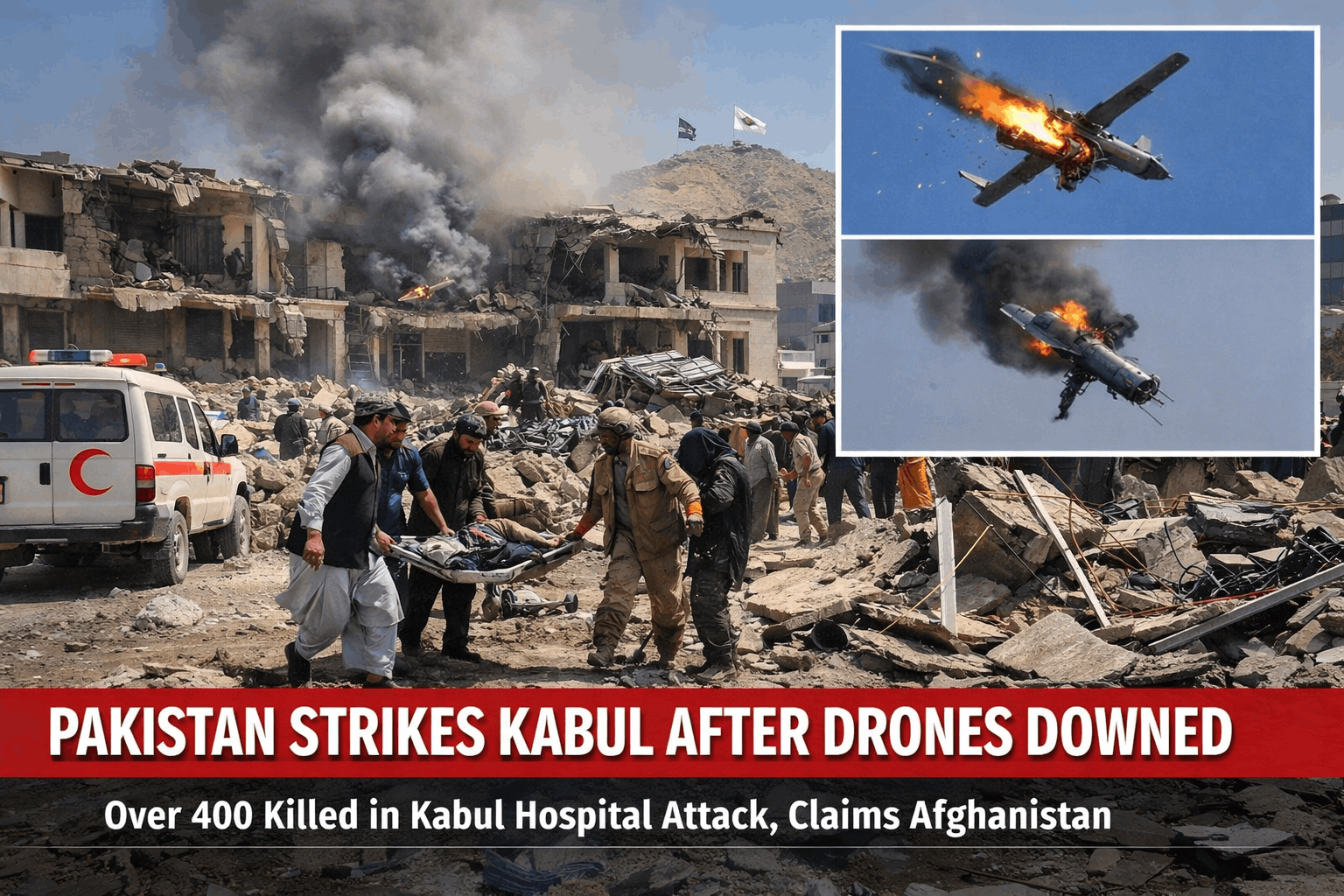
Pakistani officials indicated that the catalyst for the situation was the downing of two drones in the “twin cities” of Islamabad and Rawalpindi. This incident was perceived by Islamabad as a direct infringement on its sovereignty, marking a significant threshold crossed by actors based in Afghanistan.
Subsequently, actions were executed with precision and intensity: Pakistan initiated aerial operations aimed at what it characterized as militant infrastructure within Afghanistan, notably in Kabul. However, the implications—and conflicting assertions—have once more revealed the ambiguity inherent in this conflict.
Prompt Catalyst: The Return of Drone Warfare
Pakistan’s rationale is grounded in a well-established principle: cross-border counterterrorism. Officials assert that militant organizations, including Tehreek-e-Taliban Pakistan (TTP) and Islamic State Khorasan Province (ISKP) function from Afghan territory, potentially receiving tacit or indirect support from the Taliban regime.
The documented drone incursions into Pakistan’s federal capital region have notably heightened the level of concern. The recent drone activity over Islamabad and Rawalpindi marks a significant transition from earlier border skirmishes in Khyber Pakhtunkhwa, indicating a move from peripheral insurgency to a more strategic form of penetration.
Islamabad’s response was not just a tactical maneuver; it served as a demonstration of deterrence, aimed at restoring credibility and cautioning Kabul against any future escalation.
The Kabul Strike: Divergent Perspectives
The crisis is underscored by a significant allegation from Afghan authorities: that a Pakistani airstrike targeted a drug rehabilitation hospital in Kabul, resulting in over 400 fatalities and at least 250 injuries.
Afghan officials characterized the attack as a “crime against humanity,” emphasizing that most of the victims were vulnerable civilians receiving treatment. The facility, which is reported to be a large center with multiple thousand beds, appears to have sustained significant damage or may have been completely destroyed.
Pakistan has firmly rejected allegations of targeting civilian infrastructure. The military asserts that the strikes were conducted as “precision-based” operations targeting only militant sites, while accusing Afghanistan of inflating or inventing casualty figures to divert focus from the existence of militant safe havens.
This divergence is quite common. During the conflict, both parties have persistently provided sharply conflicting reports regarding casualties and targets, while independent verification has frequently been restricted or postponed.
Fog of War versus Information Warfare?
The claim regarding the Kabul hospital underscores a more profound concern: the escalating use of information as a weapon.
Afghanistan’s stance indicates that Pakistan is intensifying its approach to warfare, engaging in actions that indiscriminately affect civilian infrastructure and contravene international legal standards.
Pakistan asserts that Afghanistan is offering refuge to militants opposed to Pakistan and is leveraging claims of civilian casualties for propaganda purposes.
Independent observers, such as the United Nations, have consistently raised concerns regarding civilian harm; however, they face challenges in verifying these claims in real time, primarily due to limited access and security risks.
Historically, analogous patterns have been observed: Pakistan asserts the occurrence of “intelligence-based” strikes, whereas Afghan authorities document civilian casualties, which include destruction of homes, mosques, and public infrastructure.
The reality probably resides in a nuanced intermediary space—where militant objectives are situated within civilian contexts, rendering “precision” a subject of both technical and ethical debate.
Strategic Context: Transitioning from Border Clashes to Full-Scale Conflict
The ongoing escalation is a component of a larger conflict that started to intensify in early 2026. Pakistan’s military campaign, which reportedly targets numerous locations throughout Afghanistan, seeks to dismantle militant networks that are perceived as threats to its internal security.
Afghanistan, governed by the Taliban, disputes these allegations and characterizes Pakistan’s actions as a violation of its sovereignty.
The primary factors influencing the conflict are as follows:
- The Durand Line continues to be a significant source of military and political tension, highlighting the complexities surrounding this disputed border.
- The TTP insurgency highlights Pakistan’s perception of Kabul’s failure, whether due to incapacity or reluctance, to address TTP operations, which Pakistan cites as a rationale for conducting cross-border strikes.
- Retaliatory reasoning: Every assault perpetuates a cycle of escalation, as both parties cite self-defense.
- The downing of drones in Pakistan’s capital region aligns precisely with this trend—serving as both a tactical event and a symbolic escalation.
Implications for Humanitarian and Legal Considerations
If confirmed, the number of casualties reported in Kabul would indicate one of the most lethal individual events in contemporary Afghan history. A strike on a hospital, which is safeguarded by international humanitarian law, would prompt significant legal and ethical inquiries.
Nonetheless, in the absence of independent verification, the international community encounters a complex challenge:
- Condemnation may inadvertently validate unverified assertions.
- Silence poses a risk of normalizing the potential for civilian harm.
- The United Nations has issued a call for restraint, highlighting the responsibility of both parties to safeguard civilians and comply with international law.
Implications at both Regional and Global Levels
This escalation has consequences that extend beyond the scope of bilateral relations:
The risk of militant resurgence is significant; extended instability may create advantageous conditions for organizations such as al-Qaeda and ISKP.
Refugee movements: Escalating conflict is likely to result in the displacement of thousands across the permeable border.
Geopolitical ripple effects indicate that regional actors, including China, Iran, and Gulf states, could become involved in mediation efforts or engage in strategic positioning.
Previous efforts at establishing ceasefires, such as those facilitated by Qatar and various other parties, have not succeeded in maintaining stability.
Conclusion: The Conflict is Progressing into a More Hazardous Stage
Pakistan’s strikes in Kabul—subsequent to drone incidents in its capital—indicate a transition from a reactive approach to border defense towards more proactive and assertive cross-border operations.
Simultaneously, Afghanistan’s assertions regarding mass civilian casualties highlight the humanitarian implications and the escalating severity of the conflict.
The Kabul hospital strike raises critical questions regarding its nature—be it a tragic miscalculation, a contested narrative, or an instance of intentional targeting. One undeniable reality emerges:
The Pakistan–Afghanistan conflict has transcended a mere border dispute; it is developing into a prolonged, high-stakes confrontation that carries significant regional implications.
In the absence of reliable systems for verification, dialogue, and de-escalation, both nations face the potential of entering a drawn-out cycle of retaliation. This scenario would lead to a situation where the truth is disputed, and the greatest burden falls on civilians.







