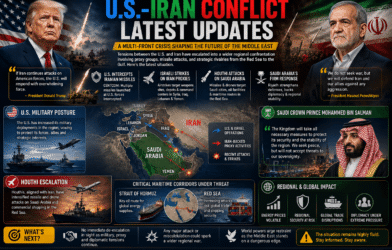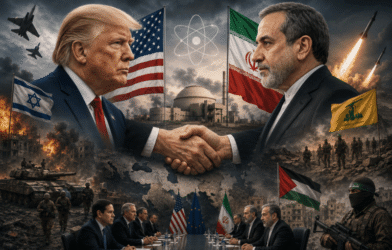
Rochester, NY: The conflict between the United States and Iran is not merely a military confrontation. It is the culmination of more than four decades of mistrust, ideological rivalry, geopolitical competition, and competing visions for the future of the Middle East.
Any discussion about how a US-Iran war could end must therefore move beyond the battlefield and focus on the political, strategic, and psychological dimensions of the conflict. History demonstrates that wars between major powers rarely end through military victory alone.
They end when both sides conclude that the costs of continued confrontation outweigh the benefits of pursuing maximalist objectives.
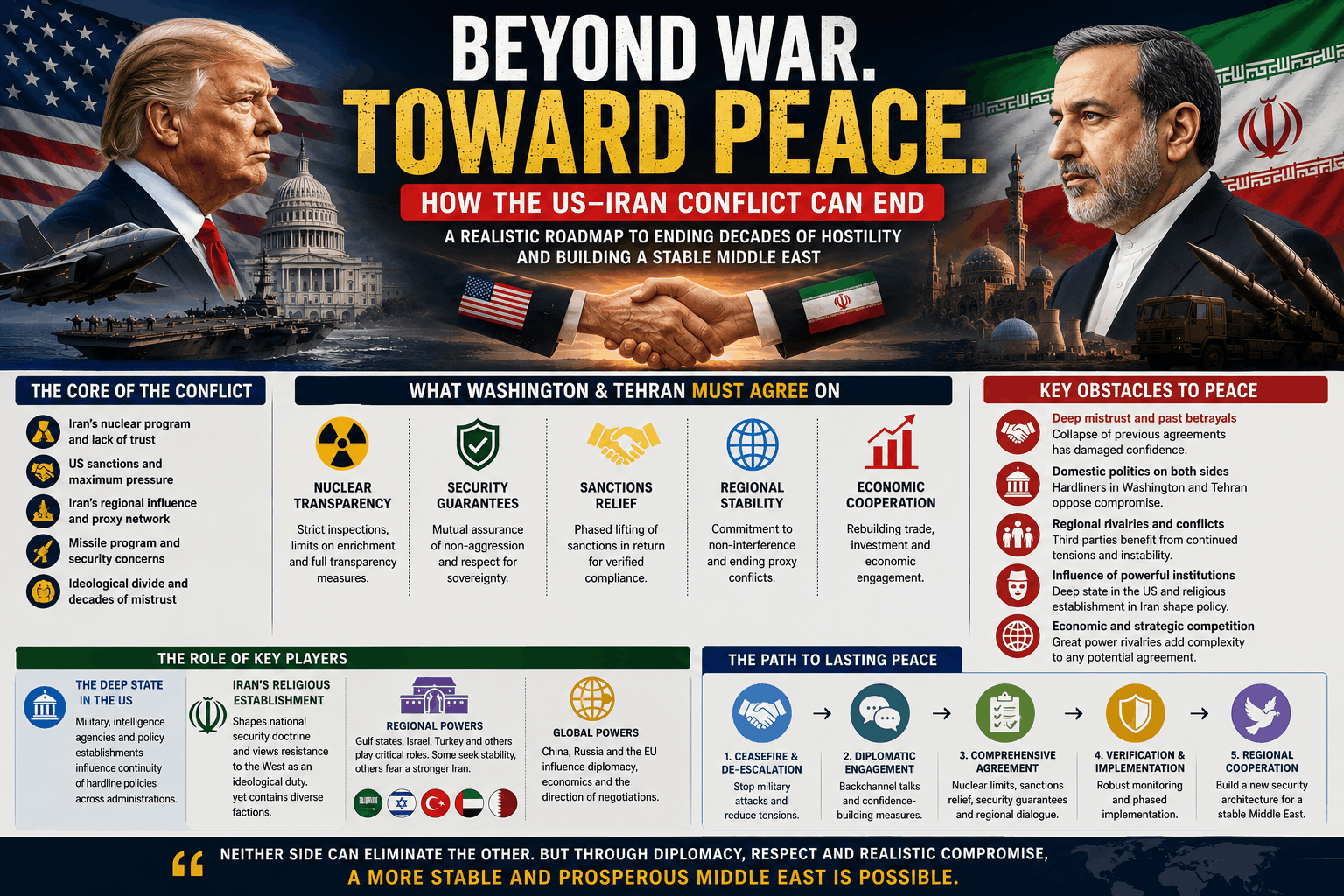
The current conflict reflects deep-rooted disagreements over Iran’s nuclear ambitions, regional influence, missile program, sanctions, and the security architecture of the Middle East. While military operations can degrade capabilities, they cannot eliminate the political realities that drive the conflict.
Therefore, a lasting peace would require compromises from both Washington and Tehran that neither side has historically found easy to make.
Why Military Victory Is Unlikely for Either Side?
The United States possesses overwhelming conventional military superiority. Its air power, naval assets, intelligence capabilities, and global logistical network far exceed Iran’s military strength. However, military superiority does not automatically translate into political victory.
The experiences of Afghanistan, Iraq, and Vietnam have demonstrated that defeating a state’s military infrastructure is far easier than reshaping its political behavior.
Iran, meanwhile, understands that it cannot defeat the United States conventionally. Instead, its strategy has always relied on endurance, asymmetric warfare, regional alliances, and the ability to impose costs on its adversaries.
Even if significant damage were inflicted upon Iran’s military and nuclear facilities, Tehran would likely retain the capacity to create instability across the region through allied groups and regional networks.
This strategic reality suggests that neither side can achieve its ultimate objectives through force alone.
The United States cannot easily compel Iran’s unconditional submission, while Iran cannot force Washington to withdraw completely from the region. Therefore, diplomacy eventually becomes the most realistic exit strategy.
What the United States Would Need to Accept?
For a durable peace agreement to emerge, Washington would need to recognize certain geopolitical realities. First, Iran is a major regional power with legitimate security concerns.
Regardless of political disagreements, Iran occupies a strategic position connecting the Persian Gulf, Central Asia, the Caucasus, and the broader Middle East.
American policymakers would likely need to accept that complete elimination of Iran’s regional influence is unrealistic. Just as Saudi Arabia, Turkey, Israel, and Egypt possess spheres of influence, Iran will continue to exert influence through political, economic, and cultural ties across the region.
Secondly, the United States would likely need to provide credible sanctions relief. Economic pressure has damaged Iran’s economy but has not fundamentally altered Tehran’s strategic calculations.
Any comprehensive agreement would require meaningful economic incentives and guarantees that future administrations cannot easily abandon negotiated commitments.
Finally, Washington would need to focus on containment and verification rather than seeking regime change. Iranian leaders view regime-change rhetoric as an existential threat, making compromise politically difficult.
What Iran Would Need to Accept?
Iran would also face significant compromises. The most critical issue remains its nuclear program. While Tehran insists that its nuclear activities are peaceful, concerns among Western governments and regional states have intensified because of uranium enrichment activities and reduced international monitoring.
For peace to be sustainable Iran would likely need to accept strict international inspections and limitations on enrichment levels that provide confidence its program remain civilian in nature.
Iran would also face pressure regarding its missile program and support for regional armed groups. While Tehran considers these tools essential for deterrence, its neighbors and the United States view them as sources of instability.
Any lasting agreement would likely require Iran to demonstrate restraint in regional conflicts while receiving security assurances in return. Such a compromise would not eliminate Iran’s influence but would seek to regulate it within mutually accepted boundaries.
Stay engaged with the issues shaping our future through comprehensive reporting and informed commentary from The Variant.
The Major Obstacles to Peace
The greatest hurdle may not be military considerations but rather mutual distrust.
The collapse of the 2015 nuclear agreement remains deeply influential. Iranian leaders argue that they fulfilled many of their obligations only to see the United States withdraw from the agreement and reimpose sanctions.
Conversely, many American policymakers believe Iran exploited the agreement while continuing activities that threatened regional stability.
This mutual sense of betrayal makes future negotiations exceptionally difficult.
Domestic politics represent another significant obstacle. In Washington, any agreement with Iran faces opposition from political groups that view Tehran as fundamentally untrustworthy.
In Tehran, hardline factions often portray negotiations with the United States as weakness or surrender.
Even if leaders reach an agreement, sustaining political support for that agreement may prove equally challenging.
The Role of Regional Powers
Several regional actors have mixed incentives regarding peace between Washington and Tehran.
Some Gulf Arab states increasingly favor stability because prolonged conflict threatens economic diversification efforts, foreign investment, and energy markets.
Recent diplomatic normalization efforts between Iran and some Gulf states indicate growing recognition that regional stability serves everyone’s interests.
Israel’s position is more complex. Israeli leaders view a nuclear-capable Iran as an existential threat and therefore seek strong restrictions on Iran’s nuclear activities.
While Israel does not necessarily oppose peace, it insists that any agreement must genuinely prevent Iran from developing nuclear weapons capabilities.
At the same time, some political factions across the region benefit from heightened tensions because conflict reinforces security narratives, justifies military spending, and strengthens political influence.
Is There a “Third Power” That Does Not Want the War to End?
Conspiracy theories often suggest that a hidden third power benefits from perpetual conflict. The reality is usually more complicated.
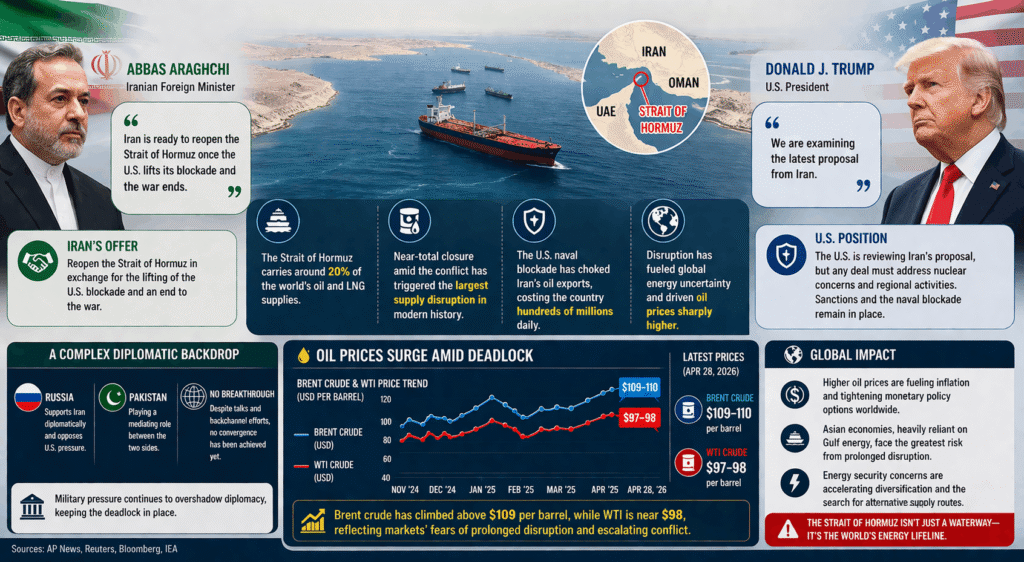
There is no publicly available evidence of a single actor controlling events or intentionally prolonging war for its own sake. However, various state and non-state actors may perceive strategic advantages in continued hostility.
Some regional rivals benefit when Iran and the United States remain focused on each other rather than pursuing broader diplomatic realignments.
Certain militant organizations derive legitimacy and recruitment opportunities from ongoing confrontation. Defense industries in multiple countries may benefit economically from sustained regional insecurity.
Additionally, geopolitical competitors such as Russia or China may sometimes see strategic advantages in American distraction, though neither country necessarily seeks uncontrolled regional escalation that could damage global economic stability.
The reality is not a single “third power” but a complex network of actors whose interests do not always align with peace.
The Role of the American Deep State
The concept of a “deep state” remains highly controversial and often misunderstood. In its simplest sense, it refers not to a secret government but to the enduring influence of bureaucratic institutions, intelligence agencies, military establishments, and policy networks that persist across administrations.
In the United States, national security institutions play a significant role in shaping policy. These organizations provide continuity regardless of which political party controls the White House.
Critics argue that such institutions sometimes favor confrontational approaches toward adversarial states. Supporters counter that they provide expertise and strategic consistency necessary for national security.
In reality, American policy toward Iran emerges from a complex interaction among elected officials, intelligence agencies, military leaders, Congress, allies, and public opinion. No single institution possesses complete control over policy decisions.
The Role of Iran’s Religious Establishment
Iran’s religious establishment occupies a unique position within the country’s political system. Unlike many states where religion and government are largely separate, Iran’s political structure incorporates religious authority directly into governance.
The clerical leadership views resistance to external pressure as both a political and ideological principle.
Historical experiences, including foreign intervention in Iranian affairs during the twentieth century, have reinforced deep suspicions toward Western intentions.
At the same time, Iran’s religious establishment is not monolithic. Different clerical and political factions hold varying views regarding engagement with the West.
Some emphasize ideological resistance, while others advocate pragmatic diplomacy to reduce economic pressure and improve living standards.
Any peace process would therefore require balancing ideological commitments with practical national interests.
The Most Realistic Path to Long-Term Peace
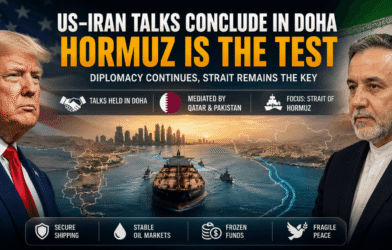
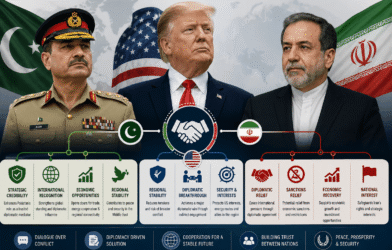
The most plausible end to a US-Iran war would not be a decisive military victory by either side. Instead, it would likely emerge through a phased diplomatic process involving ceasefires, confidence-building measures, regional security talks, sanctions relief, and nuclear transparency mechanisms.
Such an agreement would require the United States to acknowledge Iran’s security concerns and regional role while Iran accepts robust constraints and verification measures regarding its nuclear activities and regional behavior.
The challenge is that both governments must convince domestic audiences that compromise does not constitute defeat.
History shows that sustainable peace is rarely achieved when one side is humiliated. Lasting stability emerges when adversaries conclude that coexistence serves their interests better than confrontation.
Ultimately, the future of US-Iran relations will depend not on military capabilities alone but on whether leaders in Washington and Tehran can overcome decades of mistrust and recognize a fundamental reality: neither side can permanently eliminate the other, but both can suffer enormously from endless conflict.
The true victory, therefore, may lie not in defeating an adversary but in creating a regional order where neither side feels compelled to fight.