


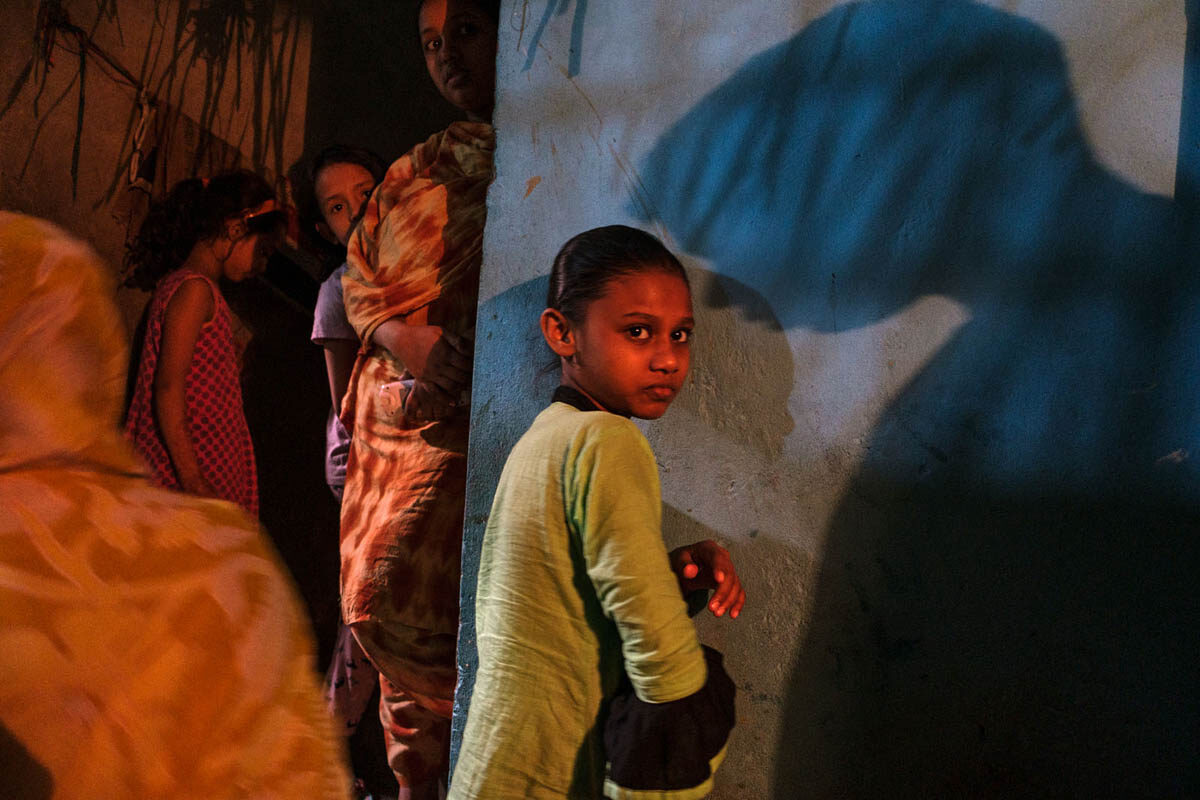
Rochester, NY/Dhaka: At the edge of Dhaka’s mobbed streets, where rickshaws outnumber road signs, lies a place that time seems to have forgotten. Geneva Camp is not a neighborhood on any official map, yet within its narrow alleys of patched tin roofs and mud-encrusted walls live tens of thousands of people whose lives have been defined by a war that ended more than half a century ago.
Here, in a settlement named after an International Red Cross office, generations of Biharis — Urdu-speaking people often called “stranded Pakistanis” — continue to endure conditions that many in a modern capital city would consider unthinkable.
In the early 1971s, after Bangladesh announced independence following a brutal nine-month war, thousands of Urdu-speaking Muslims who had supported the former West Pakistani state found them abandoned in the newly-formed Bangladesh.
Many were killed or displaced during the conflict, and a significant number fled or were forcibly moved into camps such as Geneva Camp. The International Committee of the Red Cross established temporary camps, but decades later these “temporary” homes have become de facto urban slums — overcrowded, under-resourced, and legally ambiguous in status.
Today, over 250,000 Urdu-speaking Biharis live in some 116 such settlements across Bangladesh, including 32,000 in Dhaka alone. In Geneva Camp itself, families of six to eight often cram into a single room barely larger than a garage, and dozens of such families share a single latrine.
Ubiquitous poverty defines everyday life: water pumps are few, sanitation is poor, disease is rampant, and children’s futures are constrained by gaps in education and opportunity.
Fouzia, 51, remembers her first night in the camp like an old scar. Her parents came to Dhaka in 1971 from what was then Bihar, India, seeking safety amid communal violence. When Bangladesh became independent, they were rounded up with others who were seen — rightly or wrongly — as supporters of Pakistan’s military.
She still bears the memory of watching her father dig a latrine with his own hands, because the camp had none. Today, she tells visitors that life “is like living without dignity — inside your own city, but not part of its future.” Her words echo through alleys where children play among livestock and trash, a landscape decade out of place with the metropolis that surrounds it.
Part of the reason for this prolonged marginalization lies in citizenship and legal ambiguity. After independence, the governments of Pakistan and Bangladesh agreed — initially in the 1973 tripartite agreement involving India, Pakistan, and Bangladesh — to repatriate those who wished to leave. But that process stalled and never extended to everyone.
An estimated 170,000 Urdu-speaking people were relocated to Pakistan between 1974 and 1982, but hundreds of thousands remained behind, rendered effectively stateless for decades.
Bangladesh’s stance has evolved slowly. After a 2008 High Court ruling, those born in the territory after 16 December 1971 — the date when Bangladesh’s independence was secured — were granted citizenship and voting rights.
Yet for many in the camps, obtaining national identity cards, passports, formal education, or meaningful employment remains difficult, even after decades of residence. For some residents, the legal change was welcome; others argue that the label of “stranded Pakistani” persists in social stigma if not official paperwork.
Discrimination in everyday life is not merely theoretical. Biharis residents often struggle to rent housing outside the camps, face barriers at formal workplaces, and confront social exclusion by neighboring Bengali communities — a legacy of the wartime enmity that lingered long after independence.
Their children attend informal or camp-based schools — sometimes the only education available — but lack the resources of publicly funded systems.
The reluctance of the Pakistani state to absorb these people has been equally consequential. Islamabad argues that it met its obligations by taking in those who chose to go in the years immediately after the war.
It has maintained that those born after 1971 should be considered Bangladeshis, with a rightful place in their country of birth. In practice, however, opportunities for large-scale repatriation have not materialized, and diplomatic discussions have rarely put the issue at the forefront.
For decades, leaders on both sides deflected responsibility, leaving families like Fouzia’s in bureaucratic limbo. Senior activists in the camps have accused Islamabad of repeatedly breaking its commitments, declaring that successive governments ‘deceived us’ and failed to prioritize our repatriation.
The politics of the refugee issue is complex. Both Pakistan and Bangladesh have other, more pressing foreign policy and security agendas in the 21st century. In recent years, bilateral relations have begun to shift in ways unimaginable just a decade ago.
After years of estrangement following the 1971 war and subsequent periods of frosty interaction, Pakistan and Bangladesh have taken steps to strengthen diplomatic ties, including direct flights resuming after a 14-year hiatus in early 2026, seen as a symbolic and practical step toward greater interaction. High-level meetings between foreign ministry officials have reaffirmed cooperation on trade, investment, aviation, and other regional issues.
On the military front, talks have even touched on potential defence cooperation, including discussions on the sale of JF-17 fighter jets to Dhaka, underscoring a remarkable thaw in relations given the traumatic history between the two states.
Yet in the shadows of these diplomatic developments remain people whose lives have not changed. For them, improvement in bilateral relations rarely translates into a life with running water, a job with social security, or a sense of belonging. In Geneva Camp, the daily struggle for dignity continues, and political gestures mean little when children share toilets with dozens of others and families live without basic privacy.
What both governments should do — beyond diplomatic niceties — is clear if one listens to voices like Fouzia’s: ensure legal clarity, economic integration, and humane living conditions. For Bangladesh, that means full recognition of the citizenship rights it has granted on paper, backed by tangible access to healthcare, education, and jobs.
For Pakistan, it means reopening meaningful dialogue about repatriation — including practical steps such as voluntary return programmes, legal support, and integration assistance for those who still wish to return. Even if not all want to go back, the moral obligation remains to resolve the limbo in which they live — not merely to improve state-to-state relations, but to restore human dignity to lives stuck between identities.
For decades, Geneva Camp stood as a symbol of unresolved conflict and human neglect. Perhaps, in an era of renewed diplomatic engagement between Islamabad and Dhaka, a future can be forged where people like Fouzia finally stop being “citizens of nowhere,” and begin — at last — to have a place to call home.







