


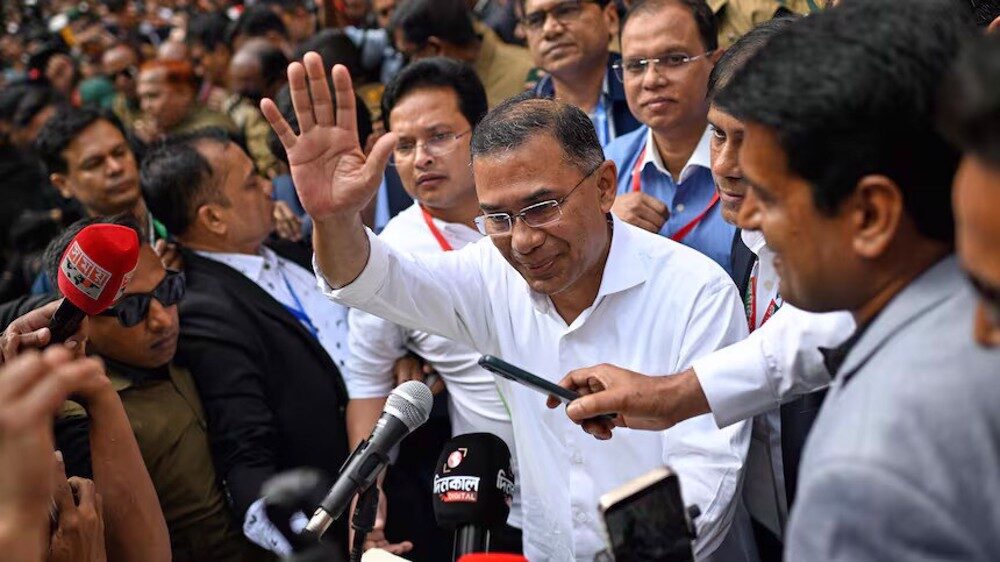
Dhaka, Bangladesh: In a historic general election, the Bangladesh Nationalist Party (BNP) took home a resounding majority in parliament, marking the beginning of a new era in Bangladeshi politics. This was the first nationwide election since the popular revolution that toppled Sheikh Hasina’s Awami League administration, and the vote was generally considered the most contested in over twenty years.
The BNP, under Tarique Rahman’s leadership, defeated its main rival, the Bangladesh Jamaat-e-Islami, and won a resounding mandate, shifting the country’s parliamentary balance and indicating a wider realignment of objectives in government, democracy, and international relations.
These results underscore the need for political change at home and have far-reaching consequences for how Bangladesh will interact with regional powers like Pakistan and India and with strategic allies like the US in the future.
The 13th National Parliamentary Election of Bangladesh took place on 12 February 2026. This was the first election to be conducted in the country after the July 2024 rebellion that toppled previous Prime Minister Sheikh Hasina’s 15-year tenure.
With about half of the vote and a parliamentary majority of two-thirds, the Bangladesh Nationalist Party (BNP) came out on top. Its front-runner, Tarique Rahman, will be returning to Bangladesh after almost two decades in exile to assume the role of prime minister.
Nearly eighteen months had passed since the July 2024 rebellion, a huge, frequently youth-led movement that deposed long-serving prime leader Sheikh Hasina and her Awami League party, bringing an end to a lengthy era of political domination in the nation. Because of her party’s involvement in the violent crackdown on protestors, her party was eventually forbidden from participating, creating a profound rift in the country’s political landscape that would influence subsequent events.
There were two main political groups that dominated the weeks before the voting. The Bangladesh Nationalist Party (BNP) — led by Tarique Rahman, son of former president Zia-ur-Rahman and first lady Prime Minister Khalida Zia — emerged from exile to contest numerous seats across the country. As a sign of his party’s revival after years of boycott and political repression, Rahman personally ran in seats like Bogra-6 and Dhaka-17, which he would later win easily.
The Islamist party headed by Shafiqur Rahman, the Bangladesh Jamaat-e-Islami, was up against the BNP in the elections. Jamaat, which has a checkered past as an outspoken opponent of Bangladesh’s 1971 independence, shocked many observers by emerging as the country’s leading opposition party, winning a large number of seats in parliament, and making its best national political showing in years.
Also heard from were smaller, more recent parties like the National Citizen Party (NCP), which emerged from the same student activism that brought down the previous regime. The NCP won a few seats, symbolizing the symbolic entry of Gen Z-driven politics into the official legislative arena.
Once the tally came in, the outcome was quite clear. A two-thirds majority was achieved by the BNP and its allies in the Jatiya Sangsad, with more than 212 seats out of 300 in the Parliament. In contrast, the coalition headed by the Jamaat came out on the other side, with around 77 seats. The rest were filled by independents and smaller parties. A disgruntled electorate eager for change showed strong participation with a reported 60% voter turnout.
The BNP and the Awami League have always been fierce rivals in Bangladeshi politics. The BNP has a center-right nationalist bent, while the Awami League is more pro-government and center-left. Sheikh Hasina’s Awami League, which has been blamed for suppressing dissent and influencing election procedures, has dominated that competition for the last fifteen years.
Student and civic movement-led rebellion deposed Hasina in 2024. Nobel Peace Prize winner Muhammad Yunus oversaw a transitional administration that prepared for elections and prioritized change in the meantime. After being outlawed in 1971 for its opposition to Bangladesh’s independence, Jamaat-e-Islami re-registered as a political party and ran well in the elections.
The current election represents a more competitive scene as compared to the pre-1971 government period and early legislative eras. Although there are ongoing concerns over inclusion and institutional integrity, this election was generally seen as the most open in decades, in contrast to prior systems that approximated predetermined results or dominant-party rule.
Bangladesh must be democratic, progressive, and inclusive, and Indian Prime Minister Narendra Modi officially thanked Tarique Rahman on this. Many perceive this as an effort by New Delhi to mend fences after tensions rose under the interim administration.
There are Indian experts who are concerned that the emergence of new political personalities who are less forgiving of previous alliances may make it harder for both countries to work together on issues like commerce, border security, and upstream water management. Some, meanwhile, think that a pragmatically-led BNP may strike a balance between national interests and keep ties from deteriorating.
After relations deteriorated during the interim administration, Pakistan’s authorities congratulated Rahman, signifying an effort to reach out and enhance bilateral cooperation. Possible motivations for Islamabad’s involvement include the prospect of rekindled strategic and commercial ties in the Bay of Bengal area.
But discussions on the impact of foreign influences on Pakistani politics are fueled by the country’s ideological alignment with Jamaat-e-Islami during the 1971 Liberation War, which has left Pakistan with historical ties to the group.
Officially, the US administration expressed its delight with the election results, calling them a watershed moment in South Asian governance and a triumph for democracy. U.S. officials consider Bangladesh an important ally in the fight against extremism, great-power rivalry, and regional instability.
Opinions on the election’s significance varied among academics and international affairs specialists in Bangladesh. According to American political scientist Dr. Rudabeh Shahid, the BNP’s triumph demonstrated “structural shifts in public sentiment against entrenched domination” and the need for realignment after many years of one-party rule.
A fellow Washingtonian, Dr. Michael Kugelman, cautioned that the BNP’s past struggles with corruption and leadership would undermine its capacity to turn electoral victories into strong leadership.
The findings, according to Professor Arun Devnath of India, a specialist in South Asian geopolitics, would have far-reaching consequences for the area, altering the power dynamic between China and other nations in South Asia as well as the relationship between India and Bangladesh.
The 2026 parliament is a radical break with Bangladesh’s recent history, especially in contrast to earlier administrations. Sheikh Hasina’s lengthy reign was marked by widespread criticism of the electoral process, including allegations of institutional bias and a lack of competition, as well as limits on civic space and campaigning for opposition parties.
In contrast, it seems that the nation’s democratic progress will reach a real turning point in the 2026 election, thanks to an emboldened student movement, first-time voting by Diaspora, and true multiparty competition.
In the future, there will be tremendous obstacles for the incoming administration. Discord in society runs deep, unemployment is rampant, and the economy is still precarious. As Rahman tries to strike a balance between national sovereignty and regional collaboration, ties between Bangladesh and other countries, particularly Pakistan and India, will be challenged.
As a key player in South Asia’s geopolitical scene, the US and other world powers will keep an eye on Dhaka’s future, hoping that the country’s 170 million residents enjoy the stability and prosperity that the democratic promise of regeneration brings.







