


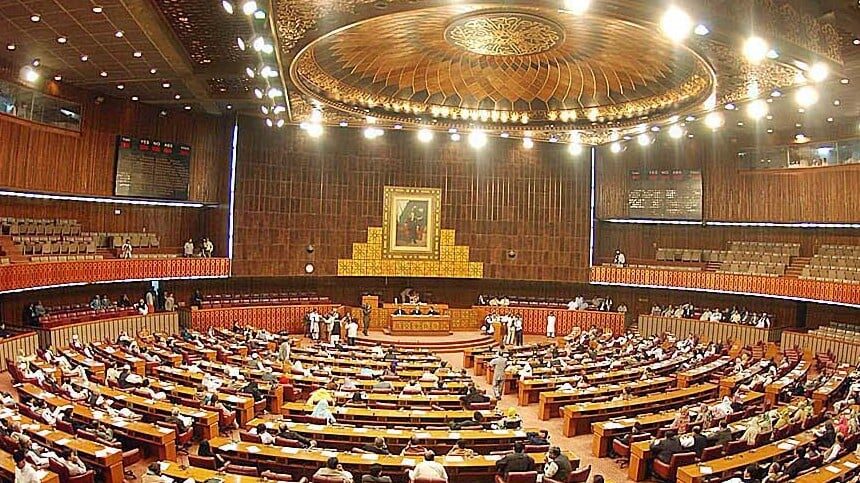
New York: The newly passed constitutional amendment empowering the Chief of Ground Forces to serve as the Chief of Defense Forces — effectively placing the Army Chief in command of the Air Force and Navy — represents a profound shift in Pakistan’s military and political architecture. Supporters hail it as a step toward “unified command” and “national security coherence.” But beneath that rhetoric lies a troubling consolidation of power that risks deepening Pakistan’s long-standing civil-military imbalance.
For decades, Pakistan’s defense establishment has operated through separate command structures, coordinated under the Joint Chiefs of Staff Committee (JCSC). While the Army historically wielded the greatest influence, the JCSC at least symbolized inter-service consultation.
This amendment, however, replaces that coordination with outright control. It transforms the Army Chief into a de facto supreme military commander, subjugating the Air Force and Navy to a land-centric leadership model. Pakistan’s defense strategy once built on inter-branch dialogue, now risks becoming an extension of army doctrine — dominated by ground warfare thinking rather than joint strategic vision.
Perhaps the gravest consequence of this change is the further erosion of civilian control over the military.
In theory, the Prime Minister and the civilian cabinet remain constitutionally supreme over defense policy. In practice, this amendment strengthens the military’s internal autonomy and weakens the civilian government’s leverage.
When a single uniformed figure commands all services, the institutional checks — both civilian and inter-service — disappear. Parliament’s oversight over defense appointments and expenditure, already fragile, will diminish further. Pakistan’s democratic institutions, still struggling to assert authority over the security establishment, may find themselves increasingly sidelined.
The Pakistan Air Force (PAF) and Navy operate in highly specialized strategic domains — air deterrence, maritime security, and technological warfare — that require independent expertise. Subordinating these services to an Army Chief risks strategic tunnel vision.
Land warfare cannot dictate air or naval doctrine. Yet the amendment institutionalizes exactly that: a single command structure driven by ground perspectives, potentially at the expense of modernization and innovation in air and maritime defense.
In an era when cyber warfare, unmanned aerial systems, and blue-water capabilities define modern military power, Pakistan cannot afford to reduce its strategic imagination to the ground level.
This amendment also sends a demoralizing signal within the armed forces. It codifies an old but unspoken reality — the Army as the dominant service, the others as auxiliaries.
Such structural hierarchy is dangerous for long-term professionalism. The Air Force and Navy, both highly technical institutions, may face stagnation in leadership growth and diminished institutional voice. Over time, this imbalance can corrode morale and limit inter-service collaboration — precisely the opposite of what “joint command” was meant to achieve.
Every constitutional amendment carries political consequences beyond its text. By formalizing the Army Chief’s supremacy overall defense branches, Pakistan is effectively legalizing what has long been criticized as de facto military dominance.
The danger is not hypothetical. Concentration of command power in one office strengthens the military’s political leverage — especially in moments of civilian instability or national crisis.
Rather than democratizing defense, this amendment militarizes the constitution itself.
The strength of a democracy lies not in centralized power but in balanced institutions. True reform in Pakistan’s defense structure should aim to enhance coordination without undermining autonomy — to ensure that all branches of the military, along with the civilian government, operate within a transparent, accountable framework.
By contrast, this amendment tilts the structure toward hierarchy, not harmony; command, not consultation.
Pakistan has long wrestled with the challenge of restoring civilian supremacy and institutional balance. This constitutional amendment, far from addressing that imbalance, cements it.
It risks transforming Pakistan’s already fragile democracy into a system where the principle of joint defense gives way to military centralization — and where civilian authority becomes symbolic rather than sovereign.
The pursuit of national security cannot come at the expense of constitutional integrity.
In empowering one man and one institution to command all others, Pakistan may have taken a decisive step away from the democratic ideals its Constitution was meant to protect.







