Calgary, Alberta: Iran’s Supreme Leader Ayatollah Ali Khamenei warned that any U.S. military strike would spark a “regional war,” a stark declaration that underlines Tehran’s readiness to escalate if directly attacked and its belief that confrontation now carries far-reaching consequences.
The Iranian leader couched his remarks in terms of self-defense and deterrence, signaling that Tehran believes its military capabilities — while not equal to the United States — is sufficient to impose heavy costs on any adversary.
Iran’s armed forces today are structured around overlapping defensive and offensive blocks, with traditional ground forces supplemented by elite units, an expanding missile corps, and extensive asymmetric capabilities.
According to publicly available assessments, Iran’s conventional military personnel number in the hundreds of thousands, with estimates ranging around 525,000 to 700,000 total military personnel when counting the regular army, the Islamic Revolutionary Guard Corps (IRGC), its naval units, air force, and associated Basij volunteer militia.
The IRGC alone controls specialized ground, naval, and missile forces that operate alongside the regular army (Artesh) and naval fleets.
On land, Iranian ground forces include over 1,600 tanks, a mix of Soviet-era T-72s and locally refurbished armor, with discussions in Tehran about acquiring modern T-90 tanks from Russia. In the waters of the Persian Gulf, Iran fields more than 100 surface vessels and submarines, from fast attack craft under IRGC naval command to heavier corvettes and Kilo-class submarines under the regular navy, giving it a modest but regionally potent maritime footprint.
Perhaps the most consequential part of Iran’s deterrent is its missile arsenal. U.S. Strategic Command has warned that Tehran possesses the largest ballistic missile arsenal in the Middle East, capable of reaching American bases across the Gulf as well as partners and adversaries alike.
The scale and diversity of Iran’s missiles give it what military planners describe as a “firestorm potential” — the ability to launch massed salvos that could strain even multiple layers of enemy defenses.
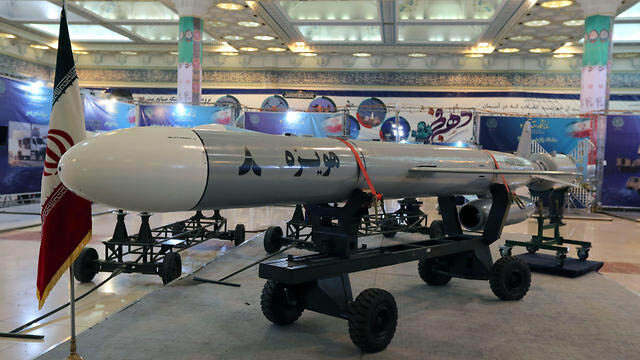
Estimates vary on the exact number of missiles Iran currently holds, but some open-source assessments suggest that Iran’s stockpile of ballistic missiles may number around 1,000 platforms, including short- and medium-range systems. These include solid-fuel missiles like the Kheibar Shekan, a medium-range ballistic missile capable of striking targets up to approximately 1,450 kilometers away, and systems such as the Jihad missile, which emphasizes low-altitude flight to evade radar detection. Other shorter-range variants and dozens of mobile launchers remain scattered across hardened sites and underground facilities.
In addition to traditional ballistic forces, Iranian forces have developed significant air defense systems of their own, including the Raad family of domestically produced surface-to-air missile systems designed to intercept aircraft, cruise missiles, and drones. These systems underpin Tehran’s strategy of layering defensive capabilities to protect key infrastructure and military sites.
Beyond missiles and air defenses, Iranian military planners have invested heavily in drones and asymmetric warfare tools. Tehran has become one of the world’s most prolific producers and exporters of relatively low-cost but effective unmanned aerial systems, which have been deployed both in its own conflicts and supplied to allied groups across the region.
Combined with proxy militias and allied forces from Lebanon to Yemen — some of which possess Iranian-designed rockets and guided missiles — Tehran’s strategy emphasizes multi-axis engagement rather than symmetrical conventional warfare.
In recent weeks, satellite imagery and open reporting have shown long lines of missiles and launchers reportedly prepped in eastern and central Iran, a landscape mirrored by the deployment of a U.S. carrier strike group into the northern Indian Ocean — an unmistakable signal of preparation on both sides.
Tehran’s drills have prompted concern in Jerusalem and Washington that Iran might be masking offensive moves as routine exercises, deepening the fog of intent and increasing the risk of miscalculation.
Iran’s naval leaders have boasted of keeping U.S. warships “under close watch,” pointing to the Islamic Republic’s coastal defenses, fast attack craft, anti-ship missiles, and mining capabilities as potent deterrents against maritime incursions.
This posture reinforces Iran’s long-standing threat to close or disrupt traffic through the Strait of Hormuz — a choke point through which a significant share of global oil exports pass — should any conflict escalate.
Yet despite the formidable numbers, analysts caution that Iran’s forces have limitations. In past conflicts, including direct missile launches in regional clashes, allied air defenses have intercepted a large portion of incoming rockets, suggesting that sheer volume alone does not guarantee battlefield success.
Moreover, Tehran’s emphasis on missile and asymmetric tools reflects an acknowledgment that its air force and conventional capabilities lag those of U.S. and allied forces by a wide margin.
Even so, Iran’s military capabilities today are not static. Hardliner commanders in Tehran have consistently highlighted continued development of precision strike capabilities and mobile, survivable systems hardened against initial air attacks. Recent missile tests, including claims of improvements in range and accuracy, are calculated both as technical progress and a demonstration of resolve.
In a possible future flashpoint, such as a U.S. or allied strike on Iranian soil, Tehran would almost certainly leverage its missile forces, drones, naval assets, and proxy networks to inflict maximum disruption on adversaries, especially in the opening hours of conflict. While Washington and its partners maintain overwhelming aerial superiority, Iran can impose costs and create strategic headaches in a multi-domain environment.
The result, according to many defense scholars, is a conflict that could be prolonged, geographically dispersed, and economically disruptive far beyond the immediate theater of operations.